
Introduction: The AI‑Driven SEO Landscape in 2026

Rapid AI advancements in content creation and SERP analysis have fundamentally altered the digital marketing landscape. Modern SEO now relies heavily on the integration of machine learning to understand how search engines evaluate authority and relevance. As we navigate 2026, the speed of these technological shifts requires a proactive approach to maintaining visibility.
The industry has seen a significant shift from manual labor to automated keyword intent mapping. This transition allows teams to process massive amounts of data to find exactly what users are searching for without the traditional overhead. Consequently, businesses are increasingly looking toward automation to stay competitive in a crowded marketplace.
Budget pressures are driving a widespread adoption of AI tools across all sectors. Organizations are finding that they can no longer justify the high costs of manual content production when efficiency can be scaled through technology. This new reality forces a rethink of how resources are allocated for maximum organic growth.
| Traditional SEO | AI-Enabled SEO (2026) |
|---|---|
| Manual keyword research and tagging | Automated intent mapping and clustering |
| High-cost freelance writing teams | Scalable AI content generation |
| Slow, reactive performance updates | Real-time AI-driven optimizations |
Why Small Budgets Can Still Win Organic Traffic

Small budgets do not have to result in small results when high-precision keyword targeting is applied. By focusing on specific, low-competition niches, companies can reduce waste and ensure every piece of content serves a clear purpose. This strategic focus is the cornerstone of succeeding with limited financial resources.
Content clustering is another powerful lever that amplifies topical authority without requiring a massive library of unrelated posts. By linking related articles together, the AI helps signal to search engines that the site is an expert on a specific subject. This efficiency allows smaller sites to outrank larger incumbents who lack a cohesive structure.
Automation cuts production costs dramatically, allowing even the smallest teams to maintain a consistent publishing schedule. In 2026, the cost of generating high-quality drafts has plummeted, making it possible to compete with high-volume publishers. This democratization of content creation is a game-changer for startups and SMBs.
- Automated keyword intent clustering to eliminate guesswork.
- One-click draft generation for rapid publishing.
- AI-driven internal linking to boost topical authority.
- Programmatic SEO for high-volume landing pages.
- Automated SERP gap analysis to find easy wins.
Case Study 1: Niche E‑commerce Brand

Niche e-commerce brands often face the daunting challenge of competing against giants with nearly unlimited ad spend. For this specific brand, the goal was to achieve organic growth in a highly competitive category without relying on paid acquisition. The strategy focused on maximizing the value of every indexed page through automated enhancements.
Project Timeline & Lift: Months 1-3: Strategic implementation. Traffic: Substantial upward trend. Conversions: Double-digit growth in organic sales.
Challenge & Goal
The brand needed to hit aggressive traffic and conversion targets while operating under severe budget constraints. Their existing content was sparse, and they lacked the resources to hire a full-time editorial team. The primary goal was to build a sustainable organic funnel that would reduce their reliance on social media advertising.
AI Strategy Implemented
The implementation involved creating automated product-page briefs and AI-generated blog posts that targeted specific consumer pain points. By utilizing intent-driven FAQs, the brand was able to capture long-tail search traffic that competitors were ignoring. These tools were integrated directly into the brand’s existing CMS for a seamless workflow.
Results & Learnings
Over a three-month period, the site experienced a steady climb in organic traffic and a noticeable improvement in search rankings. One of the key lessons learned was that addressing specific user questions through AI-generated content can outperform broad, generic articles. This case proves that quality and intent matter more than raw budget size.
Case Study 2: SaaS Startup

The SaaS environment is notoriously difficult for new players due to the presence of well-funded incumbents. This startup needed a way to break through the noise and establish itself as a thought leader without a massive marketing department. Their strategy hinged on using AI to produce high-value pillar pages and a consistent blog series.
- Pre-AI Metrics: Low keyword visibility, high cost-per-acquisition, stagnant organic leads.
- Post-AI Metrics: Broad topical coverage, low cost-per-lead, rapid lead generation growth.
Challenge & Goal
Building brand authority was the primary challenge, as the startup needed to earn trust in a technical market. Their goal was to increase organic lead generation while keeping the customer acquisition cost (CAC) at a manageable level. They needed to scale their content output without sacrificing the technical accuracy of their articles.
AI Strategy Implemented
A content calendar was fully automated, scheduling posts based on real-time SEO audits of their competitors. The team used AI-crafted pillar pages to anchor their most important topics and performed rapid A/B testing on headlines to maximize click-through rates. This data-driven approach ensured that every post had the best possible chance of ranking.
Results & Learnings
Organic leads grew significantly, and the startup observed a major improvement in lead quality as the AI narrowed in on high-intent keywords. The team discovered that using AI for technical SEO audits allowed them to fix site issues faster than they could manually. This efficiency was critical in staying ahead of established competitors.
Case Study 3: Content Creator Collective

Content creator collectives often struggle to balance the need for high-quality production across multiple platforms with limited writing resources. This group leveraged AI to expand their reach across YouTube, blogs, and newsletters simultaneously. By repurposing their best ideas through automation, they were able to dominate several niche topics.
"Using AI has allowed us to turn a single video script into a dozen blog posts and newsletters in a fraction of the time it used to take." — Lead Creator
Challenge & Goal
The collective faced a major scaling problem as their audience grew and demanded more diverse content types. They needed to maintain a high frequency of publishing without burning out their small team of creators. Their goal was to achieve cross-platform audience growth while maintaining a consistent voice.
AI Strategy Implemented
The workflow began with AI-powered keyword research to identify trending topics within their niche. From there, they used batch content generation to create draft articles and AI-enhanced video scripts for their social channels. This multi-channel approach ensured that their message reached followers regardless of the platform they used.
Results & Learnings
The results included a massive spike in community engagement and a broader reach for their core message. They learned that AI is most effective when used as a foundational tool that creators then refine with their unique personality. This combination of automation and human creativity proved to be a winning formula for the collective.
Common Tactics Across All Winners
Common tactics emerged among all these case studies, providing a blueprint for any business looking to grow with AI. These winners didn't just use tools randomly; they integrated them into a cohesive workflow that addressed every stage of the content lifecycle. Success was built on the foundation of data and automated execution.
| Strategic Tactic | Tools & Implementation |
|---|---|
| Intent-Based Research | Articfly, Search APIs, Keyword Clusters |
| Topical Mapping | Articfly Planner, SERP Gap Analysis |
| Scalable Production | Articfly One-Click Article Drafting |
| Performance Monitoring | AI-Driven Rank Tracking, Auto-Updates |
AI‑Powered Keyword Research
Successful brands are moving away from simple volume metrics to focused intent clustering and long-tail keywords. By understanding the "why" behind a search, AI helps marketers create content that matches exactly what the user is looking for. This precision reduces the time spent on content that never ranks or converts.
Automated Content Planning
AI tools now build comprehensive topical maps by identifying gaps in existing search results. Instead of guessing what to write next, teams can follow a data-backed plan that builds authority systematically. This ensures that every piece of content supports the site's overall SEO goals.
Scalable Content Production
The draft-to-publish workflow has been revolutionized by tone controls and one-click drafting. This allows for a massive increase in output without a corresponding increase in staff or freelance costs. Maintaining a consistent schedule is no longer a logistical nightmare for small content teams.
Continuous Performance Optimization
AI-based rank tracking allows for a more proactive approach to content maintenance and refreshes. Instead of letting old articles decay, automation suggests updates based on new search trends and competitor movements. This keeps traffic steady and protects the value of historical content investments.
How Articfly Enables These Wins
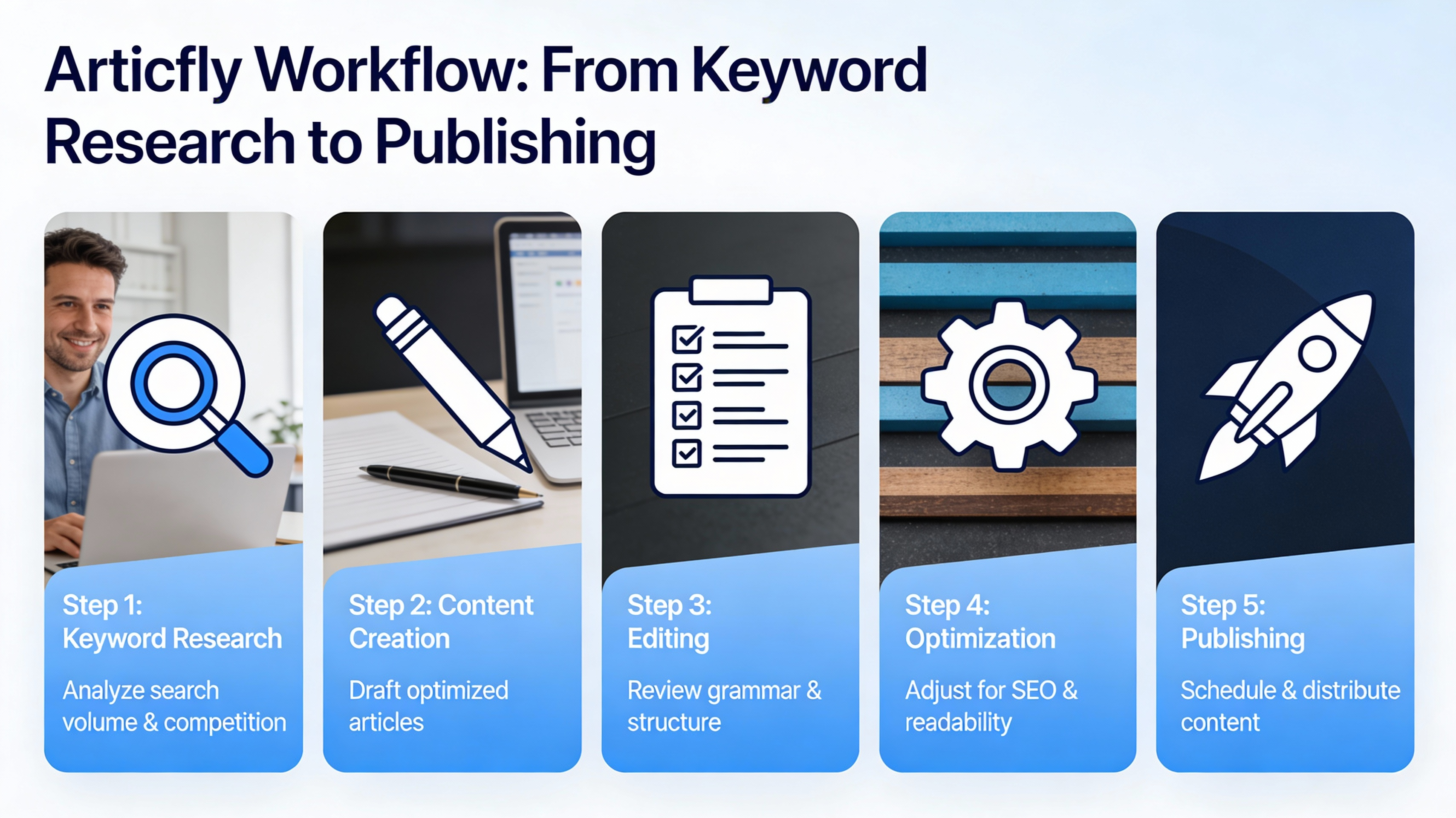
Articfly enables these wins by providing an end-to-end platform that handles everything from initial research to the final published article. Our proprietary AI system is designed to simulate the workflow of a high-end SEO agency at a fraction of the cost. This allows any brand to scale their organic presence without a large internal team.
The platform features customizable brand voice models to ensure that every AI-generated piece sounds like it was written by your team. This consistency is vital for maintaining brand identity while scaling production volumes. Users can fine-tune the tone to match their specific industry and audience expectations.
Real-time SEO scoring and suggestions are integrated into the writing process to maximize the visibility of every post. The system analyzes current SERP trends to ensure your content meets the necessary benchmarks for ranking on page one. This automated guidance removes the guesswork from search engine optimization.
- End-to-end content automation (Research to Publishing).
- Customizable tone of voice training.
- Real-time SEO audits and scoring.
- One-click integration with major CMS platforms.
- Automated internal linking and content clustering.
Key Takeaways
The key takeaways from these 2026 case studies highlight that success is no longer tied strictly to budget size. By leveraging AI, small teams can now compete with the largest players in their industry by being smarter and faster. The ROI of automation is becoming the primary driver of growth for modern businesses.
Top 3 Takeaways
- Precision intent mapping is more valuable than high-volume, generic content.
- Automation allows for scalable authority building through topical clustering.
- AI is a partner that empowers creators rather than just a tool for volume.
As search engines continue to evolve, the ability to produce high-quality, data-driven content at scale will remain a competitive advantage. Consider how Articfly can transform your existing strategy into a high-performance organic growth engine. The path to results is clearer than ever when you have the right technology on your side.
FAQ
Can AI really replace human writers for SEO?In 2026, AI serves as a powerful complement to human writers, handling the heavy lifting of research and drafting. Human editors still play a crucial role in final quality control and adding unique brand perspectives, but the efficiency gains from AI are undeniable.
What budget is considered “minimal” in 2026?A minimal budget typically refers to a range where a company cannot afford a dedicated SEO agency or multiple full-time writers. This usually describes small businesses and startups focusing their spend on strategic tools like Articfly rather than high-cost labor.
How does Articfly ensure brand‑consistent tone?Articfly uses advanced tone-training features that analyze your existing content to mimic your brand's unique style. This ensures that every generated article feels authentic and aligns with your established brand voice.
Is there a risk of duplicate content with AI?Articfly includes uniqueness safeguards to ensure that every article is original and specifically tailored to your selected keywords. The system generates content from scratch based on real-time data rather than pulling from a static database.
What support does Articfly offer for implementation?We provide comprehensive onboarding and consulting to help content teams integrate our AI into their existing workflows. This ensures you can hit the ground running and see results as quickly as possible.
Ready to take action?
Ready to scale your traffic on a shoestring budget? Explore how our automated platform can replicate the success of these real‑world 2026 case studies for your brand. Start a free trial, download the full PDF of these case studies, or schedule a demo with our team to see Articfly in action today. Your journey toward effortless, high-quality organic growth begins with a single step toward automation.