AI Article Rewriter vs Generator: Which Do You Need?
Key Takeaways
Choosing between an AI article rewriter and a generator depends entirely on your current editorial bottleneck and SEO objectives. While generators are designed to build from scratch, rewriters are precision tools meant to preserve and enhance existing value. Understanding the technical nuances between these two allows content teams to scale production without sacrificing brand integrity or ranking stability.
Decoding the Difference: Rewriting vs. Generating
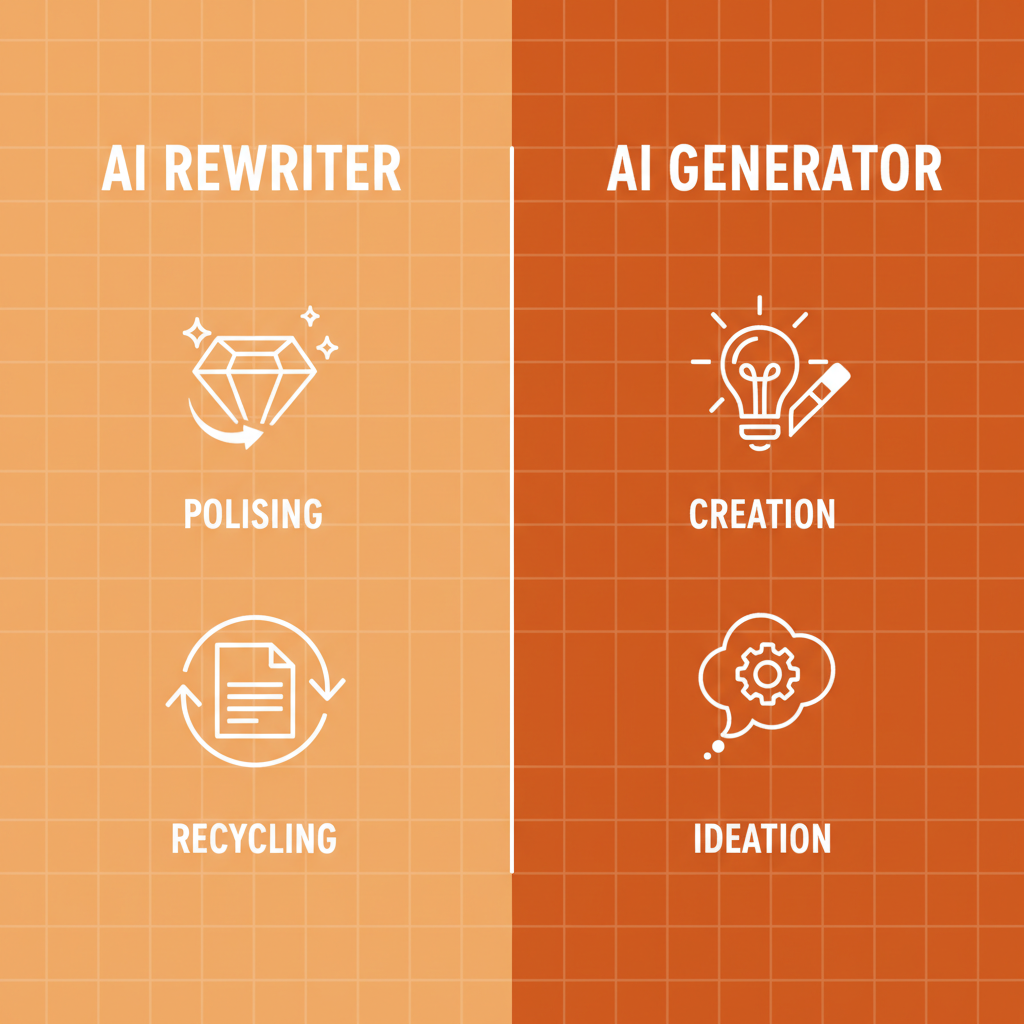
Distinguishing between rewriting and generating is the first step toward building a sustainable content engine. Many teams mistakenly use generators to update old content or try to "rewrite" a blank page with a generator, leading to inefficient workflows and inconsistent results. A generator builds a narrative structure based on a prompt or a keyword, whereas a rewriter requires a source text to reshape, refine, or update.
What is an AI Article Rewriter?
An AI article rewriter takes existing text as its foundation. It analyzes the semantic meaning of the original sentences and reconstructs them to improve clarity, change the tone, or update factual information while maintaining the core message. In a professional SEO context, this is rarely about "spinning" text to avoid plagiarism detectors; it is about modernizing a post that has lost its edge or no longer aligns with the brand’s current voice.
What is an AI Article Generator?
An AI article generator creates content from a state of near-zero input. It relies on a large language model’s training data and your specific instructions-such as keywords, target audience, and desired length-to synthesize a brand-new piece of writing. This is the industrial engine for expanding your site’s footprint into new territories where you currently have no presence.
| Feature | AI Article Rewriter | AI Article Generator |
|---|---|---|
| Primary Input | Existing source text | Keyword or prompt |
| Best Use Case | Updating old blog posts | Launching new keyword clusters |
| Brand Voice | Inherits from source/user rules | Determined by brand voice settings |
| SEO Strategy | Defensive (defending rankings) | Offensive (targeting new terms) |
| Speed to Publish | High (requires less structural edit) | Moderate (requires fact-checking) |
When to Use an AI Article Rewriter

Prioritizing content refreshing is often the most cost-effective move an agency or solo blogger can make. Instead of the high cost of acquiring new traffic for unranked keywords, a rewriter allows you to double down on content that already has some authority but is sliding down the search engine results pages (SERPs). This "defensive SEO" keeps your core assets alive and performing.
Combating Content Decay and SEO Drop-offs
Content decay is a mathematical certainty for any successful blog. As competitors publish newer data or Google updates its understanding of search intent, your once-top-ranking posts will inevitably lose visibility. An AI rewriter allows you to take those 2-year-old articles, inject new insights, and restructure them to meet current SEO standards without the labor-intensive process of manual line-editing.
Pivoting Tone and Brand Voice Consistency
Maintaining a unified brand voice becomes difficult as a team grows or when a site changes ownership. If your early content was written by various freelancers with different styles, a rewriter can unify that archive. By applying a consistent brand voice profile to your existing database, you ensure that every article on your WordPress site sounds like it came from the same authority, which builds trust with your audience.
Scenario: The Aging High-Performer
Imagine a post titled "Best WordPress Hosting 2022." It currently ranks on page 2, but the information is outdated and the conversion rate is dropping. Instead of starting over, you feed the text into a rewriter. The tool preserves the existing internal links and metadata structure but updates the technical specs and refreshes the tone to match your 2024 brand guidelines. This surgical update can often push the article back to page 1 with 20% of the effort required for a new post.
When to Deploy an AI Article Generator
Establishing topical authority requires a high volume of quality content across a variety of related keywords. If your goal is to dominate a niche, you cannot rely solely on the content you already have. Generators provide the velocity needed to fill out an editorial calendar and cover every nuance of a subject matter, signaling to search engines that your site is a comprehensive resource.
Scaling New Keyword Clusters from Zero
When you identify a new cluster of keywords that your competitors are neglecting, speed is your greatest advantage. A generator allows you to produce dozens of foundational articles in the time it would normally take to write one. This rapid deployment creates a "moat" around your new topic, making it harder for others to catch up once you start ranking.
Creating Content Briefs and First Drafts at Volume
Generators are excellent for overcoming the "blank page" problem that slows down even the best writing teams. By generating a full first draft, an editor can move straight into the refinement and optimization phase. This shift from "writing" to "editing" is where significant headcount savings occur, as a single editor can manage a much larger volume of output when they aren't responsible for the initial word count.
Specific Use Cases for Generators
- Topic Pillars: Long-form guides that serve as the hub for internal linking.
- Supporting Content: Shorter articles that target long-tail keywords.
- Comparison Posts: Structured articles comparing different products or services.
- Glossaries: Quick, informative definitions for technical terms in your niche.
Quality vs. Control: A Comparative Breakdown
Balancing editorial oversight with production speed is a constant tension in content management. Generators offer immense speed but require a more rigorous fact-checking and structural review process because the AI is building the logic of the article from scratch. Rewriters, conversely, offer tighter control because the logic and facts are already present in the source material; the AI is simply improving the delivery.
For high-stakes articles where brand reputation is paramount, a rewriter is often the safer choice for existing assets. For growth-oriented projects where the goal is to cast a wide net, generators provide the necessary scale. The key is to match the tool to the risk profile of the specific content piece. A technical tutorial requires higher control (rewriter/manual) than a generic lifestyle listicle (generator).
The Hidden Trap: Why Neither Tool is Enough Alone
Focusing solely on text generation is a common mistake that leads to stagnant SEO results. An article is more than a collection of paragraphs; it is a technical asset that includes schema markup, internal link mapping, featured images, and meta tags. If you use a tool that only outputs text, you are left with a massive manual workload to actually get that content published and ranking.
"The modern content lifecycle isn't just about writing; it's about the orchestration of analysis, publication, and maintenance. If your AI stops at the final period of the last sentence, you're only doing 20% of the work."- Articfly Engineering Team
Many teams find themselves in a "copy-paste loop," where they generate text in one tab and manually format it in WordPress in another. This process is prone to error and consumes the very time savings the AI was supposed to provide. True efficiency comes from a system that integrates the writing phase directly with the technical SEO and publication phases.
Beyond the Basics: The Full Content Lifecycle Approach
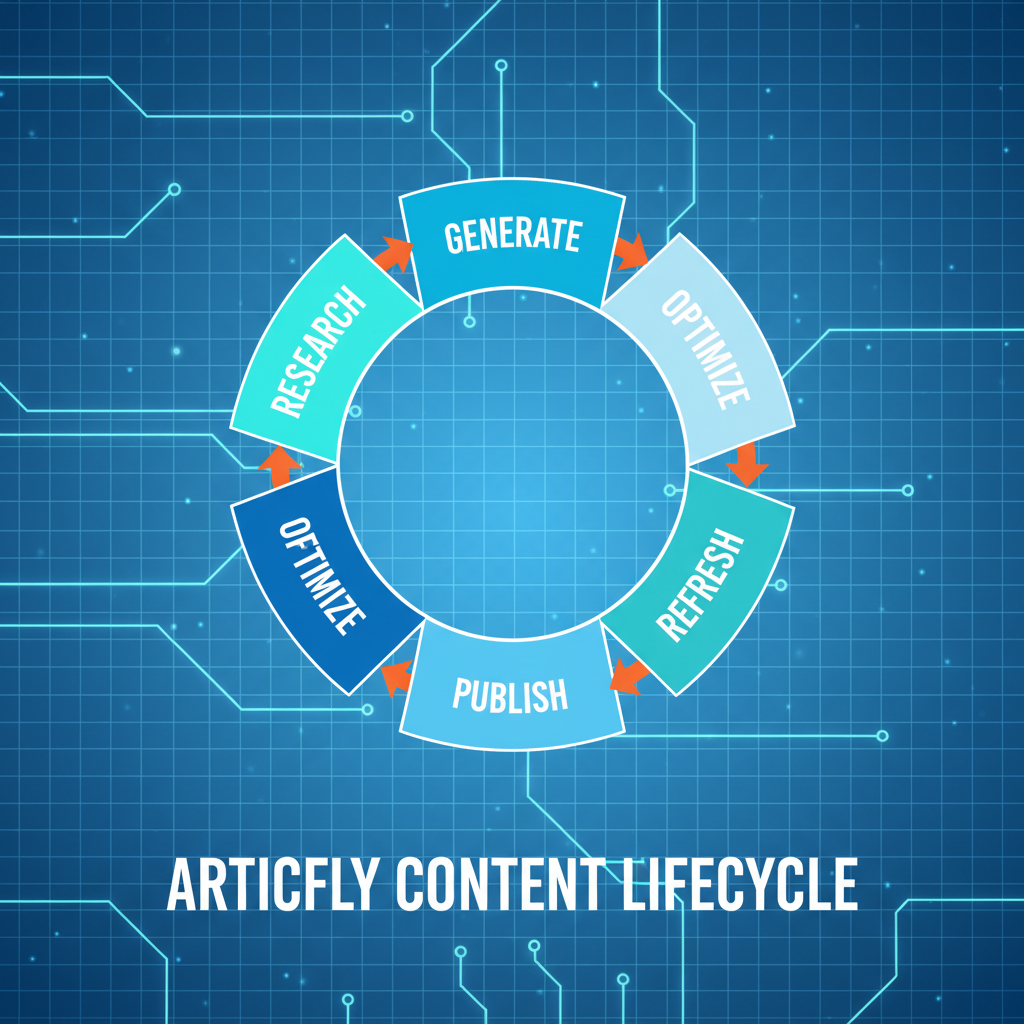
Adopting a lifecycle-first mindset shifts your focus from "how do I write more" to "how do I grow my traffic." A professional content engine should handle ideation, keyword analysis, brand voice alignment, publication, and long-term monitoring. This ensures that every piece of content-whether generated from scratch or rewritten from an old draft-is working toward a specific SEO goal.
The Role of SEO Scoring and Analysis
Writing content without real-time SEO scoring is like driving without a map. A professional workflow includes analyzing the SERPs for your target keyword while the content is being created. This includes checking readability scores, ensuring the correct keyword density, and generating the necessary schema markup to help search engines understand the context of your page. These tools should be baked into your dashboard, not treated as separate tasks.
Automating the WordPress Publication Workflow
The final hurdle in content production is the publication itself. For agencies managing multiple sites, the ability to schedule and sync articles directly from a central dashboard is a significant operational advantage. Native WordPress integration allows you to move from a finished draft to a live, optimized post in seconds, bypassing the friction of manual formatting and image uploads.
The Professional Content Lifecycle Checklist
- Ideation: AI-planned editorial roadmaps based on niche competition.
- Brand Voice: Automatic extraction and application of your unique tone.
- Optimization: Real-time SEO tools, internal link mapping, and SERP previews.
- Publication: One-click sync to WordPress via native plugins.
- Maintenance: Automated tracking of content decay and scheduled refreshes.
Frequently Asked Questions
Is AI rewriting considered 'original' content by Google?Google’s primary focus is on helpfulness and value-add for the reader. If an AI rewriter is used to update outdated facts, improve readability, and make a post more useful, it is considered high-quality content. The goal is to provide a better experience than the previous version, not just to change words to avoid "duplicate content" flags.
Can I use a generator to update old posts?While possible, it is often inefficient. A generator might ignore the existing structure or key points that are already performing well. A dedicated rewriter or refresher tool is better suited for this task because it respects the original context while applying necessary improvements, ensuring you don't lose the "soul" of the article.
Which is better for SEO: Rewriting or Generating?It depends on your goal. If you want to rank for new terms and build topical authority, a generator is the right tool. If you want to defend your current rankings and stop traffic loss on existing pages, a rewriter is more effective. A mature SEO strategy uses both tools in tandem.
Do these tools integrate directly with WordPress?Standalone AI tools usually require manual copying and pasting. However, integrated content engines like Articfly provide native WordPress plugins that allow for direct syncing, scheduling, and metadata management, which is essential for scaling production without increasing headcount.
Put this into practice
Optimizing your content workflow begins with an honest audit of your current site performance. Identify your top 20% of articles that are losing traffic and use a rewriter to refresh them. Simultaneously, look for gaps in your keyword coverage and use a generator to build out new clusters. By using a platform that handles the full lifecycle-from ideation to WordPress publication-you can manage this entire process without a large editorial team. Stop treating AI as a simple text box and start using it as an integrated content engine.
Want the system behind this content?
Join the top 1% of SEOs generating programmatic, high-converting organic traffic completely on auto-pilot.
DEPLOY ARTICFLYMore Articles
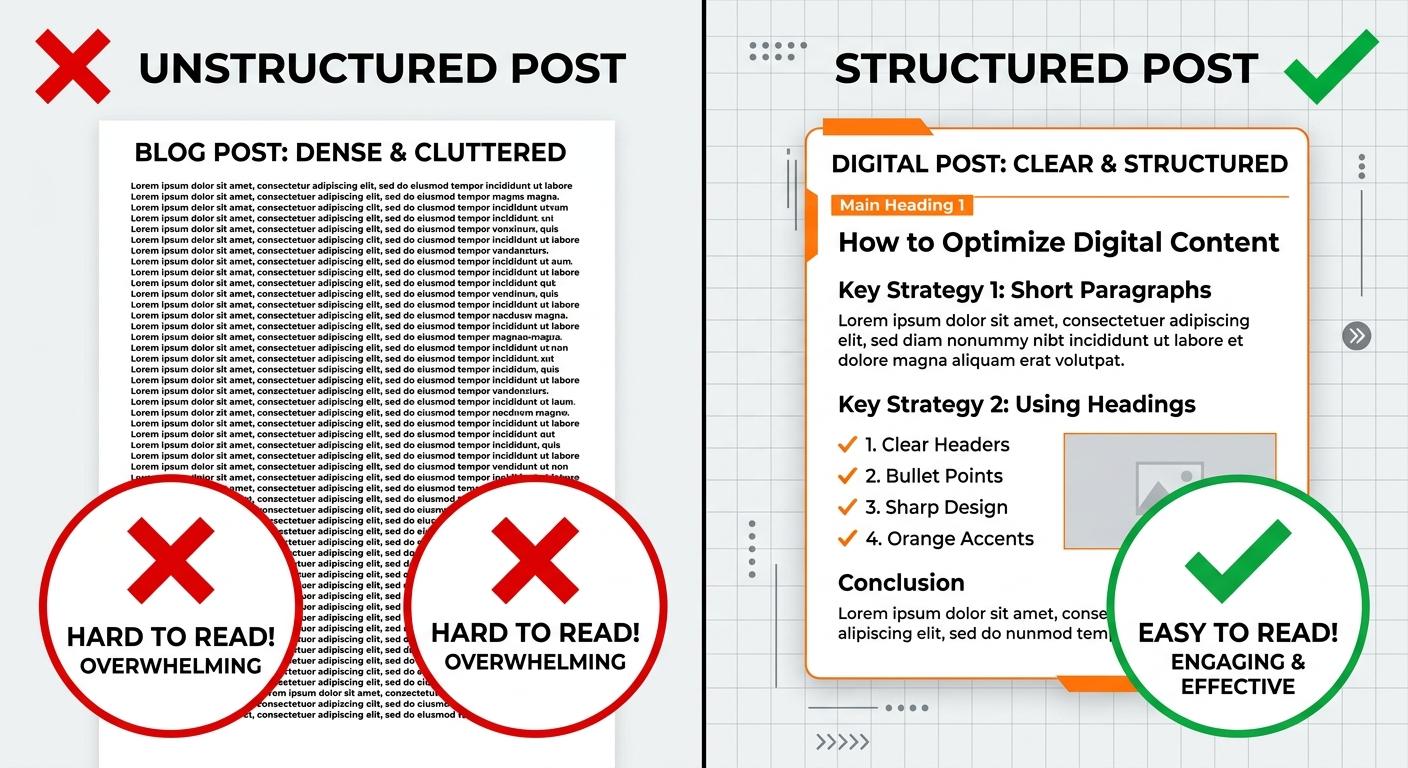
Why People Stop Reading Your Blog Post After 30 Seconds (and How to Fix It)
Most readers decide to stay or leave a blog post within the first 30 seconds. If your bounce rates are high, it's likely due to structural friction, poor hooks, or a lack of immediate value. Learn how to diagnose engagement killers and use AI-driven optimization to keep readers scrolling.
READ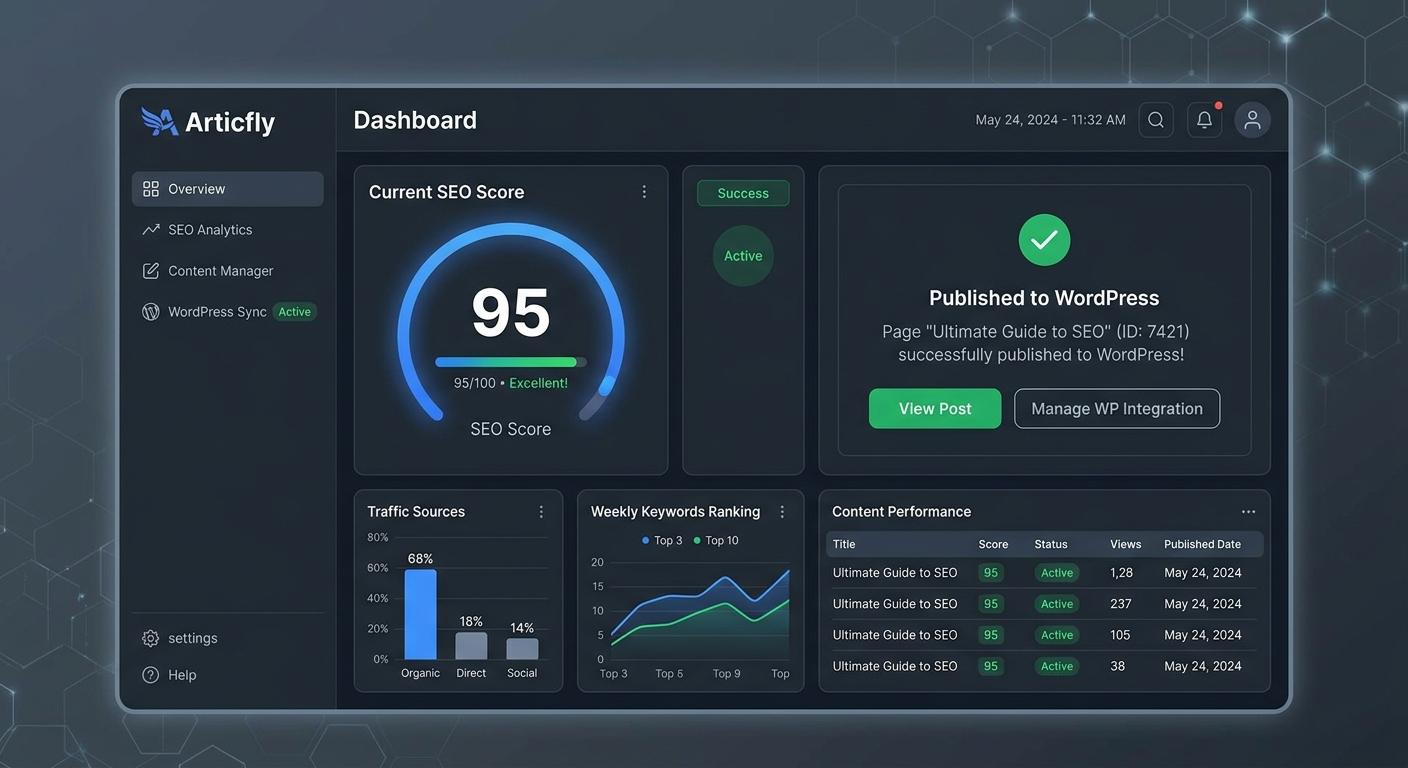
The $15 Blog Post That Brings in $2,000/Month: How AI Content Delivers 130x ROI
Discover the unit economics of high-scale AI publishing. Learn how to leverage Articfly to produce $15 blog posts that generate $2,000 in monthly recurring revenue through SEO optimization, automated publishing, and strategic content refreshing.
READ
Brand Voice in AI Content: How to Stop Your Blog from Sounding Like a Robot
Generic AI content is killing brand authority. Learn how to use Articfly’s Brand Voice Analyzer and Advanced Mode to produce high-scale, SEO-optimized content that sounds like your team, not a machine.
READ