
The Hidden Dangers of Relying Only on AI Assistants for Traffic

Over‑reliance on black‑box algorithms can create significant vulnerabilities for businesses that depend solely on automated traffic assistants. These systems often operate without transparency, meaning a single update to the underlying technology can disrupt your entire content strategy. Without a secondary layer of protection, your visibility is entirely at the mercy of platform-specific changes.
Furthermore, content produced without human-led SEO often lacks the contextual brand voice and nuance required to build long-term trust. Sudden algorithm updates from search engines can easily identify and deprioritize content that lacks a clear expert perspective. This exposure can lead to traffic being wiped out almost overnight, leaving companies without a fallback plan. Relevant resources include Articfly’s AI content creation page and Search Engine Journal.
| Feature | AI-Only Strategy | AI + SEO Strategy |
|---|---|---|
| Speed | Extremely High | High |
| Stability | Low (Algorithm Sensitive) | High (Diversified) |
| Authority | Variable | Strong (E-E-A-T focused) |
| Cost | Very Low | Moderate |
Why Traditional SEO Remains Essential in 2026

Core principles of SEO such as crawlability, relevance, and authority continue to be the bedrock of digital discoverability. While AI can generate text, it cannot independently verify the technical health of a website or the strength of its backlink profile. Sustainable growth requires a foundation that search engines recognize as authoritative and trustworthy.
Data‑driven intent matching remains a field where human insight is irreplaceable for connecting keywords with specific user needs. Modern search environments prioritize E‑E‑A‑T (Experience, Expertise, Authoritativeness, and Trustworthiness), which requires a deliberate strategy beyond simple text generation. Understanding these fundamentals is crucial for long-term success. You may find more information in the SEO guide on Articfly or the Wikipedia page on Search Engine Optimization.
- Technical Crawlability and Indexing
- Strategic User Intent Alignment
- E-E-A-T Signaling and Validation
- High-Quality Backlink Acquisition
- Comprehensive Semantic Keyword Mapping
How SEO Complements AI Assistants – A Practical Framework
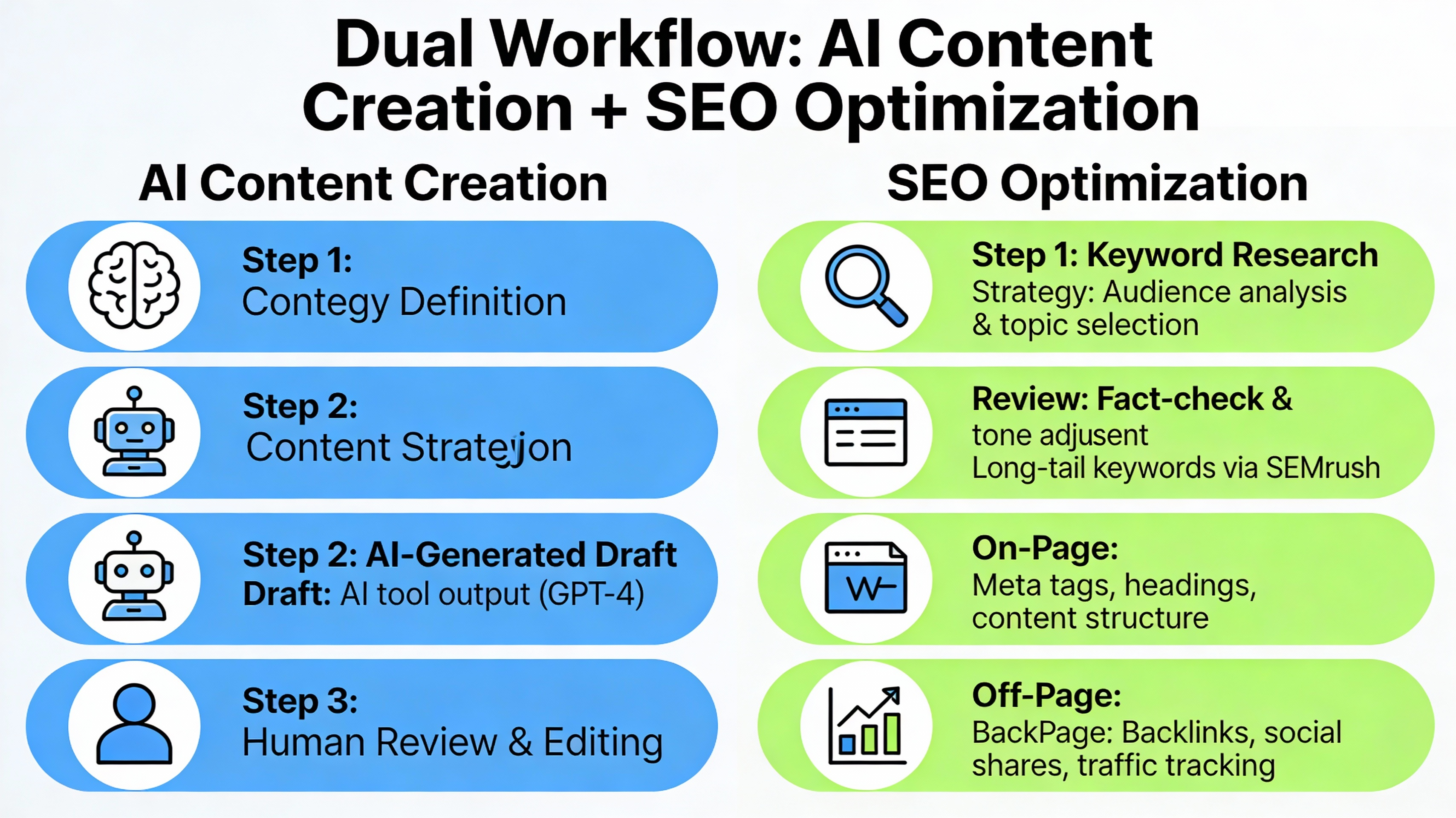
Dual‑Strategy Workflow integration allows marketing teams to combine the efficiency of AI with the rigor of traditional optimization. By using a hybrid approach, you can scale content production while ensuring that every page meets the high standards required by modern search engines. This framework prioritizes both volume and durability. Explore Articfly’s workflow automation feature or read a case study on hybrid content strategies for more details.
Keyword Research + AI Prompt Engineering
Step 1: Ideation
Use AI to generate a vast array of topic ideas based on specific keyword clusters identified during your research. This ensures that the AI is working within a pre-approved SEO context from the very beginning.
Content Structuring + AI Draft Generation
Step 2: Drafting
Direct the AI to create a draft that maps directly to your predefined SEO headings and subheadings. This prevents the assistant from drifting into irrelevant topics and keeps the content focused on user intent.
Human Review & SEO Optimization
Step 3: Refinement
Apply on-page SEO checks, internal linking, and schema markup after the AI has completed its initial draft. This human review ensures the content is optimized for both robots and readers alike.
Real‑World Example: From AI‑Only to SEO‑Boosted Traffic

Baseline traffic spikes are common when businesses first deploy AI assistants without an underlying SEO strategy. In one observed scenario, a brand saw a rapid increase in page views that quickly collapsed following a search engine core update. This volatility highlighted the danger of relying solely on automated outputs without structural optimization.
After an intervention involving a technical SEO audit and keyword refinement, the traffic began to stabilize and grow steadily. By diversifying sources and building a backlink profile, the brand created a resilient ecosystem that was no longer dependent on a single algorithm. Detailed tracking can be found in Articfly’s analytics dashboard or through a reputable source on traffic diversification.
The following description illustrates a performance chart: The "AI-Only" line shows a vertical spike followed by a 90% drop within one month. The "SEO-Boosted" line demonstrates a slower, diagonal climb that maintains its upward trajectory even during major industry updates.
Key Takeaways
AI assistants are powerful but fragile when they are used as the only tool for generating traffic. Without a proper SEO safety net, your digital assets are vulnerable to the whims of third-party platform changes. Balancing automation with proven optimization techniques is the only way to ensure long-term visibility.
- AI tools should be used for efficiency, while SEO provides the strategic resilience needed for growth.
- Diversified traffic sources protect your business from sudden algorithm updates and platform shifts.
- Implementing a dual-workflow future-proofs your content by combining data-driven planning with automated drafting.
You can refer to the downloadable checklist PDF for a summary of these points.
Frequently Asked Questions
Navigating the hybrid landscape often leads to questions about the best ways to integrate these powerful technologies. Below are the most common inquiries regarding AI and SEO stability. For further assistance, visit the Articfly FAQ page or consult Google’s 2026 Search Quality guidelines.
Can I rely on AI tools for evergreen content?While AI can draft evergreen topics, human oversight is required to ensure the information remains accurate and authoritative over time. AI lacks the ability to verify real-world changes without manual updates.
How often should I audit AI-generated pages?Quarterly reviews are recommended to ensure that AI-generated content still meets current SEO standards and remains relevant to your audience's changing needs.
Does Articfly integrate SEO recommendations automatically?The platform is designed to highlight specific SEO opportunities and scoring metrics during the creation process to help you maintain high search standards.
What are the biggest algorithm changes to watch in 2026?Search engines are increasingly prioritizing deep expertise and verified human experience over generic summaries, making E-E-A-T more critical than ever.
Next steps for AI-powered blog content creation
Sign up for a free trial today to begin testing the dual workflow within your own marketing department. Our platform provides access to templates, automated audits, and real-time SEO scoring to help you scale safely. Join our community for ongoing education and support as you transition to a more resilient traffic strategy. You can access the trial signup page or read a reputable review of AI-SEO tools for more perspective.
Action: Click the "Start Your Free Trial" button to begin your journey toward more stable traffic.