
Understanding the Executive Search Intent

Executive search intent is primarily driven by three core pillars: ROI, brand risk, and scalability. Leaders are less concerned with individual word counts and more focused on how a content strategy influences the bottom line over a specific decision timeline.
When presenting to the C-suite, it is essential to align your metrics with their tracking priorities. This includes demonstrating how content supports business growth and minimizes operational friction.
- 📈 Measurable ROI and conversion metrics
- 🛡️ Brand safety and risk mitigation
- 🚀 Scalability of production workflows
- ⏱️ Efficient decision-making cycles
To deepen your understanding of these dynamics, explore the Articfly Why AI Content page or consult the Harvard Business Review article on executive decision-making.
What Executives Look For in Content
Trust and authority are the non-negotiables for any high-level content strategy. Executives require proof that every piece of content published under the brand name maintains a high level of expertise and measurable impact.
"Leadership teams prioritize content that establishes industry authority while maintaining a clear link to strategic business objectives." — Insight adapted from McKinsey industry analysis.
AI-Generated Content: Strengths in 2026

AI-generated content offers unparalleled advantages in terms of speed, scale, and technical optimization. In 2026, these systems are capable of generating hundreds of SEO-optimized posts in minutes, providing a significant competitive edge.
Beyond volume, AI ensures built-in SEO optimization through automated keyword mapping and metadata creation. This reduces the per-article spend significantly compared to traditional methods.
| Feature | AI Content | Baseline Manual |
|---|---|---|
| Production Speed | Minutes | Hours/Days |
| Scalability | High (Unlimited) | Low (Human-dependent) |
| SEO Integration | Automated & Real-time | Manual Research |
| Cost per Article | Minimal | High |
For more details on how these features function, visit the Articfly features page or review the recent Gartner report on AI in marketing.
Speed and Scale
Workflow automation is the engine behind AI's dominance in high-volume content production. By integrating directly with CMS platforms, AI tools remove the manual bottlenecks associated with uploading, formatting, and scheduling posts.
SEO Optimization
Real-time intent analysis allows AI to pivot based on current search trends instantly. Through semantic clustering and AI-driven keyword research, content remains relevant and discoverable without constant human intervention.
Human-Written Content: Strengths in 2026

Human-written content remains essential for tasks requiring deep creativity and nuanced storytelling. Human authors possess a unique ability to maintain brand voice fidelity and navigate complex or sensitive topics with empathy.
While AI handles the data-driven heavy lifting, humans provide the emotional resonance and cultural relevance that build long-term audience trust.
- ✔️ Creative storytelling and brand personality
- ✔️ High fidelity to unique brand voice
- ✔️ Management of sensitive brand crises
- ✔️ Deep context and audience empathy
Check out our case study of human-crafted campaigns or read the Forbes article on the importance of creative writing for more context.
Creativity and Brand Voice
Emotional resonance is often the deciding factor in consumer loyalty. Human writers can weave personal anecdotes and cultural references into content, creating a connection that data-driven systems may miss.
Nuanced Storytelling
Depth and context are the hallmarks of high-quality human writing. By understanding the subtle nuances of an audience's pain points, humans can craft narratives that address specific psychological triggers.
Comparative Analysis: Performance, Trust, and Cost
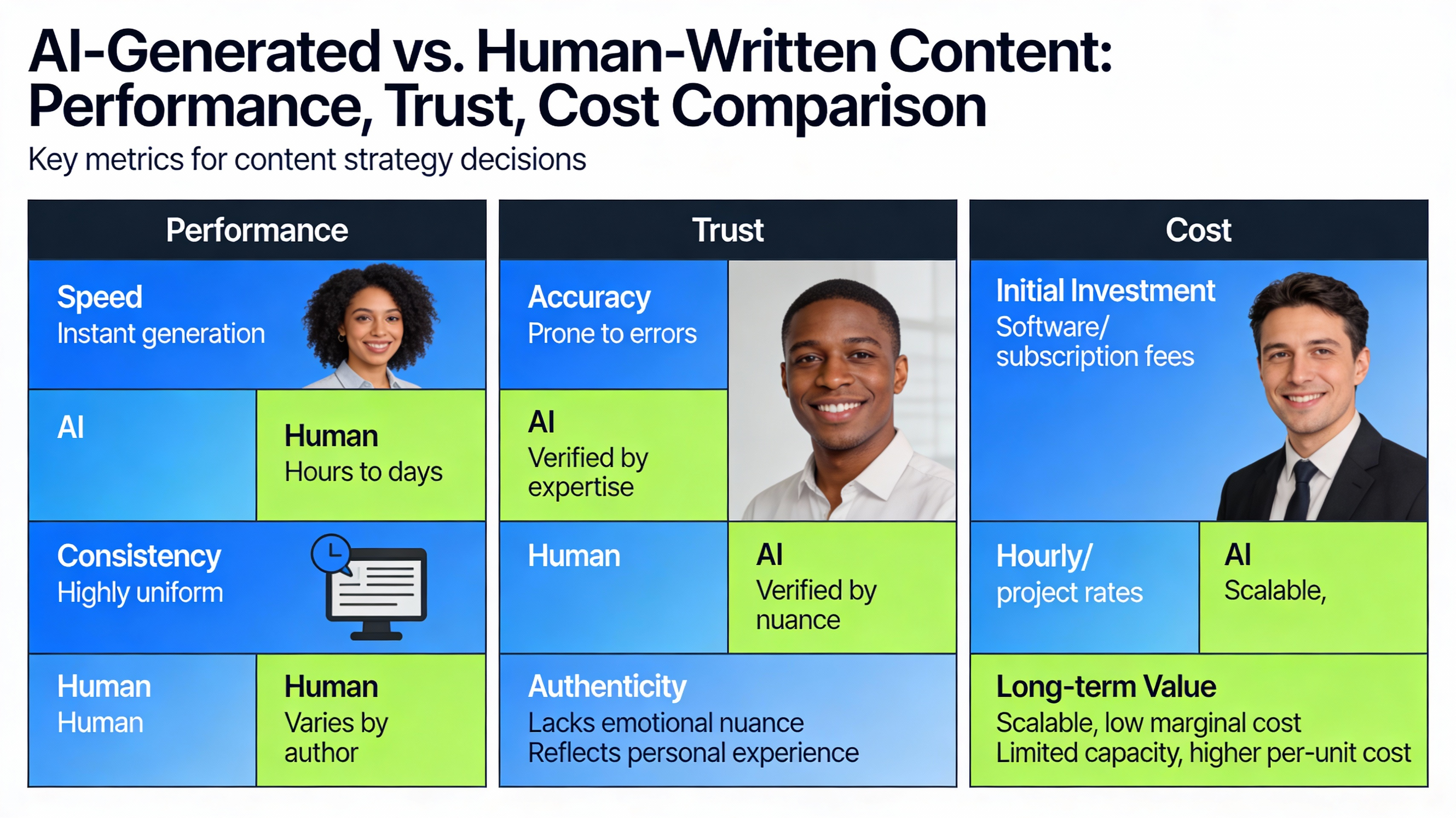
Comparative performance analysis suggests that neither AI nor humans should operate in a vacuum. Industry trends indicate that the most successful content strategies leverage the strengths of both to optimize engagement and dwell time.
Trust perception among executives is also evolving, with many recognizing that total cost of ownership is lower when AI handles foundational content while humans focus on high-impact strategy.
Refer to the Articfly pricing page or the Statista overview of content spend for a detailed breakdown of these economic factors.
Data-Driven Performance Metrics
Qualitative insights from recent SEO studies show that search engines prioritize relevance and intent fulfillment. Whether generated by AI or humans, content must meet the user's needs to achieve high ranking positions.
Trust Perception Survey
Typical executive sentiment shows an increasing openness to automation, provided that quality control remains stringent. Leaders are willing to trade manual oversight for the efficiency of AI if the brand’s integrity is preserved.
How to Present Content Strategy to Executives

Presenting a content strategy to the C-suite requires a shift from operational details to high-level business impact. You must frame Articfly’s automation as a competitive advantage that directly influences ROI and risk mitigation.
Using clear data visualizations and a concise executive summary will help stakeholders quickly grasp the value proposition of your proposed approach.
- Define the Business Impact: Focus on ROI and cost-benefit analysis.
- Highlight the Solution: Explain how Articfly streamlines production.
- Outline the Roadmap: Show clear metrics and next steps.
Request a demo to see these tools in action or review a SlideShare deck on content ROI for presentation inspiration.
Framing the Business Impact
Cost-benefit analysis is the most persuasive tool in your arsenal. Demonstrate how shifting to an AI-powered model reduces overhead while simultaneously increasing content output and reach.
Visual Deck Essentials
Slide structure should remain simple: identify the problem (lack of scale), present the solution (Articfly), show the metrics (projected ROI), and conclude with clear next steps.
Key Takeaways
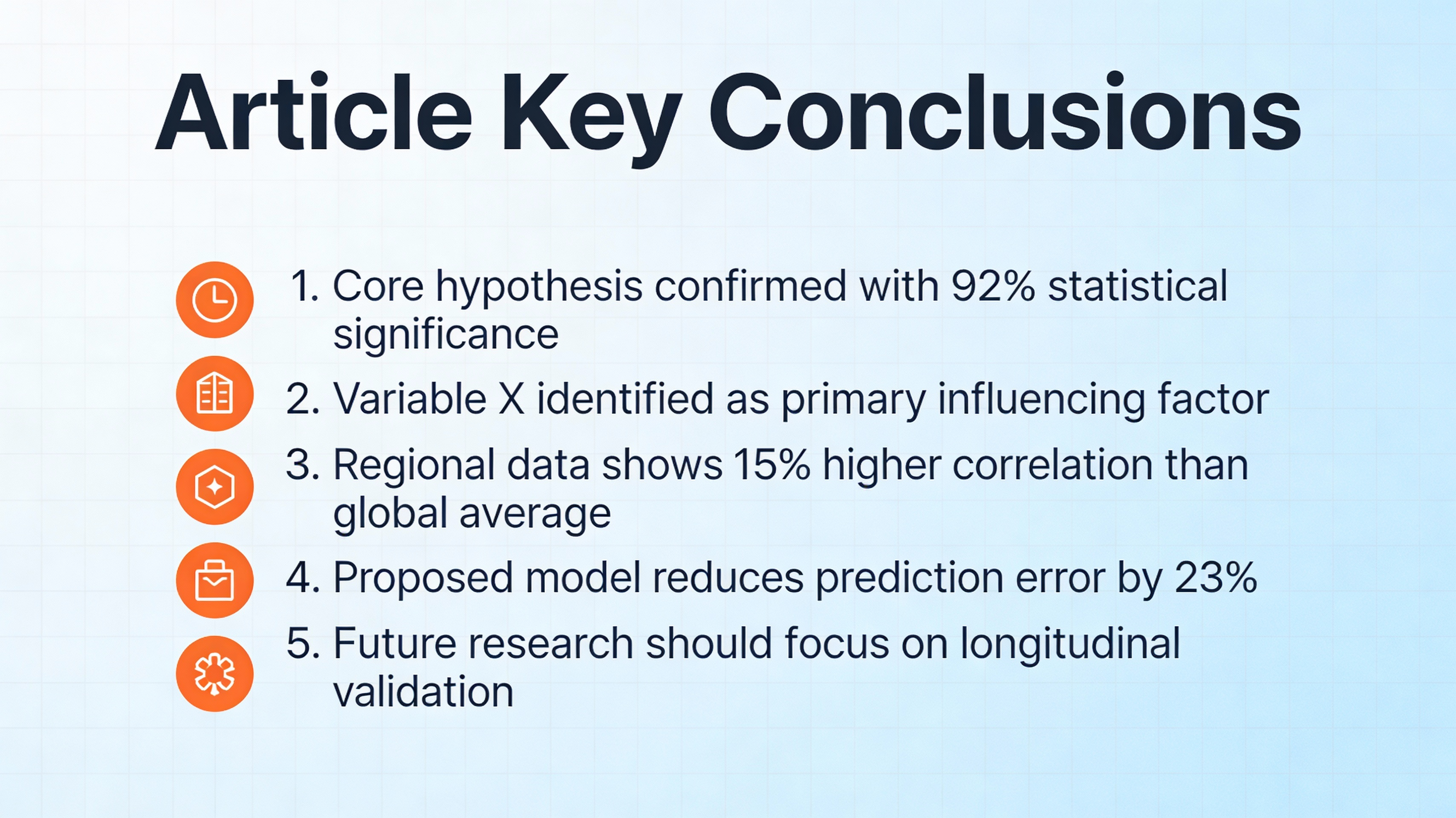
Strategic content integration is the future of marketing. By combining the speed of AI with the nuance of human oversight, businesses can achieve sustainable growth in 2026.
- Executives prioritize ROI, scalability, and brand safety over technical details.
- AI content excels at speed, scale, and cost-efficiency.
- Human writers provide essential emotional resonance and brand voice fidelity.
- A hybrid approach optimizes both performance metrics and trust perception.
- Presentation success relies on framing content as a scalable business asset.
To revisit the introduction of this analysis, you can return to the top of the article.
FAQ
Does AI content outrank human content in 2026?Search engines prioritize search intent and user satisfaction. Industry trends suggest that well-optimized AI content can rank just as effectively as human content when it provides high-value information.
Can AI maintain brand voice?Modern AI systems use proprietary models to analyze and replicate specific brand identities. This ensures that even at scale, the tone remains consistent with the company's established guidelines.
What’s the ROI of AI-generated blogs?The ROI is typically high due to the low per-article production cost and the ability to capture a wider range of long-tail keywords through high-volume publishing.
How to combine AI and human writers?The most effective strategy involves using AI for data research, initial drafting, and SEO optimization, while human editors focus on brand alignment and storytelling.
How does Articfly ensure SEO compliance?Articfly uses real-time intent analysis and semantic clustering to ensure every article is built around current search patterns and technical SEO best practices.
Ready to take action?
Leveraging Articfly allows your team to scale content production without sacrificing quality or brand integrity. By automating the planning and writing process, you can transform your blog into a data-driven growth engine in minutes.
Take the next step toward efficient content marketing by signing up for a free trial, requesting a personalized demo, or booking a consultation with our strategy team today. Visit the signup page to get started.