
Understanding the Value of Automating Blog Strategy

The value of automating blog strategy lies in the ability to bridge the gap between keyword research and actual publication. Traditional methods often involve hours of manual brainstorming and complex spreadsheet management that can slow down production. By leveraging automation, teams can ensure that every keyword is mapped to a cohesive content goal while maintaining a consistent schedule.
Modern content teams face increasing pressure to scale without sacrificing search engine performance. Automation provides the infrastructure needed to maintain SEO best practices across hundreds of articles. This scalability is essential for growing content calendars that need to adapt to changing market trends quickly.
| Feature | Manual Planning | Automated Planning |
|---|---|---|
| Time Investment | High (Hours/Days) | Low (Minutes) |
| SEO Consistency | Variable | Standardized |
| Scalability | Limited by headcount | Virtually unlimited |
Efficiency studies, such as those published by HubSpot or Moz, highlight how streamlined planning reduces the overhead costs of content marketing. Choosing a dedicated platform like Articfly allows agencies to focus on high-level strategy rather than administrative tasks.
Preparing Your Keyword List for Automation

Preparing your keyword list is a foundational step that dictates the quality of your automated output. Raw data must be cleaned and organized to ensure the AI understands the primary intent behind each search term. Grouping keywords by search intent—whether informational, transactional, or navigational—allows for more targeted content generation.
Prioritizing terms by search volume and relevance ensures that your content plan addresses the most impactful topics first. Most automation tools require specific export formats, such as CSV or Google Sheets, to process data efficiently. Referencing Google’s Keyword Planner documentation can help in gathering the initial data required for this stage.
- Remove duplicate entries and irrelevant terms.
- Categorize keywords by user intent.
- Identify primary focus keywords for each topic cluster.
- Verify search volume and competition metrics.
- Format data into a clean CSV or spreadsheet for import.
Using an Articfly Keyword Import Guide can further simplify this preparation phase. A well-structured list prevents the AI from generating overlapping or redundant topics, ensuring a cleaner content map.
How AI Transforms Keywords into a Full Content Plan
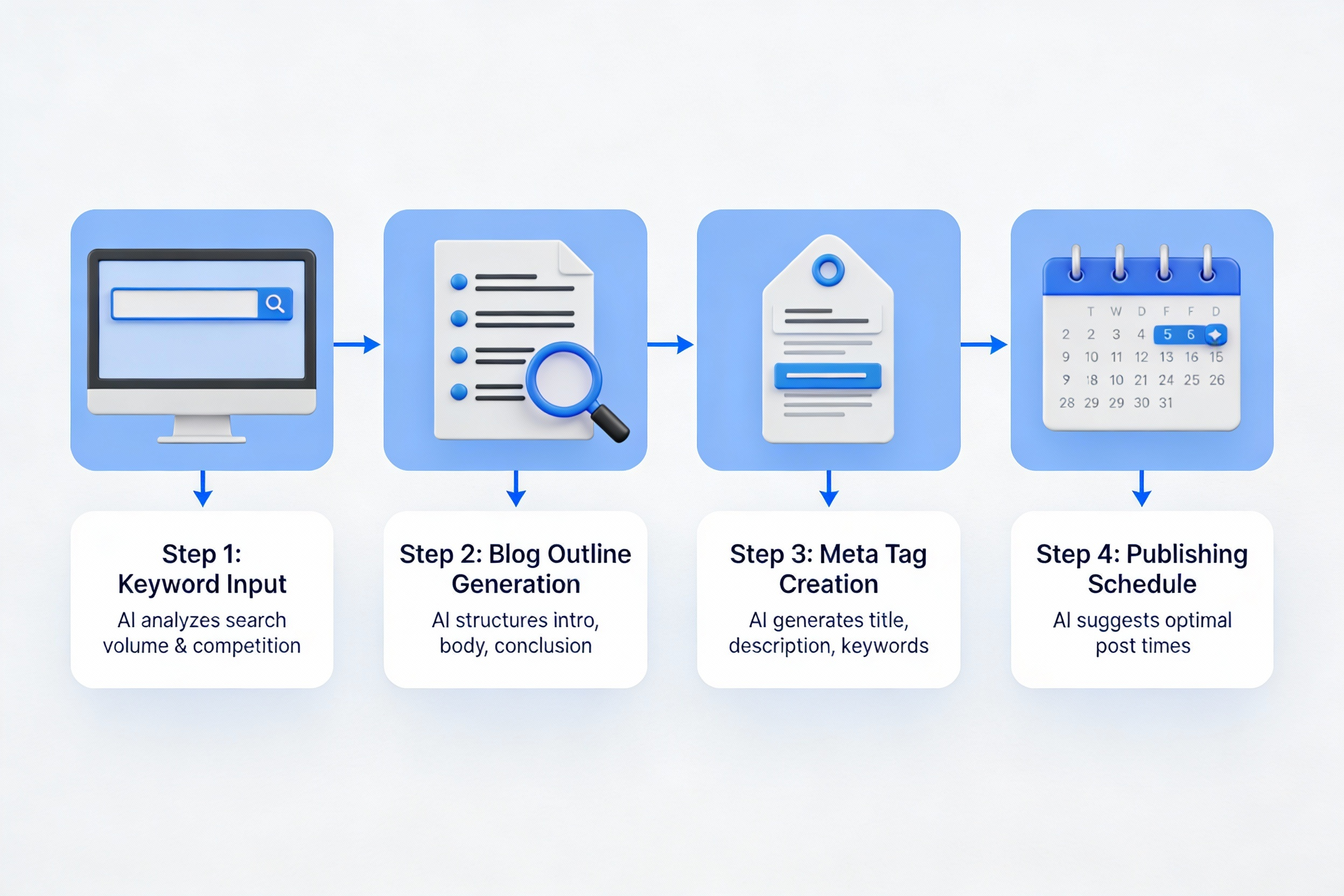
AI transforms keywords into actionable strategies by performing deep intent analysis and topic clustering. This process goes beyond simple keyword matching to understand the semantic relationships between different terms. By utilizing Natural Language Processing, the system identifies what information users are truly seeking.
Once the intent is clear, the AI automatically constructs a detailed H1-H3 structure for each article. This includes generating optimized meta titles, descriptions, and suggestions for internal linking. These elements are designed to meet both user needs and search engine requirements simultaneously.
The AI Planning Pipeline
- Input: Raw keyword data and brand parameters.
- Analysis: Intent classification and semantic clustering.
- Structure: Automated generation of headings and outlines.
- Metadata: Creation of SEO titles and descriptions.
- Output: A publish-ready content roadmap.
For those interested in the technical aspects, an Articfly AI Engine Overview provides more depth on these mechanisms. Understanding these automated workflows helps content managers trust the output generated by advanced algorithms.
Step-by-Step Workflow with Articfly

The workflow with Articfly is designed to be intuitive, allowing users to move from a list of keywords to a complete plan in minutes. The process begins with the simple act of uploading or pasting your prepared keyword data into the platform. This serves as the raw material for the AI’s generative process.
After the data is imported, users select their target audience and the specific tone of voice that matches their brand identity. Configuring SEO settings, such as target word counts and focus keywords, allows for further customization. Once the AI planner runs, the output can be reviewed and edited within a built-in editor before being exported to a CMS.
- 1️⃣ Import: Upload or paste your keyword list into the dashboard.
- 2️⃣ Define: Select your target audience and brand tone.
- 3️⃣ Configure: Set focus keywords and desired word counts.
- 4️⃣ Generate: Run the AI planner and review the generated outlines.
- 5️⃣ Publish: Export the final plan to your CMS or editor.
Case studies from the Content Marketing Institute show that these automated steps can significantly reduce the time spent on administrative drafting. For new users, an Articfly Getting Started tutorial offers a visual walkthrough of these specific actions.
Optimizing the Generated Strategy for Maximum Impact

Optimizing the generated strategy ensures that the AI's foundational work is polished for maximum audience engagement. While automation handles the heavy lifting of structure and SEO, human refinement can significantly boost click-through rates. Editors should focus on refining headlines to make them more compelling to human readers.
Adding internal links to established pillar pages helps distribute authority throughout the website. Additionally, adjusting keyword density and including latent semantic indexing (LSI) terms can further enhance search visibility. Scheduling the final articles based on audience activity insights ensures they reach readers at the optimal time.
| Metric | AI-Generated Baseline | Post-Human Optimization |
|---|---|---|
| Headline CTR | Standard | Improved |
| Internal Link Depth | Automated | Strategically Enhanced |
| Reader Retention | High | Optimized |
Resources like the Articfly Optimization Tips page offer more granular advice on these final adjustments. Experts at various SEO blogs emphasize that the combination of AI efficiency and human creativity leads to the best results.
Common Pitfalls and How to Avoid Them
Common pitfalls in automation often arise when users rely too heavily on technology without performing a final review. Ignoring the nuances of search intent can lead to content that, while technically optimized, does not fully satisfy the user's query. It is vital to ensure that keyword grouping does not lead to thin or repetitive content.
To avoid these issues, always treat the AI output as a highly advanced draft rather than a finished product that requires no oversight. Regularly checking for brand consistency and factual accuracy maintains the integrity of the blog. Following Articfly Best Practices can help teams navigate these challenges effectively.
"Successful content automation requires a balance of algorithmic precision and human editorial judgment to truly resonate with an audience."Content strategist Jane Doe
Articles from Search Engine Journal frequently suggest that a human-in-the-loop approach is the most effective way to utilize AI. This ensures that the scale of automation never comes at the cost of genuine value for the reader.
Key Takeaways
Key takeaways from this guide emphasize that automation is a powerful tool for modernizing content workflows. By accelerating the planning stage, teams can focus more of their energy on high-level strategy and creative execution. However, the quality of the output remains tied to the quality of the initial keyword preparation.
- Automation significantly reduces the time required for content planning and SEO structure.
- Proper keyword preparation and intent grouping are critical for AI accuracy.
- Reviewing and optimizing AI-generated plans ensures they meet brand standards.
- A structured workflow allows for scalable growth without losing content quality.
For more information on how to implement these strategies, visiting the Articfly homepage can provide additional insights into the tools available for content creators.
Frequently Asked Questions
Can I use my own keyword research tools with Articfly?Yes, Articfly is designed to be compatible with data from major keyword research tools. You can export your lists as CSV files and upload them directly into the platform for strategy generation.
How does the AI ensure brand-consistent tone?Users can select specific tone parameters and audience profiles during the configuration stage. The AI then applies these constraints to the outlines and metadata it generates.
What SEO metrics does the generated plan include?The plan typically includes focus keyword recommendations, heading structures, meta titles, meta descriptions, and suggested internal linking opportunities.
Is there a limit to the number of keywords per batch?While limits may depend on the specific plan, the system is built to handle large batches of keywords to facilitate bulk content planning and scalability.
How secure is my data during processing?Data security is a priority, and information processed through the AI engine is handled according to standard industry protocols to ensure privacy and integrity.
For more detailed answers, the Articfly FAQ page offers a comprehensive list of common inquiries and technical support topics.
Next steps for automated content creation
Your journey toward automation starts with applying these planning techniques to your next content cycle. By integrating AI-powered tools into your workflow, you can transform a simple list of keywords into a high-performing blog strategy. This shift not only saves time but also improves the overall consistency of your SEO efforts.
To see these results in action, consider signing up for a free 14-day trial to explore the full suite of planning features. Uploading a sample keyword list will allow you to experience the efficiency of the AI planning workflow firsthand. Visit the Articfly signup page or review the testimonial page to learn how other teams have successfully scaled their content.