
On this page:
- Introduction to AI on Your Website
- Implement AI Chatbots to Enhance User Interaction
- Use AI for Website Analytics and User Behavior Insights
- Integrate AI-driven FAQ Bots to Streamline Customer Service
- Leverage AI for Automated, SEO-optimized Content Creation
- Employ AI to Personalize Website Experience and Content
TL;DR: Integrating AI into your website is no longer optional; it's a strategic imperative for enhanced performance, user engagement, and operational efficiency. From automating customer support with chatbots and FAQ bots to deriving actionable insights from analytics, generating SEO-optimized content, and personalizing user experiences, AI offers transformative capabilities. Embracing AI helps businesses save time, reduce costs, and deliver superior, tailored interactions, ensuring websites remain competitive and effective in a dynamic digital landscape.
Introduction to AI on Your Website
In the rapidly evolving digital landscape, the integration of Artificial Intelligence (AI) into website operations is transitioning from a novel concept to a strategic necessity. Modern websites are no longer static digital brochures; they are dynamic, interactive platforms designed to engage users, convert visitors, and provide seamless experiences. AI serves as the backbone for achieving these objectives, offering unparalleled capabilities to automate tasks, personalize interactions, and derive deeper insights from user data.
AI, in the context of websites, encompasses a range of technologies that enable machines to simulate human intelligence. This includes learning from data, understanding natural language, recognizing patterns, and making decisions with minimal human intervention. For website owners, this translates into opportunities to enhance every facet of their online presence—from improving customer support and optimizing user interfaces to streamlining content creation and personalizing user journeys.
The growing role of AI on the web is evident in the increasing adoption of smart tools across industries. Businesses are leveraging AI to understand their audience better, predict market trends, and deliver content that resonates more effectively. This shift is driven by the demand for instant gratification, highly personalized experiences, and efficient problem-solving that traditional website functionalities often cannot meet alone.
The integration of AI into website operations is transitioning from a novel concept to a strategic necessity.
Companies like Articfly exemplify this evolution by specializing in AI content automation. Our platform demonstrates how AI can be harnessed not just for superficial enhancements but for core operational improvements, such as generating high-quality, SEO-optimized blog content at scale. By understanding and implementing AI solutions, businesses can significantly boost their website's performance, user engagement, and overall profitability. The following tips will delve into specific, actionable ways to integrate AI into your website for measurable improvements.
Implement AI Chatbots to Enhance User Interaction
One of the most immediate and impactful applications of AI on a website is the deployment of AI chatbots. These intelligent virtual assistants are designed to simulate human conversation, providing real-time support, answering queries, and guiding users through various processes on your website, 24 hours a day, 7 days a week. The primary goal is to enhance user interaction by making assistance readily available, thereby improving overall customer satisfaction and engagement.
AI chatbots possess sophisticated capabilities far beyond simple rule-based scripts. Modern chatbots leverage Natural Language Processing (NLP) and machine learning to understand complex queries, interpret user intent, and provide relevant, context-aware responses. They can manage multiple conversations simultaneously, retrieve information from knowledge bases, and even escalate complex issues to human agents when necessary, ensuring no query goes unresolved.
Integration examples abound across various sectors. E-commerce sites use chatbots to assist with product recommendations, order tracking, and returns processing. Service-based businesses deploy them for appointment scheduling, general inquiries, and troubleshooting common issues. Even informational websites utilize chatbots to help visitors navigate content and find specific articles or resources quickly. The seamless integration of a chatbot often appears as a small chat icon on the website, inviting users to initiate a conversation at any point.
The impact of AI chatbots on response time and user satisfaction is profound. Traditionally, users might wait minutes or even hours for a human agent to respond, leading to frustration and potential loss of interest. Chatbots eliminate this wait time, offering instant responses, which is a critical factor in today's fast-paced digital environment. This immediate feedback loop significantly boosts user satisfaction by providing timely and efficient support precisely when it's needed.
The benefits of implementing AI chatbots are multifaceted. Firstly, they lead to significant cost savings on live support. By automating routine inquiries, businesses can reduce the need for a large human support team, allowing human agents to focus on more complex, high-value interactions. Secondly, chatbots can increase conversions. Their ability to guide users through the sales funnel, answer pre-purchase questions, and recommend products can directly contribute to higher conversion rates. Lastly, AI chatbots excel at personalizing interactions. By learning from past conversations and user behavior, they can tailor responses and recommendations, making each user's experience feel unique and valued, thereby fostering stronger customer relationships and loyalty.
Use AI for Website Analytics and User Behavior Insights
Beyond direct user interaction, AI plays a transformative role in website analytics, moving beyond traditional data collection to provide deeper insights and actionable data. Conventional analytics tools often present raw data and basic metrics, requiring significant human effort to interpret and draw conclusions. AI-powered analytics, however, automate much of this interpretation, identifying hidden patterns, correlations, and anomalies that might otherwise go unnoticed.
AI analysis extends to various aspects of website performance, including traffic patterns, user behavior sequences, and conversion funnels. Instead of merely showing page views, an AI system can identify which sequence of pages leads to the highest conversion rates, detect sudden drops in engagement on specific pages, or even predict potential churn based on observed user activity. This level of granular insight allows businesses to understand not just what is happening, but why it is happening.
Examples of AI in action include sophisticated AI dashboards that present insights in an intuitive, easy-to-digest format. These dashboards can highlight critical trends, flag underperforming content, or identify segments of users with unique behavioral characteristics. Predictive analytics is another powerful application, where AI models forecast future outcomes based on historical data. For instance, an AI might predict which visitors are most likely to make a purchase within a certain timeframe, allowing for targeted marketing interventions. It can also anticipate potential system issues or traffic surges, enabling proactive resource allocation.
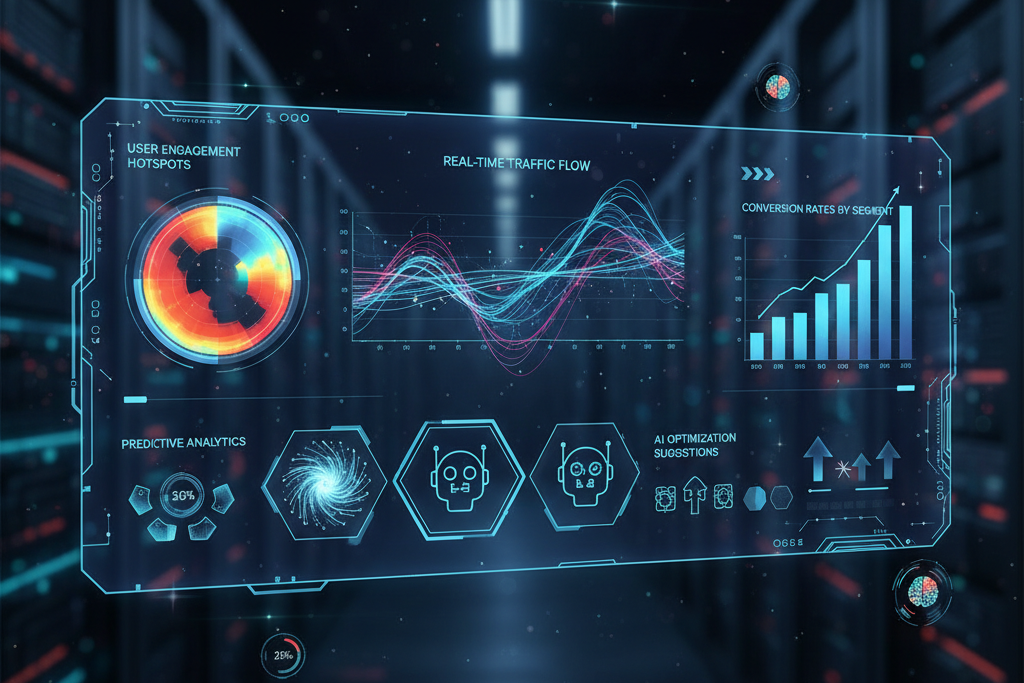
The primary benefit of AI-driven analytics is the ability to make data-driven decisions that truly optimize marketing strategies and user experience (UX). With a clear understanding of what drives conversions, what frustrates users, and which content performs best, businesses can fine-tune their website design, content strategy, and advertising campaigns. This leads to more efficient resource allocation, higher ROI on marketing spend, and a significantly improved user journey, ultimately enhancing overall website performance and achieving business objectives more effectively.
Integrate AI-driven FAQ Bots to Streamline Customer Service
Another powerful application of AI for website enhancement is the integration of AI-driven FAQ bots. While similar to general chatbots, FAQ bots are specifically designed to handle a high volume of common questions, providing instant and accurate answers without requiring human intervention. This specialized focus allows businesses to significantly streamline their customer service operations and improve the user experience by offering immediate access to information.
FAQ bots typically operate by leveraging a comprehensive knowledge base of frequently asked questions and their corresponding answers. When a user inputs a query, the bot uses natural language processing (NLP) to understand the intent behind the question, even if phrased differently from the stored FAQ. It then retrieves the most relevant answer from its database and presents it to the user instantaneously. This process is far more efficient than traditional FAQ pages, which require users to manually search or scroll through lists of questions.
The primary benefit of these bots is their ability to significantly reduce the support workload for human agents. A large percentage of customer service inquiries often consist of repetitive questions that can be easily automated. By handling these common queries, FAQ bots free up human staff to address more complex, nuanced, or critical issues that require empathy and detailed problem-solving. This reallocation of resources optimizes operational efficiency and ensures that human agents can provide higher-value support.
Furthermore, AI FAQ bots dramatically improve the user experience. Visitors to your website can get immediate answers to their questions, eliminating frustrating wait times. This instant gratification is a key driver of satisfaction in the digital age. Whether a user wants to know about shipping policies, product specifications, or service terms, the bot provides consistent and accurate information around the clock, regardless of business hours or geographical location.
The consistent information provided by FAQ bots also minimizes the potential for human error. Unlike human agents, who might occasionally misinterpret a policy or provide slightly varied answers, an AI bot delivers pre-approved, standardized information every time. This consistency builds trust and ensures that all users receive the same high-quality support. Ultimately, integrating an AI-driven FAQ bot transforms basic customer inquiries into a seamless, efficient, and highly satisfactory interaction, contributing positively to your website’s overall performance and brand reputation.
Leverage AI for Automated, SEO-optimized Content Creation
For any website aiming for sustained growth and visibility, content is king. However, consistently producing high-quality, SEO-optimized content can be time-consuming and resource-intensive. This is where AI-powered content creation tools, such as Articfly’s platform, become invaluable. These solutions automate the content generation process, enabling businesses to scale their content efforts, improve search engine rankings, and maintain a consistent output of engaging material.
The AI writing process for platforms like Articfly begins with a topic or a set of keywords. The AI system then analyzes search intent, identifies relevant subtopics, and structures a comprehensive outline. Following this, the AI generates the article draft, drawing upon vast amounts of data to produce coherent, factually precise, and grammatically correct text. This process significantly accelerates content production, turning ideas into ready-to-publish articles in minutes, not hours or days.

A crucial aspect of AI-generated content is its inherent SEO optimization. Articfly’s proprietary AI system is designed to understand and apply SEO best practices from the outset. This includes strategic keyword placement, proper heading structure, readability scores, and internal linking suggestions. By embedding these SEO elements during content creation, the articles are naturally optimized to rank higher in search engine results, driving more organic traffic to your website. This eliminates the need for extensive post-generation SEO auditing, saving valuable time and expertise.
Beyond mere accuracy, advanced AI tools can also adapt to specific brand tones and writing styles. Whether your brand is professional and academic, or casual and conversational, the AI can be trained to produce content that aligns perfectly with your existing brand identity. This ensures consistency across all your published material, strengthening brand recognition and resonance with your target audience.
The benefits of leveraging AI for content creation are substantial. Firstly, it provides immense time savings. What used to take hours of research, drafting, and editing can now be completed in a fraction of the time. Secondly, it helps maintain consistent quality across all articles. AI ensures that every piece of content adheres to predefined standards of accuracy, grammar, and style. Most importantly, AI allows businesses to scale their content efforts dramatically. Whether you need five blog posts a month or fifty, AI platforms make it possible to meet ambitious content schedules without compromising quality or incurring exorbitant costs.

Articfly transforms the way blogs are built—turning ideas into engaging, data-driven articles in minutes.
For startups, agencies, and growing brands, Articfly empowers content teams with automation, making high-quality content production effortless and scalable. It’s an essential tool for any website looking to establish authority, improve SEO, and engage its audience through a continuous stream of fresh, relevant content.
Employ AI to Personalize Website Experience and Content
In today's competitive digital environment, a one-size-fits-all approach to website content and experience is increasingly ineffective. Users expect tailored interactions that anticipate their needs and preferences. This is precisely where AI excels, playing a pivotal role in personalizing website experience and content, leading to heightened engagement, improved retention, and ultimately, higher conversion rates.
AI-driven personalization technologies analyze vast amounts of user data, including browsing history, past purchases, demographic information, geographic location, and real-time behavior. By recognizing patterns and making intelligent predictions, AI systems can dynamically adjust the content, layout, and recommendations presented to each individual user. This creates a highly relevant and engaging experience that feels uniquely crafted for them.
Consider several examples of AI in action for personalization. Dynamic content refers to elements on a webpage that change based on user characteristics. For instance, a returning visitor might see a different hero image or promotional banner based on their previous browsing behavior or items in their cart. Product recommendation engines, famously used by e-commerce giants, leverage AI to suggest products that a user is likely to be interested in, significantly increasing average order value and customer satisfaction. Similarly, content recommendation systems on news sites or blogs use AI to present articles and topics that align with a reader's demonstrated interests, keeping them engaged for longer.

Beyond static content, AI can also personalize the entire user journey. From the moment a user lands on your site, AI can adapt the navigation, search results, and call-to-action buttons to guide them more efficiently toward their goals. This might involve reordering search results based on a user's purchase history or highlighting specific service options that match their identified business needs.

The benefits of this level of personalization are clear. It dramatically increases engagement by presenting users with content and products that genuinely interest them, reducing bounce rates and encouraging deeper exploration of the site. Improved retention follows, as users feel understood and valued, fostering loyalty to the brand. Ultimately, personalized experiences drive higher conversion rates, as tailored recommendations and optimized journeys guide users more effectively toward desired actions, whether it's a purchase, a subscription, or a lead submission. Embracing AI for personalization transforms your website from a generic platform into a highly responsive, individualized experience for every visitor.
Implementing AI on your website is no longer a luxury but a fundamental strategy for achieving superior performance in today's digital landscape. From providing instant customer support with AI chatbots and FAQ bots to extracting actionable insights from analytics, scaling SEO-optimized content creation, and delivering deeply personalized user experiences, AI offers a comprehensive suite of tools to elevate your online presence. By adopting these AI tips, businesses can achieve greater efficiency, significant cost savings, and enhanced user satisfaction, ensuring their websites are not just competitive but truly exceptional.
Ready to transform your content strategy with AI? Explore how Articfly’s AI content platform can automate your blog creation, save time, and ensure consistent, high-quality, SEO-optimized articles. Learn more about Articfly today and revolutionize your content production.