Side Hustle to $10K/Month: Scaling Your Blog into a Business
Key Takeaways
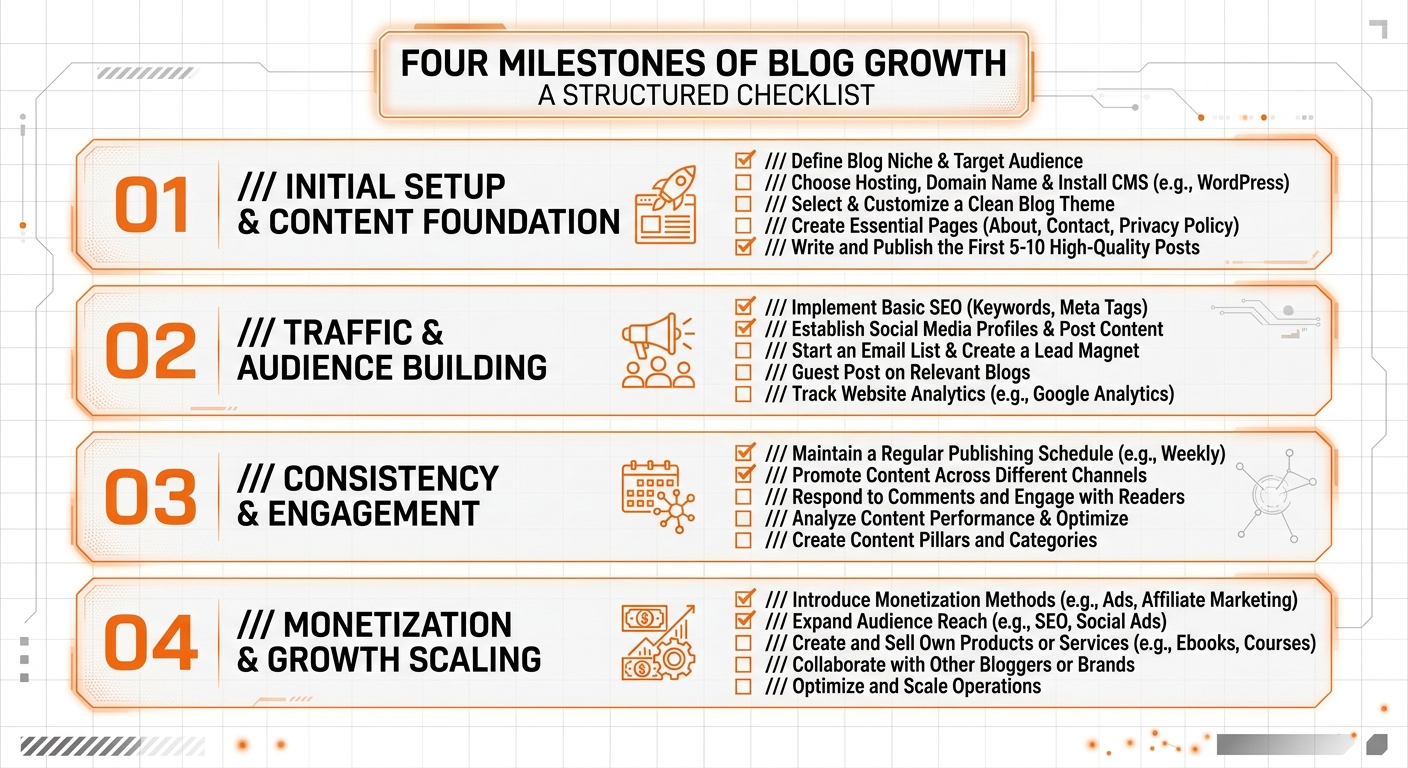
A systematic approach to blogging requires a shift in perspective from being a manual writer to operating as an editor-in-chief who manages a high-output content engine. This 14-month roadmap focuses on moving through specific phases of growth, moving from foundation to aggressive scaling, and finally into revenue diversification to reach the $10,000 per month threshold.
- Months 1-4: Focus on niche validation and establishing a baseline of 50 high-quality articles.
- Months 5-10: Scale production to 30+ articles per month using automation and AI-driven SEO tools.
- Months 11-14: Optimize high-performing posts and stack revenue through ads, affiliates, and digital products.
- The Core Shift: Automate manual tasks like internal linking and content refreshes to prevent burnout and ensure consistent growth.
The Foundation: Identifying a High-Yield Niche
Selecting a business-ready niche is the most critical technical decision in the entire 14-month lifecycle. Not all topics have the commercial depth to support a $10,000 monthly income within a reasonable timeframe. You must look for an intersection where high search volume meets high commercial intent and multiple monetization layers.
A high-yield niche allows you to earn from both display ads and high-commission affiliate programs. For example, a hobbyist blog about "cloud watching" might gain traffic, but it lacks the affiliate products and high CPMs (Cost Per Mille) found in niches like personal finance, B2B software, or specialized home improvement. You are building an asset, not a diary, which means the market's willingness to spend must be your primary filter.
Niche Selection Checklist
- Commercial Intent: Are people searching for "how-to" guides or "best [product] for [problem]"?
- Affiliate Ecosystem: Are there at least 10-15 high-quality products with commissions over $50?
- Display Ad Potential: Does the niche have an average CPM of $20 or higher on major ad networks?
- Topic Depth: Can you reasonably map out 200+ unique article topics without repeating yourself?
- Competition Gap: Can you find long-tail keywords where the current top results are outdated or low-quality?
Once you verify these criteria, your goal is to map your topical authority. This involves grouping your initial keywords into clusters. A cluster-based approach ensures that you aren't just writing random posts, but building a technical network of content that signals expertise to search engines from day one.
Phase 1 (Months 1-4): Building the Content Engine
Establishing a baseline of content is the primary objective during the first four months of operation. This phase is often called the "Sandboxing" period, where you are not only waiting for search engines to index your site but also building your internal workflow. You must move away from the "manual labor" mindset where every paragraph is a struggle and toward a systematized production line.

During this stage, your focus is on quality over pure volume, but with an eye toward future speed. You should aim to publish 30 to 50 "seed" articles. These articles define your brand voice and set the tone for your domain's authority. If you spend four hours manually formatting every post, you will never scale. Instead, define your style guidelines early: your vocabulary, your formatting rules, and your stance on technical topics.
| Process Step | Manual Approach (Solo Blogger) | Engine Approach (Systematized) |
|---|---|---|
| Ideation | Wait for inspiration or basic search. | AI-mapped editorial calendar for 90 days. |
| Drafting | Writing 1,500 words from scratch (6 hours). | AI-generated draft with human-led editing (1 hour). |
| SEO Check | Guessing keywords and meta tags. | Real-time scoring and schema generation. |
| Publishing | Manual copy-paste into WordPress. | Direct sync and schedule via dashboard. |
By the end of Month 4, your site should look like a professional publication. Every post should be optimized for a specific primary keyword and use proper header tags (H2, H3, H4) to ensure crawlability. This structural discipline creates the "hooks" that search engines use to understand your content's relevance.
Phase 2 (Months 5-10): Aggressive Scaling and SEO
Scaling your publication frequency becomes your secondary lever for growth once your initial content starts gaining traction. Between months 5 and 10, you should transition from 10 articles a month to 30 or more. This increase in velocity tells search engines that your site is a fresh, authoritative source of information. However, scaling requires more than just more words; it requires advanced SEO management.
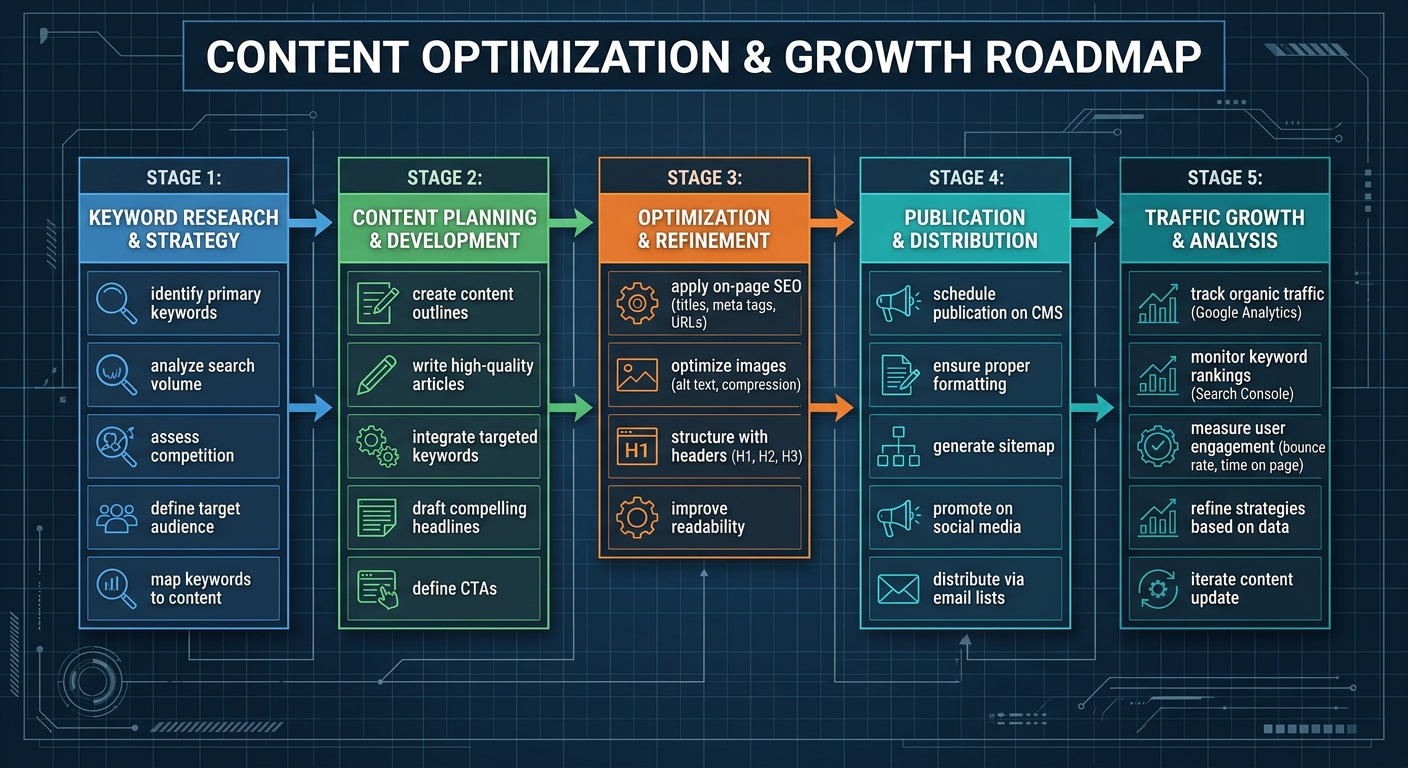
You must implement internal link mapping to connect your new posts back to your "pillar" content. Internal links distribute "link juice" across your site, helping lower-authority pages rank faster. At this stage, you should also begin monitoring for content decay. Even a six-month-old post can start losing rankings if competitors publish more comprehensive or updated information. Use tools to track your performance and refresh aging posts by adding new sections or updated data points.
Content Volume vs. Traffic Expectations
| Month | Total Article Count (Cumulative) | Focus Activity | Traffic Outlook |
|---|---|---|---|
| Month 5 | 60-70 | Internal Link Mapping | First steady clicks appearing |
| Month 7 | 120-140 | Optimization of Top 10 Pages | Noticeable growth in impressions |
| Month 10 | 200+ | Keyword Gap Analysis | Significant organic traffic surge |
Data tracking is essential in this phase. You are no longer guessing what works; you are analyzing which keyword clusters are driving the most impressions. If a specific cluster is performing well, double down on it. If another is lagging, it may require an "article refresh" or a deeper look at the search intent. Consistency is the only way to break through the noise of the mid-tier blogging space.
Phase 3 (Months 11-14): Optimization and Revenue Stacking
Maximizing the revenue per visitor is the final step in reaching the $10,000 monthly goal. Traffic is a vanity metric unless it is properly converted. By Month 11, you should have enough data to know exactly which posts are your "cash cows." You likely have a handful of articles driving 50% of your traffic; these pages need to be optimized for maximum conversion.
Revenue stacking means you aren't relying on a single paycheck. Most $10k/month blogs use a combination of methods. High-traffic informational posts earn through display ads (like Mediavine or Raptive). High-intent "buyer's guides" earn through affiliate commissions. Finally, your own digital products or newsletters can capture "lost" revenue from visitors who aren't ready to buy a recommended product but value your expertise.
Monetization Comparison
- Display Ads: Passive and scale with traffic. Best for "How-to" and "What is" content. Requires high volume (50k+ sessions) for significant returns.
- Affiliate Marketing: High margin per click. Best for "Best [X] for [Y]" or "Product Review" content. Can earn $1,000+ from a single high-converting post.
- Digital Products: Highest margin and total control. Best for solving a specific pain point (e.g., templates, mini-courses, or gated data).
At this stage, your role is more about "Revenue Operations" than content creation. You are tweaking call-to-action buttons, testing different affiliate offers, and ensuring your site speed remains high despite the increased traffic and ad scripts. The $10,000 mark is reached when your diversified streams-perhaps $4k from ads, $4k from affiliates, and $2k from digital sales-all hit their stride simultaneously.
FAQ
Yes, but the barrier to entry has changed. Success in the current landscape requires a systemic approach rather than a hobbyist mindset. You must use modern SEO tools and AI-assisted workflows to compete with established sites. Focusing on high-yield niches and topical authority clusters is the only way to outpace the competition.
How much content do I actually need to publish to see these results?While quality is paramount, volume is the secondary driver of authority. Most blogs reaching $10k/month have at least 200-300 high-quality, optimized articles. This roadmap suggests scaling to this level by Month 10 to allow time for the content to mature in search rankings and start generating revenue through multiple channels.
Can I use AI to write my blog without getting penalized by Google?Google’s guidelines state that they reward high-quality content that demonstrates expertise, experience, authoritativeness, and trustworthiness (E-E-A-T), regardless of how it is produced. Using AI as a content engine is effective as long as you maintain a strong brand voice, verify all factual claims, and ensure the final output provides genuine value to the reader.
What is the most profitable monetization method for a new blog?Affiliate marketing is often the fastest path to significant revenue because it pays per action rather than per thousand views. However, for long-term stability, "stacking" revenue is best. Start with affiliates, add display ads once you hit traffic thresholds, and eventually launch your own digital products to capture the full value of your audience.
Put this into practice
Transforming these insights into results requires immediate action on your foundational workflow. Do not wait for the perfect moment to start; the 14-month clock only begins when you commit to a systematic production schedule.
- Evaluate your current niche for commercial intent and affiliate depth to ensure it can support your income goals.
- Audit your current content production speed and identify where manual bottlenecks are slowing your publication rate.
- Identify one manual task-such as keyword research or internal linking-to automate this week using a dedicated dashboard.
- Map out a 90-day editorial calendar based on keyword clusters to ensure you are building topical authority from day one.
Want the system behind this content?
Join the top 1% of SEOs generating programmatic, high-converting organic traffic completely on auto-pilot.
DEPLOY ARTICFLYMore Articles
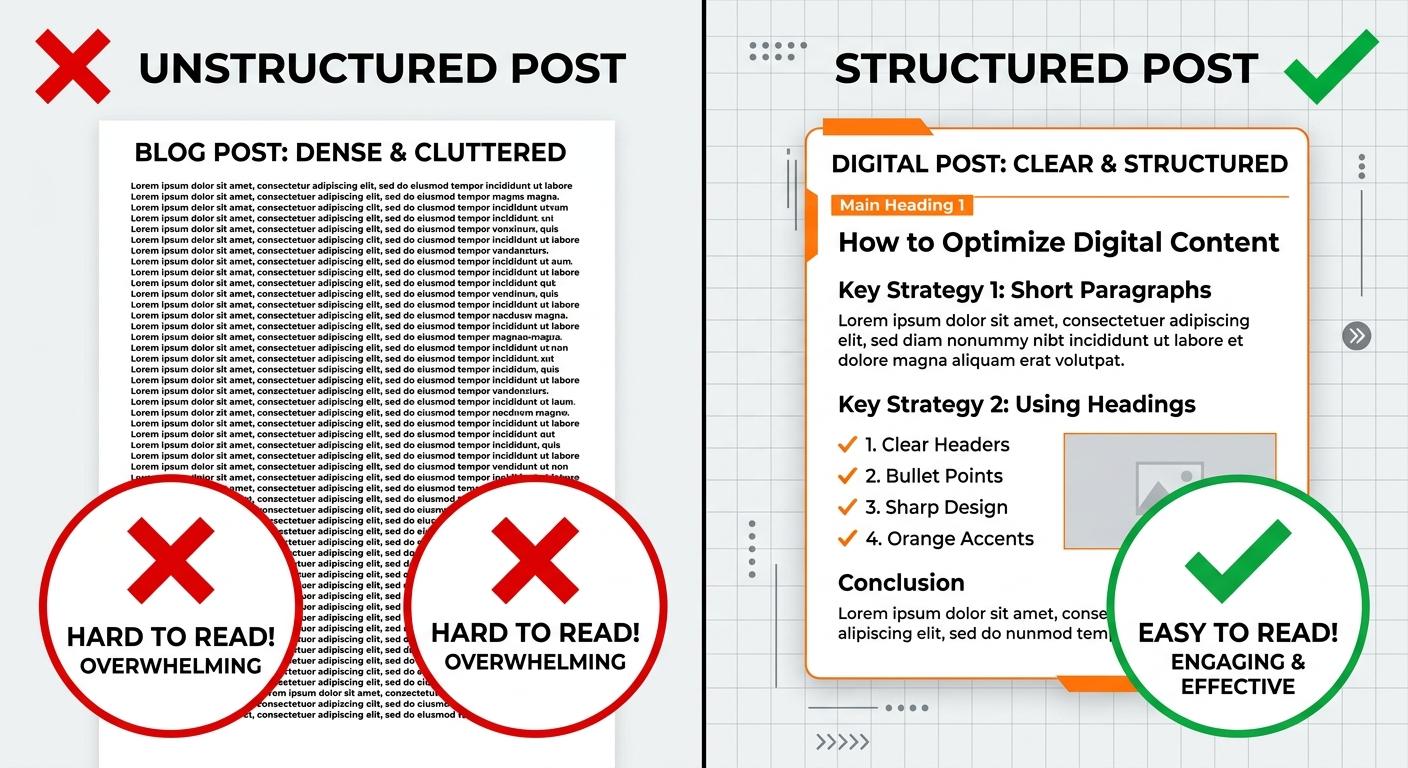
Why People Stop Reading Your Blog Post After 30 Seconds (and How to Fix It)
Most readers decide to stay or leave a blog post within the first 30 seconds. If your bounce rates are high, it's likely due to structural friction, poor hooks, or a lack of immediate value. Learn how to diagnose engagement killers and use AI-driven optimization to keep readers scrolling.
READ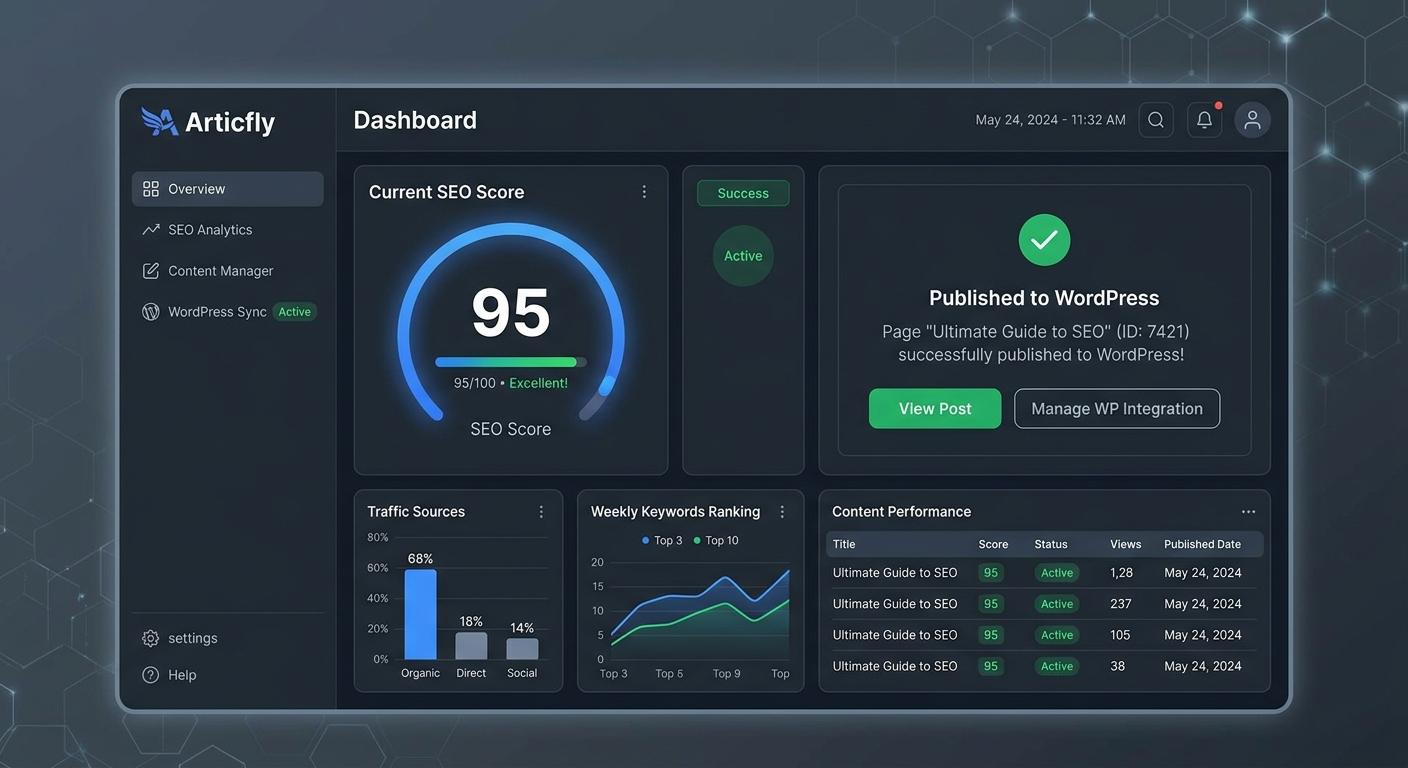
The $15 Blog Post That Brings in $2,000/Month: How AI Content Delivers 130x ROI
Discover the unit economics of high-scale AI publishing. Learn how to leverage Articfly to produce $15 blog posts that generate $2,000 in monthly recurring revenue through SEO optimization, automated publishing, and strategic content refreshing.
READ
Brand Voice in AI Content: How to Stop Your Blog from Sounding Like a Robot
Generic AI content is killing brand authority. Learn how to use Articfly’s Brand Voice Analyzer and Advanced Mode to produce high-scale, SEO-optimized content that sounds like your team, not a machine.
READ