
TL;DR: A content audit systematically reviews and optimizes existing content to boost SEO. This guide provides a 6-step framework, covering inventory, performance analysis, decay identification, action planning, implementation, and monitoring. Leveraging tools and AI can streamline the process, transforming underperforming assets into powerful organic traffic drivers and ensuring your content strategy remains effective and competitive.
Introduction
In the dynamic landscape of digital marketing, content is king, but even the mightiest monarchs can lose their luster over time. Did you know that a significant portion of content published just two years ago experiences a 70% drop in organic traffic? This phenomenon, known as content decay, poses a substantial threat to your search engine optimization (SEO) efforts and overall online visibility. Without a proactive approach, even high-quality articles can become outdated, lose relevance, and cease to attract valuable organic traffic.
A content audit is a systematic process of evaluating all existing content on your website to identify strengths, weaknesses, and opportunities for improvement. It's not merely a cleanup operation; it's a strategic imperative for modern SEO. By meticulously reviewing your content assets, you can pinpoint underperforming pages, update stale information, and realign your content with current search intent and algorithmic preferences. This leads to profound SEO improvement, driving more relevant visitors to your site.
This comprehensive guide will walk you through a proven 6-step content audit framework, designed to help you uncover quick SEO wins and solidify your long-term content strategy. By committing to this systematic review, you'll transform dormant assets into powerful traffic generators, ensuring your investment in content continues to yield maximum returns. Prepare to unlock the hidden potential within your existing content library and secure a competitive edge in search rankings.
Why Content Audits Deliver Quick SEO Wins
A content audit isn't just about spring cleaning your website; it's a potent strategy for achieving rapid and measurable SEO improvements. By systematically reviewing your content, you gain clarity on what's working, what's not, and where the most impactful opportunities lie. This focused approach allows you to identify low-hanging fruit—content pieces that require minimal effort to update but can deliver significant boosts in SEO benefits and organic visibility.

One of the primary benefits is addressing content decay. As search algorithms evolve and information ages, even once top-performing articles can slide down rankings. An audit helps you identify these declining assets and implement targeted refreshes, restoring their authority and relevance. This directly aligns with Google's ranking factors, which increasingly favor fresh, comprehensive, and accurate content.
A strategic content audit is not just a cleanup; it's a precision strike to re-energize your SEO and unlock dormant organic traffic potential.
Beyond decay, audits significantly improve user engagement. By ensuring your content is up-to-date, relevant, and well-structured, you enhance the user experience (UX), leading to lower bounce rates and longer dwell times—positive signals that Google interprets as content quality. Moreover, regularly updated content satisfies Google's preference for content freshness, often resulting in quicker indexing and improved rankings for competitive keywords.
Consider these compelling statistics on content audit ROI:
- Websites that consistently update old blog posts can see organic traffic increase by as much as 111% within a year.
- One study found that refreshing just 10% of a site's content library resulted in a 25% average increase in organic traffic to those pages.
- Fixing broken links and consolidating thin content can lead to a 15-20% improvement in crawl budget efficiency, allowing search engines to index more of your valuable pages.
- Optimizing existing content is often 3-5 times more cost-effective than creating new content, offering a faster path to increased ROI.
The 6-Step Content Audit Framework
To ensure a comprehensive and effective content audit, a structured approach is essential. This 6-step framework provides a systematic pathway from initial data collection to ongoing performance monitoring, maximizing your SEO optimization efforts. Each step builds logically on the previous one, creating a robust process that uncovers opportunities and guides actionable decisions.
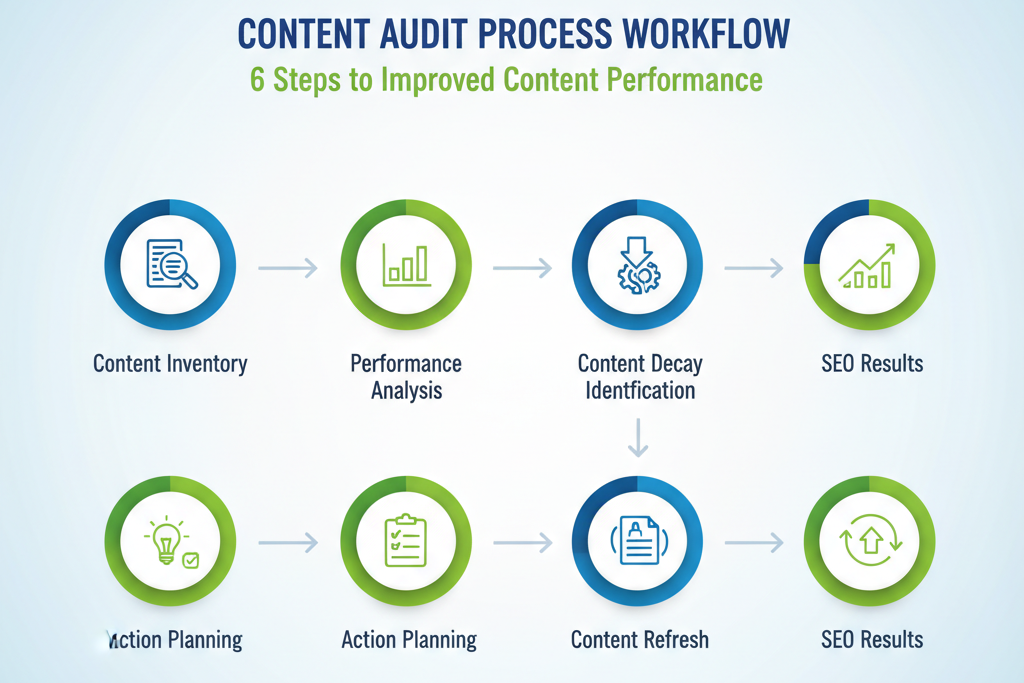
The framework begins with a complete content audit framework, ensuring you have a full understanding of your digital assets. This foundational step is critical for accurate analysis. Following inventory, you move into performance analysis, where data from various sources is consolidated to assess the impact and reach of each content piece. Identifying content decay patterns is the next crucial phase, as it pinpoints areas requiring immediate attention due to declining performance or outdated information.
With a clear understanding of decay, the framework progresses to action planning. This is where strategic decisions are made about whether to update, refresh, consolidate, or remove content. The subsequent step, content refresh implementation, involves executing these decisions with specific techniques aimed at improving SEO value and user experience. Finally, the framework concludes with continuous monitoring and improvement, recognizing that SEO is an ongoing process requiring regular assessment and adaptation.
This systematic approach ensures that no content piece is overlooked and that every action taken is data-driven and aligned with your overall SEO objectives. By adhering to this framework, you transform what could be an overwhelming task into a manageable and highly impactful project, ultimately leading to significant and sustainable gains in your organic search presence.
Step 1 - Complete Content Inventory
The foundational step in any successful content audit is to create a complete and accurate content inventory. This involves gathering every piece of content published on your website into a single, comprehensive list. Without a full understanding of your assets, any subsequent analysis will be incomplete and potentially misleading. The goal is to build a master content catalog that serves as your central reference point.
Tools for Content Inventory:
- Screaming Frog SEO Spider: This desktop tool crawls your website and extracts crucial data such as all URLs, page titles, meta descriptions, headings, image alt text, and internal/external links. It's invaluable for discovering pages you might not even know exist.
- Google Analytics: Export a list of all pages that have received traffic over a specific period (e.g., the last 12-24 months). Navigate to Behavior > Site Content > All Pages. This ensures you capture content that has been actively visited.
- Google Search Console: Export data from the "Pages" report under the "Performance" section. This will provide a list of pages that have appeared in search results, along with their impressions and clicks.
- CMS Exports: If you use a Content Management System (CMS) like WordPress, HubSpot, or Shopify, you can often export a list of all published posts and pages directly from the backend. This can provide additional data like author, categories, and tags.
- Sitemap XML: Your website's XML sitemap lists all pages you want search engines to crawl and index. This is a good fallback for ensuring no important pages are missed.
Essential Data Collection Points:
Once you have a list of URLs, the next critical phase is data collection. For each URL, populate a spreadsheet with the following key attributes:
- URL: The full and canonical URL of the page. This is the primary identifier.
- Page Title: The H1 heading or the main title of the content.
- Meta Description: The short summary displayed in search results.
- Publish Date / Last Updated Date: Crucial for identifying content decay.
- Word Count: Helps assess content depth and identify thin content.
- Content Type: (Blog Post, Product Page, Service Page, Landing Page, Guide, etc.)
- Author: Who created the content.
- Category/Tags: Helps with content organization and topic clustering.
- Primary Keyword: The main keyword the page is optimized for.
- Internal Links: Count of internal links pointing to and from the page.
- External Links: Count of external links on the page.
- Google Analytics Data (to be added in Step 2): Organic Sessions, Bounce Rate, Avg. Time on Page.
- Google Search Console Data (to be added in Step 2): Impressions, Clicks, Average Position.
Spreadsheet Template Recommendations:
While you can create your own, using a structured spreadsheet is vital. Google Sheets or Excel are ideal. Create separate columns for each data point listed above. A good practice is to create tabs for different content types (e.g., "Blog Posts," "Landing Pages") within the same spreadsheet, or simply consolidate everything into one master sheet for easier URL mapping and analysis.
This meticulous content inventory forms the bedrock of your content audit. It provides a clear, data-rich overview of your entire content ecosystem, paving the way for informed strategic decisions in the subsequent steps.
Step 2 - Performance Analysis & Metrics
With your comprehensive content inventory in hand, the next critical step is to analyze the performance of each content piece. This involves delving into key performance metrics to understand how your content is contributing to your overall SEO goals. This phase is data-driven, providing the evidence needed to make informed decisions about your content strategy.
Leveraging Google Analytics Metrics:
Google Analytics (GA) is indispensable for understanding user behavior and content engagement. Focus on these metrics for each URL in your inventory:
- Organic Sessions/Pageviews: This metric directly indicates how much organic traffic a specific page is receiving. A significant decline over time signals content decay.
- Bounce Rate: A high bounce rate (e.g., above 70-80% for informational content) can suggest that users aren't finding what they're looking for, or the content isn't engaging enough.
- Average Time on Page: Longer times on page generally indicate higher user engagement and satisfaction. Low times might suggest content is not valuable or difficult to consume.
- Conversions (Goals/Events): If applicable, track how specific content contributes to micro or macro conversions (e.g., newsletter sign-ups, demo requests, product purchases). This is crucial for evaluating content ROI.
To access this data, navigate to 'Behavior' > 'Site Content' > 'All Pages' in Google Analytics. Filter by 'Organic Search' as a segment to focus solely on organic performance. Export this data and map it to your content inventory spreadsheet using URLs as the key identifier.
Google Search Console Data:
Google Search Console (GSC) provides direct insights into how your content performs in Google Search. Key metrics to export and analyze include:
- Impressions: How many times your page appeared in search results for specific queries.
- Clicks: How many times users clicked on your page from search results.
- Average Position: Your page's average ranking for its queries. A high impression count with low clicks or a declining average position can indicate issues with title tags, meta descriptions, or search intent misalignment.
- Queries: The actual search terms users typed to find your content. This helps understand evolving search intent.
Go to 'Performance' > 'Pages' in GSC, select a timeframe, and export the data. Match this data to your inventory.
Data is the compass of a content audit. Without precise performance metrics, your decisions are merely guesses in the dark.
Social Shares and Engagement Rates:
While not a direct ranking factor, strong social signals can indicate content appeal and reach. Tools like Ahrefs, SEMrush, or BuzzSumo can provide insights into how often your content is shared on social media platforms. High share counts suggest content resonance and potential for broader distribution, influencing indirect SEO benefits.
Benchmarks for Identifying Underperforming Content:
Identifying "underperforming" content requires setting benchmarks relative to your industry, website, and content goals. However, some general indicators include:
- Declining Organic Traffic: A consistent downward trend in organic sessions over a 6-12 month period, especially for historically strong pages.
- High Bounce Rate / Low Time on Page: For informational content, a bounce rate above 75% and an average time on page below 1-2 minutes often signals poor engagement.
- Low Impressions / Clicks (GSC): Pages receiving minimal impressions or clicks over an extended period, particularly if they target important keywords.
- High Average Position with Low Clicks: Ranking on the first page (e.g., avg. position 1-5) but getting very few clicks indicates issues with your title tag or meta description's click-through appeal.
- No Conversions: For content intended to drive business outcomes, a complete lack of conversions despite decent traffic is a red flag.
- Outdated Information: Content discussing topics that have evolved significantly, rendering its information obsolete or less useful.
By meticulously conducting this traffic analysis and evaluating against these engagement rates, you can accurately categorize your content for the next phase of the audit, setting the stage for strategic action.
Step 3 - Identify Content Decay Patterns
Once you have a comprehensive inventory and have analyzed performance metrics, the next crucial step is to identify patterns of content decay. Content decay refers to the natural decline in a page's organic search performance over time, typically marked by decreasing traffic, lower rankings, and reduced engagement. Recognizing these patterns early allows for timely intervention, preserving your SEO equity.
Spotting Declining Traffic Trends:
The most straightforward indicator of content decay is a consistent decline in organic traffic to a specific page or cluster of pages. In Google Analytics, set your date range to compare performance over different periods (e.g., year-over-year, or the last 6 months vs. the preceding 6 months). Look for pages that once performed well but are now showing a downward trend in organic sessions. A significant drop (e.g., 20% or more) for an outdated content piece is a strong signal for review.
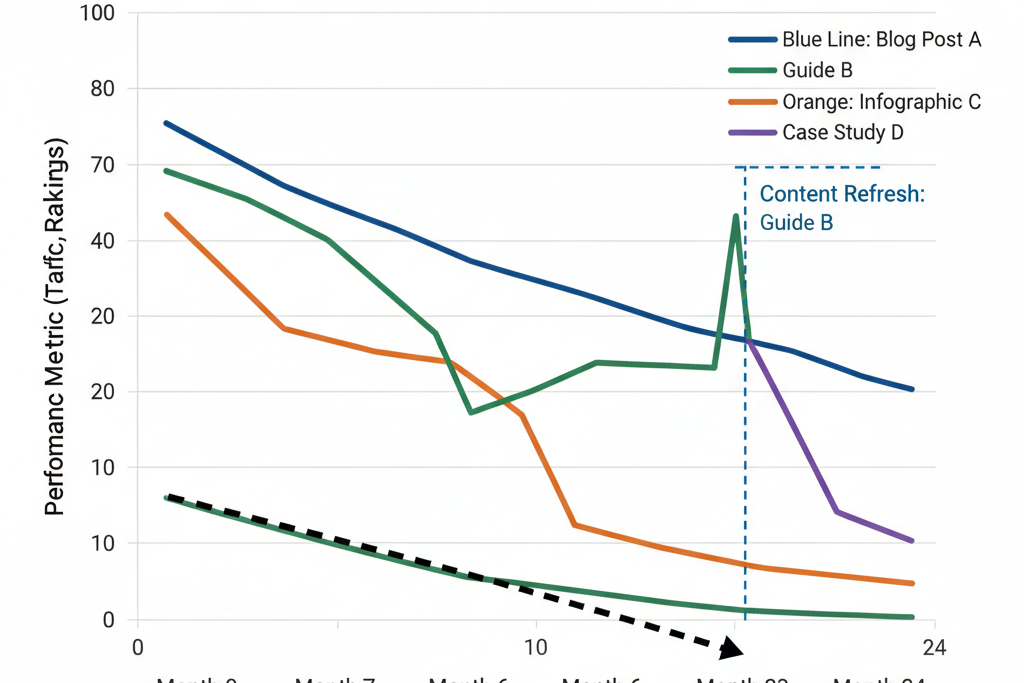
Alongside organic sessions, also observe declining impressions and average position in Google Search Console. If a page's average ranking is consistently slipping from page one to page two or beyond, it signifies a loss of search engine authority for its target keywords. These performance decline trends are visual cues that your content is losing its competitive edge.
Outdated Information and Accuracy:
Content decays not only in traffic but also in relevance and accuracy. Information-based articles, especially those referencing statistics, tools, or best practices, can quickly become stale. Ask yourself:
- Are the statistics still current? (e.g., "50 SEO Statistics for 2019" is clearly outdated).
- Are the tools or software mentioned still relevant or even in existence?
- Have industry best practices or regulations changed since publication?
- Are there newer, more comprehensive resources available on the same topic?
Content that is factually incorrect or significantly out of date can harm your credibility and lead to higher bounce rates as users quickly realize the information is no longer useful.
Changing Search Intent and User Needs:
Search intent evolves constantly. What users sought when an article was first published might differ significantly from what they search for today. For example, a "Beginner's Guide to Social Media" from 2015 would be vastly different from one needed today due to platform changes (e.g., TikTok's rise) and evolving strategies. A search intent shift can cause your content to rank for less relevant queries or lose rankings for its original target keywords.
Analyze the queries your decaying pages rank for in Google Search Console. If the queries are no longer perfectly aligned with the content's current message, it's a strong indicator that the content needs to be refreshed to meet contemporary user needs.
Specific Examples of Content That Typically Decays:
- "How-to" Guides and Tutorials: Often tied to specific software versions, platforms, or step-by-step processes that change.
- Statistical Articles: Lists of facts, figures, and research findings that lose relevance as new data emerges.
- Review Articles: Products, services, or tools that evolve, are discontinued, or are surpassed by competitors.
- Trend Reports and Predictions: Inherently time-sensitive content that becomes obsolete once the trend passes.
- Seasonal Content: Articles tied to specific events or holidays that lose relevance post-event.
- Legal or Compliance Content: Information that changes with new laws or regulations.
By systematically reviewing these indicators, you can accurately pinpoint which content pieces are succumbing to decay and prioritize them for the next stage of your content audit: action planning.
Step 4 - Action Planning: Update, Refresh, or Remove
With a clear understanding of which content pieces are underperforming or decaying, the next crucial step is to develop a strategic action plan. This involves making informed decisions for each piece of content in your inventory: should it be updated, refreshed, consolidated, or removed entirely? This strategic phase transforms your data analysis into a concrete content strategy for optimization.
Decision-Making Process and Criteria:
Categorize each piece of content based on its performance metrics, relevance, and potential for improvement. Use the following criteria to guide your update decisions:
- Update: (High-Value, Slight Decay, Outdated Information)
- When to Update: Content that is generally performing well or has strong backlink profiles, but contains outdated statistics, examples, or minor inaccuracies. It still aligns with current search intent but needs a factual refresh.
- Action: Add new information, recent statistics, updated examples, or integrate new research. Improve factual accuracy.
- Goal: Maintain and enhance relevance, authority, and freshness without overhauling the core message.
- Refresh/Optimize: (Moderate Value, Moderate Decay, Opportunity for Better Keywords/Structure)
- When to Refresh: Content that has seen a moderate decline in traffic or rankings, but still addresses a relevant topic. It might be missing key subtopics, using suboptimal keywords, or have poor readability.
- Action: Expand content depth, optimize for new or secondary keywords, improve readability (headings, paragraphs, media), enhance internal linking, and add new sections to address evolving search intent.
- Goal: Boost organic visibility, improve user engagement, and capture a wider range of related search queries.
- Consolidate/Merge: (Low Value, Duplicate Topics, Thin Content)
- When to Consolidate: You have multiple pieces of content addressing very similar topics, resulting in keyword cannibalization (competing against yourself). Or, you have several "thin content" pages with low word counts and minimal value.
- Action: Choose the best-performing page to keep, then merge relevant, unique content from the weaker pages into the chosen one. Implement 301 redirects from the deleted pages to the consolidated master page to preserve link equity.
- Goal: Create one comprehensive, authoritative resource, eliminate cannibalization, and strengthen search signals.
- Remove/Delete: (No Value, Irrelevant, Low Quality, No Organic Traffic)
- When to Remove: Content that is completely irrelevant to your current business goals, severely outdated with no potential for update, duplicate, or consistently receives zero organic traffic and has no discernible value (e.g., no backlinks, no internal links).
- Action: Delete the page and implement a 301 redirect to a relevant, existing page (e.g., a category page, a more general related article, or your homepage if no direct alternative exists). If truly no relevant page, allow it to 404 naturally (but monitor for crawl errors).
- Goal: Enhance site quality, improve crawl budget efficiency, and remove potential ranking penalties from low-value content. This is also known as content pruning.
Setting Optimization Priorities:
With your content categorized, prioritize actions based on potential SEO impact and effort required:
- High Impact, Low Effort: Quick fixes that can yield immediate results (e.g., updating a few stats on a high-traffic page, fixing broken internal links).
- High Impact, High Effort: Comprehensive refreshes or consolidations for strategically important pages with significant decay.
- Low Impact, Low Effort: Deleting truly irrelevant or thin content that offers no value.
- Low Impact, High Effort: These should be deprioritized unless critical for compliance or brand integrity.
This action planning phase transforms your audit findings into a actionable roadmap, ensuring that your efforts are focused on the content that will deliver the most significant return on investment.
Step 5 - Content Refresh Implementation
Once you've identified which pieces of content to refresh or update, the next step is the actual implementation. This phase is about strategically enhancing your content to improve its SEO value, user experience, and overall performance. The goal is to breathe new life into existing assets without necessarily starting from scratch, focusing on targeted optimization techniques.
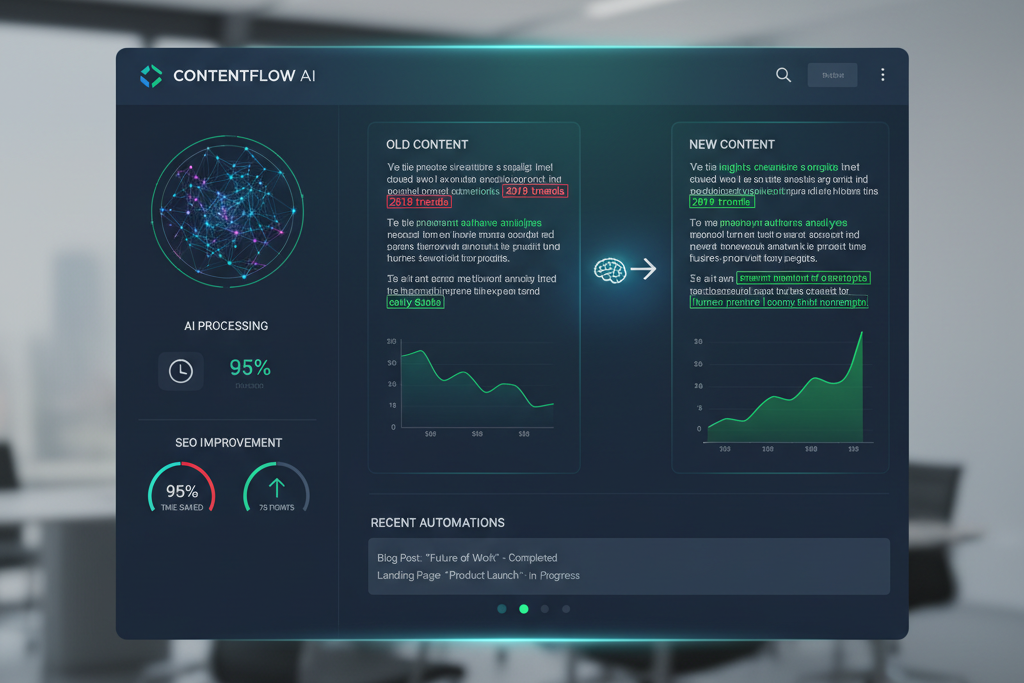
Specific Techniques for Updating Content:
- Add New Statistics and Data: Replace outdated figures with the latest industry statistics, research findings, and reports. Always link to credible sources. This boosts factual accuracy and authority.
- Update Examples and Case Studies: Ensure all examples, tools, or products mentioned are current and relevant. Replace deprecated software mentions with contemporary alternatives. Add new, compelling case studies if appropriate.
- Improve Content Structure and Readability:
- Break up long paragraphs into shorter, more digestible ones.
- Use more headings (H2s, H3s) to create a clear hierarchy and make the content scannable.
- Incorporate bullet points and numbered lists to present information clearly.
- Add a Table of Contents for longer articles to improve navigation.
- Optimize for Featured Snippets: Restructure sections to answer common questions directly and concisely, using clear headings (e.g., "What is X?", "How to do Y?"). This increases your chances of securing a featured snippet in search results.
- Expand Content Depth and Comprehensiveness: Identify gaps in your content. What related questions might users have that your article doesn't currently answer? Add new sections, subtopics, or FAQs to make the article more comprehensive and authoritative.
- Enhance Visuals: Update screenshots, infographics, charts, and videos. Ensure images are high-quality, relevant, and properly optimized with descriptive alt text. New visuals can significantly improve engagement.
- Improve Internal and External Linking:
- Internal Links: Add new internal links to relevant, more recent content on your site. Update existing internal links to point to the most authoritative versions of pages.
- External Links: Verify that all external links are still working and point to credible, live resources. Replace broken or outdated external links.
- Optimize Title Tags and Meta Descriptions: Re-evaluate your title tags and meta descriptions for click-through appeal and keyword targeting, especially if average position is good but clicks are low. Ensure they accurately reflect the refreshed content.
- Review Keywords and Search Intent: Use tools like Google Search Console to identify new, relevant keywords the page is already ranking for, or could rank for. Integrate these naturally into the refreshed content. Ensure the content refresh fully addresses current search intent.
Best Practices for Maintaining SEO Value While Refreshing:
- Keep the URL the Same: Unless absolutely necessary (e.g., merging pages), avoid changing the URL. If a URL change is unavoidable, implement a 301 redirect from the old URL to the new one immediately.
- Don't Delete Existing Valuable Content: Integrate or expand upon existing well-written sections rather than deleting them, especially if they contain valuable keywords or phrases.
- Update Publish Date: For significant refreshes, update the 'last modified' or 'published' date on the page. This signals freshness to search engines and users.
- Resubmit to Google: After a major refresh, use Google Search Console's URL Inspection Tool to request re-indexing for the updated page. This prompts Google to recrawl and re-evaluate your content faster.
By carefully applying these content improvement techniques, you can transform underperforming content into high-ranking, engaging assets that consistently drive organic traffic and conversions.
Step 6 - Monitor Results & Continuous Improvement
A content audit is not a one-time event; it's an ongoing process of refinement and optimization. The final, yet perpetually looping, step in the framework is to rigorously monitor the results of your content updates and establish a system for continuous improvement. This ensures that your efforts translate into tangible SEO gains and that your content assets remain high-performing over time.
Tracking the Impact of Content Updates:
Immediately after implementing content refreshes or consolidations, it's crucial to set up robust performance tracking. Focus on the same metrics you used during your initial analysis, specifically for the pages you updated:
- Organic Traffic (Google Analytics): Monitor organic sessions and pageviews for the updated pages. Look for upward trends in the weeks and months following the refresh.
- Keyword Rankings (Google Search Console / SEO Tools): Track the average position for target keywords. Pay attention to improvements in ranking for primary and secondary keywords.
- Impressions and Clicks (Google Search Console): An increase in impressions and clicks indicates that Google is recognizing the updated content as more relevant for search queries.
- Engagement Metrics (Google Analytics): Observe changes in bounce rate, average time on page, and conversion rates. Improvements here signal better user experience and content quality.
- Internal Link Equity: If you consolidated content, verify that 301 redirects are properly implemented and that link equity is flowing to the new, authoritative page.
Create a dedicated dashboard or report in Google Analytics and Search Console specifically for your updated content. Compare pre- and post-update performance over 30, 60, and 90-day windows to identify trends and measure ROI.
Establishing Monitoring Systems and Regular Audit Schedules:
To embed continuous improvement into your content strategy, establish a routine:
- Monthly Check-ins: Review a subset of your most critical content pieces monthly. Look for any sudden dips in performance or new content decay indicators.
- Quarterly Review: Conduct a lighter, targeted audit quarterly. Focus on specific content types (e.g., all "how-to" guides) or content clusters that address critical business topics.
- Annual Full Audit: Plan a comprehensive content audit, mirroring the 6-step framework, at least once a year. This ensures every piece of content is re-evaluated against current SEO standards and business objectives.
Automate alerts for crucial metrics (e.g., significant drop in organic traffic to a high-value page) using custom alerts in Google Analytics or specialized SEO tools.
Emphasizing the Importance of Ongoing Content Maintenance:
Content maintenance is not an optional extra; it is a fundamental component of sustained SEO success. Just as a garden requires regular weeding and watering, your content library needs continuous care to flourish. Neglecting maintenance after an audit will inevitably lead to a return of content decay, undermining all your hard work.
By integrating these monitoring and maintenance practices into your workflow, you create a self-sustaining cycle of optimization. This proactive approach ensures that your content remains fresh, relevant, and highly visible in search results, consistently driving organic growth for your brand. It's the key to transforming content auditing from a reactive fix into a powerful, strategic asset.
Leveraging AI for Efficient Content Audits
The scale and complexity of content audits can be daunting, especially for websites with hundreds or thousands of pages. This is where artificial intelligence (AI) becomes an invaluable ally, transforming a time-consuming, manual process into a streamlined and highly efficient operation. AI-powered tools can significantly reduce the effort required for regular content audits, making a continuous improvement cycle far more achievable.
Articfly AI, for instance, offers a powerful solution for scaling various aspects of AI content tools, including those that aid in content audits. Imagine automating the initial data collection for your content inventory. AI can rapidly crawl your site, extract URLs, titles, meta descriptions, and even estimate word counts, feeding directly into your audit spreadsheet. This dramatically cuts down on the manual labor of Step 1.
Beyond inventory, AI can excel at identifying decay patterns. By integrating with analytics platforms, AI algorithms can analyze historical traffic and ranking data to flag pages showing significant decline. They can even cross-reference content publication dates with major algorithm updates or industry shifts, providing intelligent insights into *why* content might be decaying. This automation provides a significant boost to audit efficiency, allowing human auditors to focus on strategic analysis rather than data crunching.
Furthermore, advanced AI systems can even suggest targeted updates. By analyzing current search results for your target keywords, AI can identify missing topics, suggest new angles, or recommend specific phrases to incorporate for better alignment with evolving search intent. For example, if a page is performing poorly, Articfly AI could suggest specific sections to expand or keywords to re-optimize, based on real-time competitor analysis and search trends. This moves beyond mere identification to proactive solutioning, making content optimization faster and more precise.
Leveraging AI for your content audits transforms them into a more scalable content strategy. Instead of a cumbersome annual project, audits can become a more regular, data-driven practice. This ensures your content library remains fresh, relevant, and highly optimized, consistently driving organic growth with significantly less manual effort. Articfly AI empowers content teams to maintain high-quality, high-performing content effortlessly, turning ideas into engaging, data-driven articles and providing the analytical backbone for continuous content excellence.
Common Content Audit Mistakes to Avoid
While content audits are incredibly beneficial, they can also be complex. Numerous pitfalls can derail your efforts and lead to inaccurate conclusions or wasted time. Being aware of these common audit pitfalls allows you to sidestep them, ensuring a more effective and impactful audit.
- Inconsistent Metrics & Data Collection:
- Mistake: Using different date ranges for Google Analytics and Search Console, or relying on incomplete data.
- Solution: Standardize your data collection period (e.g., always 12 months year-over-year) and ensure all relevant data points from Step 1 and 2 are systematically recorded in your master spreadsheet.
- Ignoring User Intent & Changing Search Queries:
- Mistake: Solely focusing on keyword rankings without considering if the content still matches what users are truly looking for.
- Solution: Regularly review Google Search Console's "Queries" report for each page. Analyze emerging long-tail queries and shifts in primary intent to ensure your content provides the most relevant answers.
- Over-Optimizing or Keyword Stuffing:
- Mistake: In an attempt to refresh, stuffing keywords or making content sound unnatural.
- Solution: Focus on natural language, user value, and comprehensiveness. Integrate keywords naturally within the context. Prioritize solving user problems over chasing keyword density.
- Not Tracking Results Post-Audit:
- Mistake: Implementing changes but failing to monitor their impact, leaving you uncertain if efforts were successful.
- Solution: Establish clear KPIs and track changes in organic traffic, rankings, and engagement for all updated pages for at least 3-6 months post-implementation. This is crucial for verifying the success of your optimization errors.
- Fear of Deleting or Consolidating Content:
- Mistake: Hesitating to remove or merge low-performing, irrelevant, or duplicate content, fearing a loss of traffic.
- Solution: Trust your data. Removing or consolidating truly low-value content (with proper 301 redirects) can significantly improve site quality and crawl budget, ultimately boosting the performance of your valuable pages.
- Conducting Audits Infrequently (or Never):
- Mistake: Treating a content audit as a one-off task rather than an ongoing process.
- Solution: Integrate content auditing into your regular content calendar. Schedule quarterly reviews and annual comprehensive audits to ensure continuous relevance and performance.
By avoiding these common best practices, you can ensure your content audit efforts are efficient, accurate, and ultimately more effective in driving substantial SEO improvements for your website.
Maximizing Content Performance Through Strategic Audits
A content audit is more than just a task; it's a strategic imperative for any brand aiming for sustainable online growth. The systematic 6-step framework outlined—from complete inventory and performance analysis to decay identification, action planning, implementation, and continuous monitoring—provides a clear, actionable roadmap to transform your content library. By addressing content decay, improving user experience, and aligning with evolving search intent, you unlock significant SEO improvements that drive organic traffic and conversions.
Remember that the digital landscape is constantly changing, meaning your content strategy must also be dynamic. Embrace the power of ongoing SEO maintenance. Tools, especially AI-powered solutions like Articfly AI, can streamline this process, making regular audits and optimizations more efficient and scalable. Don't let your valuable content assets languish; give them the attention they deserve.
Next Steps: Begin by taking the first step—inventorying your content. Select a small segment of your site and apply the audit framework. Start identifying those low-hanging fruit and implement your first set of refreshes. Your path to enhanced organic visibility begins now. Continuously improve, continuously monitor, and watch your content climb the search rankings.