
TL;DR: Traditional SEO is evolving. Content clusters and pillar pages offer a strategic framework to build topical authority, improve search rankings, and drive organic traffic by organizing related content around a central, comprehensive pillar topic. This guide provides a step-by-step approach to identify pillar topics, create supporting cluster content, implement robust internal linking, and measure success, ultimately enabling businesses to dominate search results and scale content production efficiently.
Table of Contents
- Understanding Content Clusters and Pillar Pages
- The SEO Benefits: Why Content Clusters Dominate Search Rankings
- Choosing Your Pillar Topics: The Foundation of Your Strategy
- Creating Supporting Cluster Content: The Building Blocks
- Mastering Internal Linking: The Glue That Holds It All Together
- Implementation Roadmap: Building Your First Content Cluster
- Measuring Success: Tracking Your Content Cluster Performance
Understanding Content Clusters and Pillar Pages
The landscape of search engine optimization is in constant flux. Gone are the days when a singular, keyword-stuffed blog post could guarantee a top spot on the SERP. Modern SEO demands a more sophisticated approach: one centered on demonstrating comprehensive topical authority. This evolution has given rise to the powerful SEO strategy known as content clusters and pillar pages.
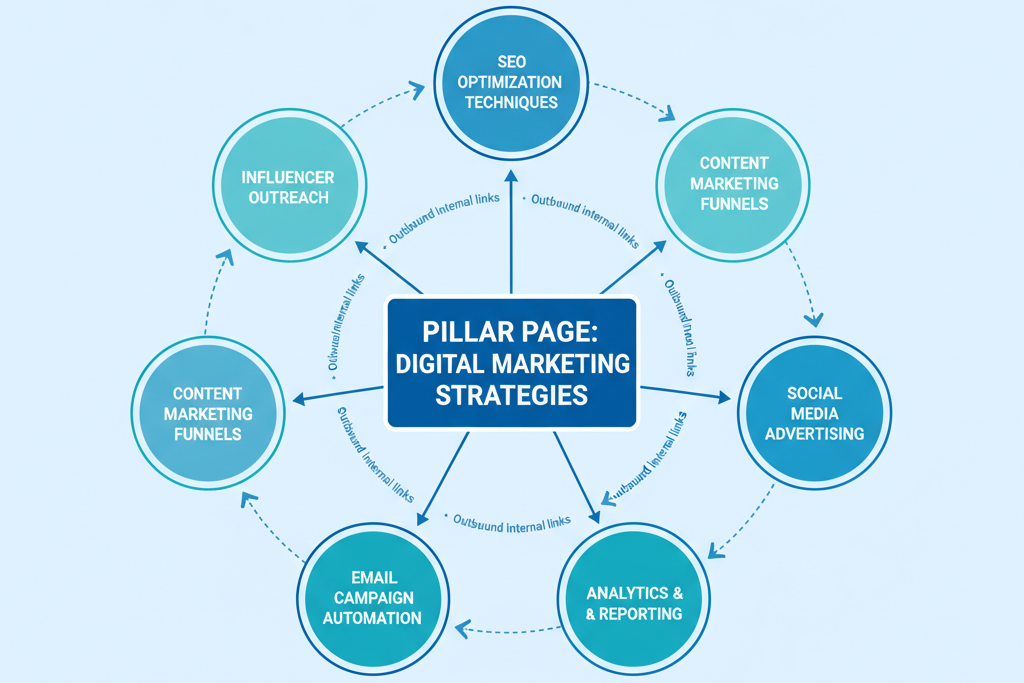
At its core, a content cluster is a group of interconnected content pieces that extensively cover a broad subject area. The central component of this strategy is the pillar page. A pillar page acts as a comprehensive, high-level overview of a core topic, addressing the fundamental aspects of a subject. It is typically long-form, offers broad information, and links out to several related, more specific articles.
These specific articles are the "cluster content" or "sub-topics." Each piece of cluster content delves deeper into a particular sub-area mentioned on the pillar page. Crucially, all cluster content links back to the central pillar page, and the pillar page links out to all relevant cluster content, creating a robust web of internal links. This structure is often referred to as a "hub-and-spoke model," where the pillar page is the hub and the cluster content pieces are the spokes.
This approach works for modern SEO because search engines, particularly Google, prioritize content that demonstrates expertise, authoritativeness, and trustworthiness (E-A-T). By organizing content into clusters, you signal to search engines that your website is a definitive resource on a particular subject. Data supports this shift: websites implementing content clusters often see significant improvements in organic traffic and search engine rankings. For instance, HubSpot reported that companies adopting content clusters saw a 13% increase in organic traffic within six months of implementation.
The SEO Benefits: Why Content Clusters Dominate Search Rankings
Implementing a content cluster strategy offers a multitude of tangible SEO benefits that directly contribute to improved search rankings and sustained online visibility. This structured approach moves beyond individual keyword optimization to establish comprehensive topical authority, a critical factor for success in today's search landscape.
-
Improved Topical Authority and Semantic Search
Content clusters help search engines understand the breadth and depth of your expertise on a given subject. By thoroughly covering a topic through a pillar page and numerous supporting cluster articles, you build strong topical authority. This is essential for semantic search, where search engines interpret user intent and context rather than just matching keywords. Google's Knowledge Graph, for example, prioritizes entities and relationships between topics. A well-constructed content cluster naturally aligns with this semantic understanding, making your content more discoverable for complex queries.
-
Enhanced Internal Linking and Crawl Efficiency
The hub-and-spoke model inherently creates a robust internal linking structure. This not only passes "link equity" (PageRank) from authoritative pages to less authoritative ones but also improves crawl efficiency. Search engine bots can more easily navigate and index your content, ensuring that all valuable pages are discovered and understood. A well-organized internal link profile also signals the hierarchical importance of your content.
-
Increased Dwell Time and User Engagement
When a user lands on a pillar page that comprehensively answers their initial query, they are more likely to explore related sub-topics linked within the cluster. This encourages users to spend more time on your site, moving from one relevant article to another. Increased dwell time and multiple page views signal to search engines that your content is valuable and satisfying, positively impacting rankings.
-
Higher Conversion Rates
By providing a complete ecosystem of information around a topic, you guide users through the buyer's journey. From initial awareness (pillar page) to deeper consideration (cluster content), your site serves as an authoritative resource. This consistent value builds trust and positions your brand as an expert, leading to higher conversion rates for products, services, or lead generation.
-
Reduced Keyword Cannibalization
Without a cluster strategy, different articles might inadvertently target the same keywords, leading to keyword cannibalization where your own pages compete against each other in search results. Content clusters prevent this by clearly defining one primary pillar topic and distinct, complementary sub-topics for each cluster article, ensuring each piece targets unique, yet related, long-tail keywords.
-
Resilience Against Algorithm Updates
Search engine algorithms are frequently updated. Strategies focused on building comprehensive topical authority, like content clusters, are inherently more resilient to these changes. Instead of chasing individual keyword trends, you're building a foundational web of expertise that aligns with Google's long-term goal of delivering the most relevant and high-quality results.
Developing topical authority through content clusters is not merely an SEO tactic; it is a strategic investment in becoming the definitive resource for your audience.

Choosing Your Pillar Topics: The Foundation of Your Strategy
The success of your content cluster strategy hinges on selecting the right pillar topics. A well-chosen pillar topic is broad enough to encompass numerous sub-topics, yet specific enough to cater to a defined audience interest. This foundational step requires a systematic approach:
-
Align with Business Goals and Expertise
Start by identifying your core business offerings, products, or services. What areas do you want to be known for? What problems do you solve for your customers? Your pillar topics should directly relate to your unique value proposition and the expertise you possess. If Articfly specializes in AI-powered content creation, a pillar topic like "AI Content Strategy" would be highly relevant.
-
Conduct Comprehensive Keyword Research
Utilize keyword research tools (e.g., Ahrefs, SEMrush, Google Keyword Planner) to identify broad, high-volume keywords with moderate to high competition. These often represent pillar page opportunities. Look for "head terms" or broad informational queries. For example, "email marketing" is a broad pillar candidate, while "best email marketing software for small businesses" could be a cluster topic.
Criteria for a good pillar keyword:
- Broad Search Intent: The term should indicate a general interest rather than a very specific problem.
- Sufficient Search Volume: There should be enough search demand to warrant a comprehensive page.
- Ability to Generate Sub-Topics: Crucially, the topic must be dissectible into at least 10-20 related, more specific articles.
-
Analyze Competitor Strategies
Examine what pillar topics your competitors are ranking for. Identify gaps in their content strategy where you can offer more comprehensive or unique insights. Tools can help you uncover competitor content that performs well, providing inspiration for your own pillar topics and potential cluster content.
-
Assess Audience Needs and Pain Points
Beyond keywords, truly understand your target audience. What questions do they ask? What challenges do they face? Conduct surveys, analyze customer support queries, or monitor social media discussions. A pillar topic should address a significant pain point or area of interest for your ideal customer. This ensures your content provides genuine value.
-
Evaluate Content Scope and Depth
Can you realistically create a comprehensive pillar page (typically 2,000-5,000+ words) and at least 10-20 supporting cluster articles for the chosen topic? Ensure you have the resources and expertise to cover the subject thoroughly, establishing your authority.
By following this methodical process, you can select robust pillar topics that will serve as the strong foundation for your entire content strategy.

Creating Supporting Cluster Content: The Building Blocks
Once your pillar topic is defined, the next critical step is to develop the supporting cluster content. These individual articles are the "spokes" that deepen the topical coverage initiated by your pillar page. Each cluster piece should be a standalone, SEO-optimized article that fully explores a specific sub-topic related to your pillar.
Key Considerations for Cluster Content Creation:
-
Content Formats and Length Recommendations
Cluster content can take various forms, offering diverse ways to engage your audience and cover specific angles:
- How-to Guides: Step-by-step instructions (e.g., "How to Set Up Google Analytics for E-commerce").
- Listicles: Curated lists of resources, tips, or tools (e.g., "10 Essential Tools for Content Marketing").
- Detailed Explanations: In-depth dives into specific concepts (e.g., "Understanding the Role of Schema Markup in SEO").
- Case Studies: Real-world examples demonstrating success (e.g., "How Company X Increased Traffic with AI Content").
- Comparison Articles: Reviewing and comparing different products or services (e.g., "WordPress vs. HubSpot for Blogging").
Regarding length, cluster content typically ranges from 700 to 2,000 words. The ideal length depends on the complexity of the sub-topic and the depth required to answer user queries comprehensively.
-
Keyword Targeting for Cluster Content
Each cluster article should target a specific, long-tail keyword related to the pillar topic. These keywords should have lower search volume but higher intent. For example, if your pillar page is "Content Marketing Strategy," cluster topics could target "content marketing for B2B," "measuring content ROI," or "content distribution channels." Use keyword research tools to identify these specific opportunities and ensure each cluster piece has a unique primary keyword.
-
Ensuring Unique Value and Depth
Every piece of cluster content must add unique value and depth that isn't fully covered on the pillar page. The pillar page provides a high-level overview, while the cluster content dives into granular details. Avoid simply rehashing information from the pillar page; instead, expand upon specific points, offer new insights, or provide actionable advice that addresses a particular user need.
-
Internal Linking Strategy within Cluster Content
A crucial aspect is ensuring strong internal linking. Each cluster article MUST link back to its parent pillar page using relevant anchor text. Additionally, cluster articles can link to other highly relevant cluster articles within the same cluster, further strengthening the topical network. This interconnectedness is what makes the cluster powerful for SEO.
By creating a diverse and valuable array of supporting articles, you not only cater to a wider range of user queries but also solidify your site's authority on the overarching pillar topic.

Mastering Internal Linking: The Glue That Holds It All Together
Internal linking is the circulatory system of your content cluster, crucial for both SEO and user experience. It directs search engine crawlers to discover all relevant pages and helps users navigate through related content, deepening their engagement. Mastering this aspect is paramount for the success of your content cluster strategy.
Comprehensive Guidance on Internal Linking Strategies:
-
Anchor Text Best Practices
Anchor text is the visible, clickable text in a hyperlink. For content clusters, its strategic use is vital:
- Descriptive and Keyword-Rich: Anchor text should accurately describe the content of the linked page and, where natural, include relevant keywords. Avoid generic phrases like "click here" or "read more." For example, instead of "read more about SEO," use "learn more about advanced SEO tactics."
- Vary Anchor Text: While keyword-rich, avoid using the exact same anchor text repeatedly. Natural language variation is key. If linking to your pillar page from multiple cluster articles, use variations of its main target keyword or synonyms.
- Contextual Relevance: The anchor text should fit naturally within the surrounding sentence or paragraph, providing context for the link.
-
Link Placement and Frequency Recommendations
Thoughtful link placement enhances both user experience and SEO value:
- Pillar Page to Cluster Content: The pillar page should link out to all relevant cluster articles. These links are typically placed within the body of the text, often after a brief summary or introduction to the sub-topic. A common practice is to have a dedicated section on the pillar page listing or briefly summarizing the cluster articles.
- Cluster Content to Pillar Page: Every cluster article must link back to its parent pillar page. This link is critical for reinforcing the hub-and-spoke model. Place this link early in the article (e.g., within the first few paragraphs) and/or naturally within the body, using a relevant anchor text that points to the broad pillar topic.
- Cluster-to-Cluster Links: Where relevant, cluster articles can also link to other highly related cluster articles within the same cluster. This creates a dense, interconnected web, signaling to search engines the depth of your topical coverage.
- Frequency: There’s no hard rule, but aim for natural integration. A long-form pillar page might have 10-20 (or more) outbound links to cluster content. Cluster articles should have at least one link back to the pillar, and potentially 2-3 links to other relevant cluster pieces if they genuinely add value.
-
Tools for Managing Internal Links
As your content grows, managing internal links can become complex. Several tools can assist:
- WordPress Plugins: Plugins like Yoast SEO or Rank Math offer internal linking suggestions as you write.
- Dedicated SEO Tools: Ahrefs, SEMrush, and Screaming Frog SEO Spider can crawl your site and provide audits of your internal link structure, identifying broken links or opportunities for improvement.
- Spreadsheets/Content Calendars: For planning, a simple spreadsheet can track which cluster articles link to which pillar pages and vice-versa.
Common Mistakes to Avoid:
- Over-Optimization: Stuffing keywords into anchor text unnaturally can be penalized.
- Broken Links: Regularly check for and fix broken internal links, as they hinder both users and crawlers.
- Irrelevant Links: Only link when it adds genuine value and context for the reader. Don't link just for the sake of it.
- Too Many Links in a Single Paragraph: Maintain readability. Distribute links naturally throughout the content.
By meticulously crafting your internal linking strategy, you create a powerful, navigable resource that enhances both user experience and search engine visibility.
Implementation Roadmap: Building Your First Content Cluster
Building your first content cluster might seem daunting, but a structured implementation plan simplifies the process. This 7-step roadmap provides a clear path from conception to execution, complete with timeline estimates and resource considerations.
-
Step 1: Pillar Topic Selection (Estimated: 1-2 weeks)
Task: Following the criteria outlined previously, identify 1-3 potential pillar topics. Conduct thorough keyword research, competitor analysis, and audience assessment. Finalize one primary pillar topic for your first cluster.
Resources: Keyword research tools (Ahrefs, SEMrush), audience survey data, competitor analysis tools.
Output: A definitive pillar topic with its primary target keyword. -
Step 2: Cluster Content Brainstorming and Outlining (Estimated: 1-2 weeks)
Task: Break down the pillar topic into 10-20 distinct sub-topics. For each sub-topic, identify a specific long-tail keyword. Create a detailed outline for each cluster article, ensuring unique value and depth for each.
Resources: Keyword research tools, content brief templates.
Output: A list of 10-20 cluster content titles and primary keywords, with outlines for each. -
Step 3: Pillar Page Content Creation (Estimated: 2-4 weeks)
Task: Write the comprehensive pillar page (typically 2,000-5,000+ words). Focus on broad coverage, high-level answers, and an overview of the sub-topics that will be covered in cluster content. Include placeholder links for future cluster articles.
Resources: Content writer, subject matter expert, SEO editor, Articfly AI platform for initial draft generation.
Output: Drafted and edited pillar page content. -
Step 4: Cluster Content Creation (Estimated: 4-8 weeks, depending on volume)
Task: Write all 10-20 (or more) cluster articles. Each article should be SEO-optimized for its specific long-tail keyword and provide unique, in-depth value.
Resources: Content writers (can be scaled with Articfly AI for efficiency), SEO editor.
Output: All cluster articles drafted and edited. -
Step 5: Internal Linking Implementation (Estimated: 1-2 weeks)
Task: Implement all internal links. Update the pillar page to link to all live cluster articles. Add internal links from each cluster article back to the pillar page and to other relevant cluster articles. Ensure diverse, contextual anchor text.
Resources: Website CMS access, SEO plugin (e.g., Yoast, Rank Math), internal linking audit tools.
Output: Fully interconnected content cluster. -
Step 6: Publishing and Initial Promotion (Estimated: Ongoing)
Task: Publish the pillar page and all cluster articles. Distribute the content through social media, email newsletters, and other relevant channels. Submit new URLs to Google Search Console for indexing.
Resources: CMS, social media management tools, email marketing platform, Google Search Console.
Output: Live, indexed content cluster. -
Step 7: Monitoring and Iteration (Estimated: Ongoing)
Task: Continuously monitor the performance of your content cluster using analytics tools. Look for opportunities to update content, add new cluster articles, or refine internal links based on performance data.
Resources: Google Analytics, Google Search Console, Ahrefs/SEMrush.
Output: Performance reports and an iteration plan.
A well-planned content cluster implementation acts as a force multiplier for your SEO efforts, systematizing content production for maximum impact.
Measuring Success: Tracking Your Content Cluster Performance
The strategic effort invested in building content clusters must be validated through rigorous measurement. Tracking key performance indicators (KPIs) allows you to assess the effectiveness of your strategy, identify areas for improvement, and demonstrate a tangible return on investment.
Key Performance Indicators (KPIs) to Track:
-
Organic Traffic to Pillar and Cluster Pages
Monitor the total organic traffic to your pillar page and each individual cluster article. Look for trends, especially an upward trajectory after implementation. Analyze traffic sources to ensure it's truly organic.
-
Search Engine Rankings
Track the ranking positions for your pillar page's broad target keyword and each cluster article's specific long-tail keywords. Pay attention to improvements over time, especially for the pillar page, as it gains authority.
-
Topical Authority and Keyword Visibility
Observe how many related keywords your pillar page and cluster articles are ranking for. Tools like Ahrefs or SEMrush can show you the "keyword footprint" of your cluster, indicating increased topical relevance and visibility across a wider range of search queries.
-
Engagement Metrics
- Dwell Time / Average Session Duration: Increased time spent on pages within the cluster indicates users are finding your content valuable and are exploring related topics.
- Pages Per Session: A higher number suggests users are navigating effectively between your pillar and cluster content via internal links.
- Bounce Rate: A lower bounce rate for both pillar and cluster pages indicates that the content is relevant to user intent.
-
Conversion Rates
If your content cluster has specific conversion goals (e.g., lead generation, product sign-ups, downloads), track how much traffic from these pages contributes to those conversions. This demonstrates the direct business impact of your content.
-
Backlinks Acquired
Pillar pages, due to their comprehensive nature, are often prime candidates for attracting high-quality backlinks. Track the number and quality of backlinks pointing to your pillar page, as these significantly boost its authority.
Tools for Measurement:
- Google Analytics: For organic traffic, engagement metrics (dwell time, pages/session, bounce rate), and conversion tracking.
- Google Search Console: For keyword performance, impressions, clicks, average position, and indexing status.
- SEO Platforms (Ahrefs, SEMrush, Moz): For detailed keyword rankings, competitive analysis, topical authority insights, and backlink tracking.
Benchmarks for Success and Iteration:
Set realistic benchmarks, such as a 10-15% increase in organic traffic to the cluster within 3-6 months. Regularly review your data (monthly or quarterly) to identify trends. If certain cluster articles aren't performing, consider:
- Content Refresh: Update outdated information, add new insights, or improve readability.
- Internal Link Optimization: Refine anchor text or add more relevant internal links.
- Content Expansion: Add new cluster articles to cover gaps in your topical coverage.
- Promotion: Re-promote underperforming content through other channels.
By continuously tracking performance and iterating based on data, you ensure your content clusters remain powerful assets that drive sustained SEO success.
Scaling Your Content Cluster Strategy for Long-Term Growth
Mastering content clusters and pillar pages is no longer an optional strategy but a fundamental requirement for businesses aiming to establish robust online authority and achieve sustainable SEO success. This guide has detailed the critical steps: from defining the hub-and-spoke model and understanding its profound SEO benefits, to meticulously selecting pillar topics, crafting valuable cluster content, and implementing a precise internal linking strategy. The roadmap for implementation and the framework for measuring success provide a clear path forward.
The long-term benefits extend beyond immediate ranking improvements. By consistently building out well-structured content clusters, you cultivate a reputation as a trusted, comprehensive resource within your niche. This foundational approach enhances user experience, reduces bounce rates, increases dwell time, and ultimately drives higher conversion rates. As your digital footprint expands with interconnected, high-quality content, your site becomes more resilient to algorithm shifts and gains a stronger competitive advantage.
The next step is clear: begin identifying your first pillar topic. Start small, commit to the process, and leverage tools and platforms like Articfly to streamline content creation and ensure SEO best practices are integrated from the outset. Embrace this powerful content strategy to transform your online presence and unlock unparalleled organic growth.
Are you ready to elevate your SEO strategy and dominate your niche? Explore how Articfly AI can empower your team to efficiently plan, write, and structure your next content cluster.