
The 2026 Budget Crisis: Why Traditional Content Production Is Unsustainable

The 2026 budget crisis is forcing marketing departments to reconsider their reliance on manual content creation as rising operational costs hit a breaking point. Industry reports from organizations like the Content Marketing Institute suggest that marketing spend trends are shifting toward efficiency as traditional production pipelines struggle to keep pace with demand.
Manual content workflows often lead to inflated budgets due to the extensive human hours required for research, writing, and optimization. As these costs rise, brands risk falling behind competitors who adopt more agile methodologies.
| Feature | Traditional Production | Automated Workflows |
|---|---|---|
| Production Time | 12–24 Hours | Minutes |
| Cost per Article | High (Freelance/Agency rates) | Low (Subscription-based) |
| Scalability | Limited by headcount | Virtually unlimited |
Refer to the Articfly Why Automation page or the recent CMI budget report for more detailed industry analysis.
Rising Costs in the Content Industry
Agency retainers and freelance rates have seen steady increases, making it difficult for startups and growing brands to maintain high-frequency publishing. The overhead associated with managing these external vendors further strains internal resources and administrative capacity.
Impact on Marketing Budgets
When content costs spiral, many organizations are forced to shift budget allocation away from paid media and other growth channels. This creates an opportunity cost where delayed publishing schedules result in lost organic traffic and reduced lead generation.
The Hidden Expenses of Manual Content Creation
Hidden expenses in content creation often stem from inefficiencies that are not immediately visible on a balance sheet. From personnel turnover to the time spent in endless revision loops, these factors contribute to a significantly higher true cost per article.
Quality inconsistencies also pose a financial risk, as off-brand content or SEO gaps may require expensive fixes or complete rewrites. Addressing these bottlenecks is essential for maintaining a sustainable marketing strategy in 2026.
- 📉 High personnel turnover and onboarding costs.
- 🔄 Extended revision cycles and multi-stage approvals.
- ⚠️ Brand voice drift requiring manual correction.
- 🛑 SEO gaps that lead to poor ranking performance.
Read more on the Articfly case study page or explore the Forbes article on content production inefficiencies for deeper insights.
Personnel and Agency Fees
Salary benchmarks for experienced content managers continue to rise, alongside increasing contract fees for specialized agencies. These fixed costs remain high regardless of the actual volume of content produced, creating a rigid budget structure.
Revision Loops and Time Waste
Studies suggest that the average number of edits per article can range from three to five rounds in a traditional setting. This back-and-forth communication consumes valuable hours that could be better spent on strategy and high-level campaign planning.
Quality Inconsistency
When multiple writers are involved, brand voice drift becomes an inevitable challenge. These SEO gaps often mean that even well-written content fails to reach its target audience, wasting the initial investment.
Automated SEO Workflows: The Cost-Effective Alternative
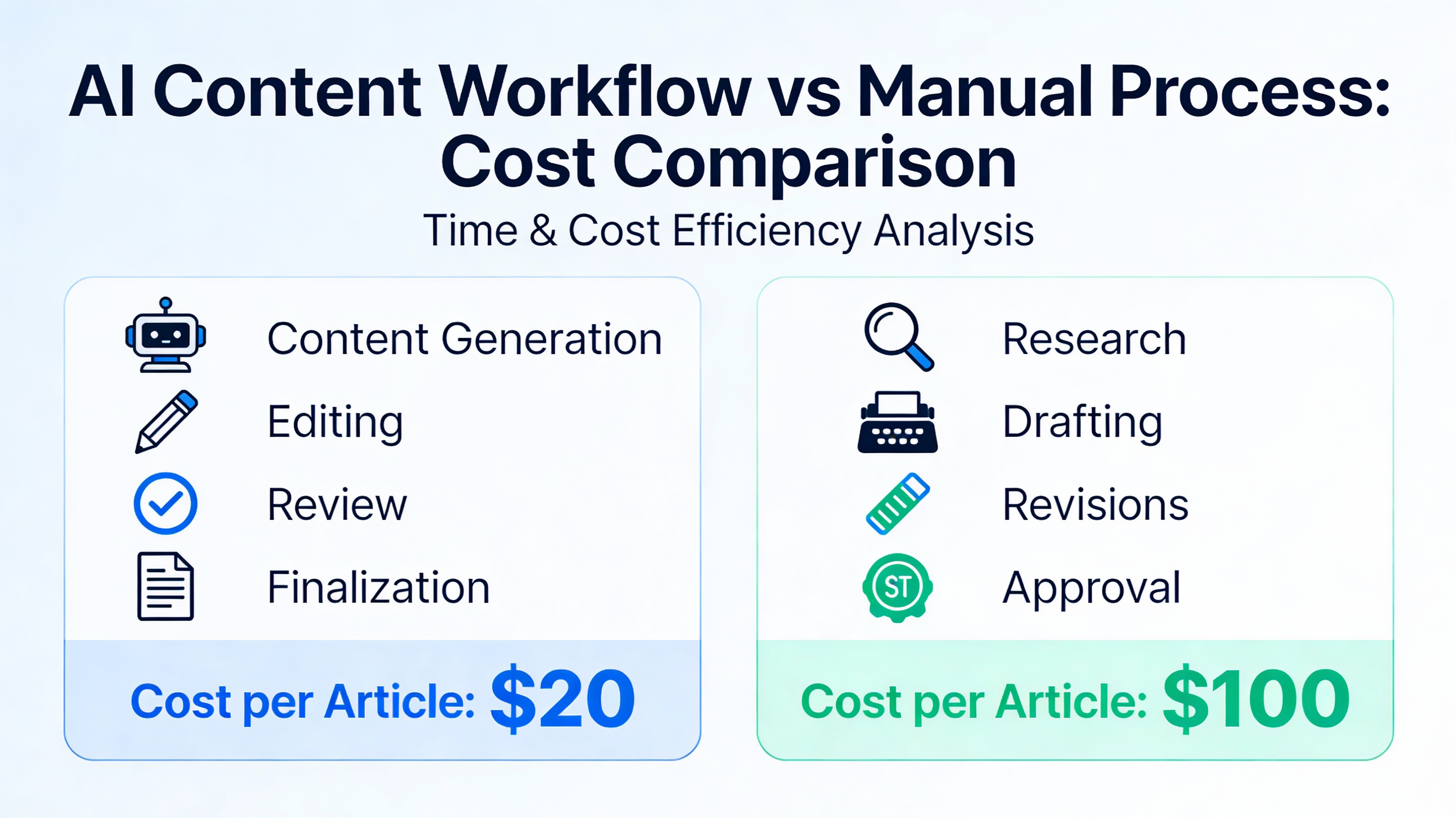
Automated SEO workflows leverage advanced AI technology to handle the heavy lifting of keyword research, outline generation, and search engine optimization. By streamlining these technical tasks, businesses can focus their energy on refining their unique brand narrative.
AI tools analyze search intent and semantic clusters to ensure that every piece of content is built on a foundation of data. This approach significantly reduces the time spent on manual research and ensures higher alignment with what users are actually searching for.
"The integration of AI into SEO workflows allows for a level of data analysis that was previously impossible for human teams alone."
Check the Articfly feature overview or the MIT Technology Review for a scholarly overview of AI in SEO.
How AI Generates SEO-Optimized Articles
The system performs deep intent analysis to understand the "why" behind a search query. It then uses semantic clustering to organize topics in a way that signals authority to search engines, increasing the likelihood of high rankings.
Speed and Scalability Benefits
Automation allows for the production of multiple articles per hour, providing a level of scalability that manual teams cannot match. This includes multi-language support, enabling brands to expand into new markets without hiring regional content teams.
Maintaining Brand Voice with AI
Modern platforms use tone presets and brand-voice modules to ensure consistency across all outputs. A human-in-the-loop editing process allows for final touch-ups, ensuring the content remains authentic and engaging for the reader.
Implementing Articfly's Automated Content Pipeline
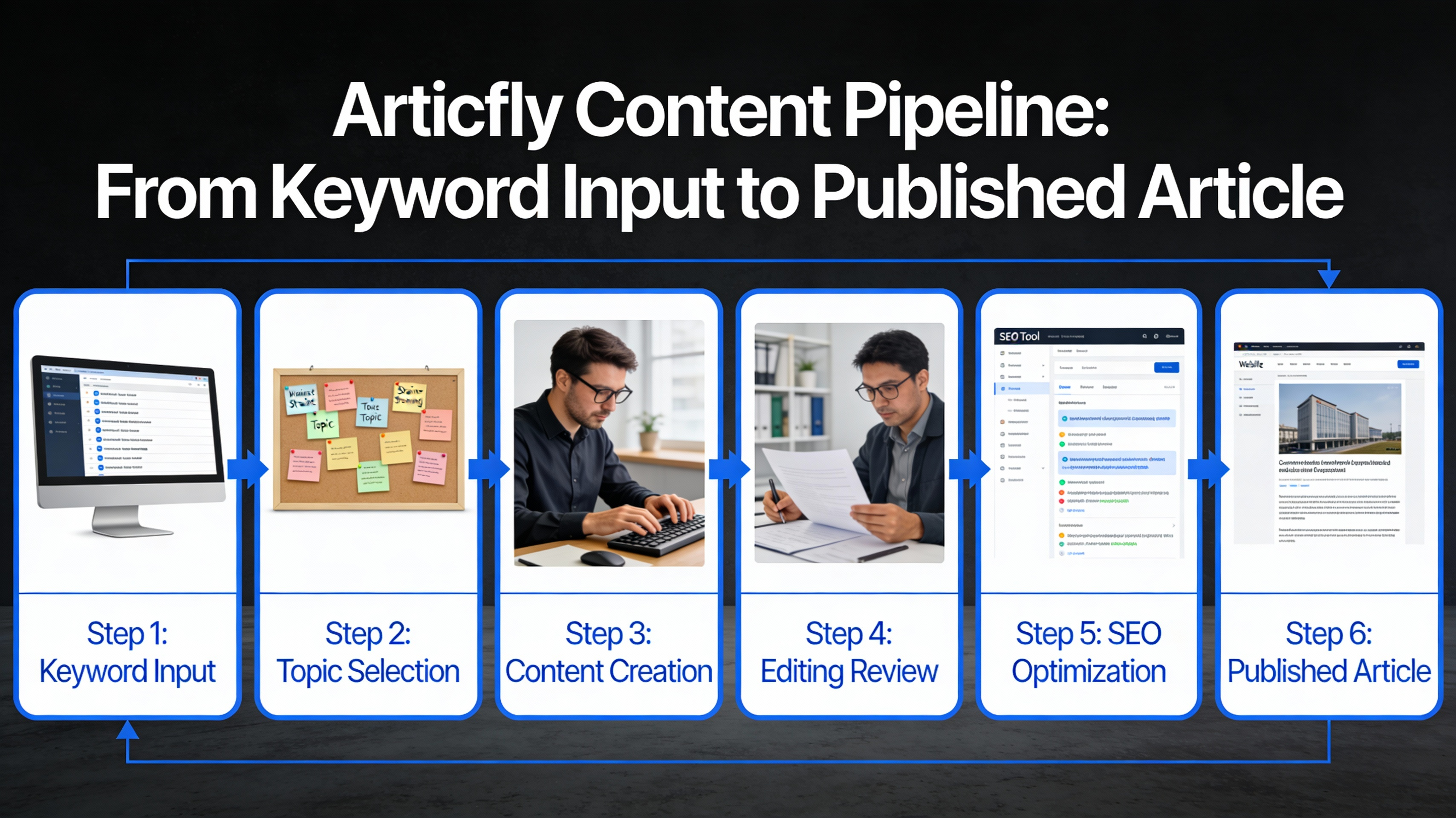
Implementing Articfly's automated content pipeline is a straightforward process designed to integrate seamlessly with your existing marketing strategy. By following a structured setup, teams can begin generating high-quality articles in a matter of minutes.
Setting up the system involves defining clear goals and utilizing brand-voice modules to train the AI on your specific requirements. This ensures that the generated output meets your standards right from the start.
- Define your primary content goals and target keywords.
- Configure the AI brief and establish your brand voice guidelines.
- Review the generated content, make quick edits, and publish.
Visit the Articfly pricing page or view the tutorial on AI content workflow best practices for more implementation tips.
Step 1 – Define Your Content Goals and Keywords
Successful automation starts with clear goal setting and the identification of audience personas. By knowing exactly who you are writing for, you can select keywords that drive meaningful engagement and conversions.
Step 2 – Set Up the AI Brief and Tone Guidelines
Using Articfly’s brand-voice module, you can input specific rules about your brand's personality and vocabulary. This step is crucial for ensuring the AI produces content that feels like it was written by an internal team member.
Step 3 – Review, Edit, and Publish in Minutes
The final stage involves a quick human review checklist to verify facts and add personal anecdotes. This hybrid approach combines the speed of AI with the nuance of human creativity for the best possible results.
Tips for Seamless Human-AI Collaboration
Knowing when to intervene is key to a successful workflow. Use AI for the bulk of the drafting and research, then use human expertise to fine-tune the emotional resonance and calls to action.
Success Stories: Companies That Cut Content Costs by Up to 70%

Real-world success stories demonstrate the tangible impact of switching to automated content production. Companies across various industries have reported significant savings in both time and budget after implementing Articfly.
These examples highlight how businesses can reallocate their savings into other high-impact marketing initiatives. Whether you are a small startup or a global enterprise, the benefits of automation are readily accessible.
Startup Snapshot: Faced with a limited budget, this startup used Articfly to save up to 70% on content costs, allowing them to publish daily and increase organic traffic by 150%.
Agency Snapshot: By automating drafts, this agency scaled client output by 4x without increasing headcount, significantly improving their profit margins.
Enterprise Snapshot: A global brand used AI to maintain consistency across five different languages while reducing their content turnaround time from weeks to hours.
Explore our full case studies or view a neutral industry benchmark report for more data on AI ROI.
Startup Example
Startups often face the challenge of needing high visibility with low capital. By automating their blog, one tech startup saved hundreds of hours, allowing their small team to focus on product development instead of writing.
Agency Example
Agencies frequently struggle with client turnaround times. Automation allows agency owners to provide faster results to clients while maintaining the high quality expected of a professional service provider.
Enterprise Example
For large organizations, global brand consistency is a major hurdle. AI-powered workflows ensure that the tone of voice remains uniform across multiple departments and international regions, protecting the brand's reputation.
Key Takeaways
Key insights for marketing leads focus on the necessity of adapting to the changing economic landscape of 2026. Automation is no longer a luxury but a requirement for those looking to scale their content efforts efficiently.
- Efficiency: Automated workflows drastically reduce the time and cost associated with manual production.
- Scalability: AI allows businesses to publish high volumes of content without increasing their team size.
- Consistency: Brand-voice modules ensure that all content remains aligned with corporate identity.
- SEO Authority: Semantic clustering and intent analysis help content rank higher and faster.
- Budget Protection: Reallocate saved funds to other high-ROI marketing channels like paid media.
Sign up for an Articfly demo signup to see these benefits in action.
FAQ
Frequently asked questions regarding Articfly and automated SEO workflows often center on quality, security, and brand consistency. Here are the answers to the most common queries.
How does AI ensure SEO best practices?Articfly uses proprietary algorithms to analyze search intent and semantic keywords, ensuring that every article is structured to meet modern search engine requirements for authority and relevance.
Will my brand's voice stay consistent?Yes. By utilizing the brand-voice module, you can train the AI on your specific tone, style, and vocabulary, ensuring that every piece of content sounds like your brand.
What is the typical cost reduction?While results vary, many users report cost reductions of up to 70% compared to traditional manual content production methods.
How secure is my data on Articfly?We prioritize data security with enterprise-grade encryption and strict privacy protocols. You can find more details on our security page or review neutral AI ethics guidelines.
Next steps for automated SEO workflows
Turn your content budget into a growth engine by integrating automation into your daily operations. Transitioning away from unsustainable manual processes will free your team to focus on high-level strategy and creative innovation.
Take the first step toward a more efficient future. Explore our demo request form to see how our platform can transform your output, or check the ROI of AI content tools to see the long-term value of making the switch today.
Ready to start? Use our limited-time budget-crisis discount for new members.