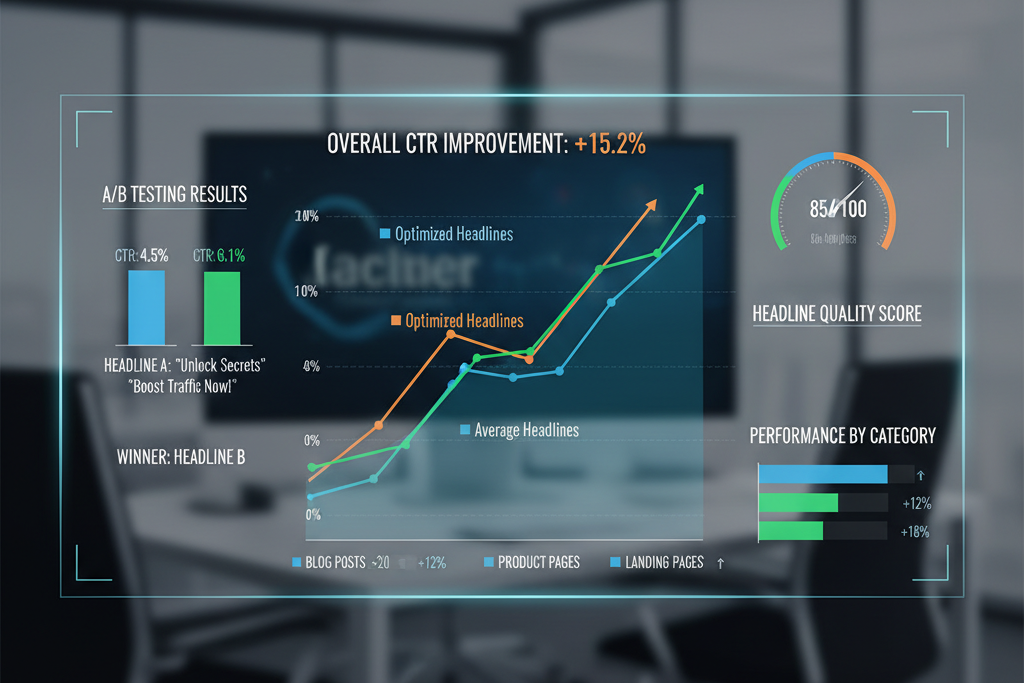
TL;DR: Elevate Your SEO with Impactful Headlines
Headlines are the gateway to your content, critically influencing Click-Through Rates (CTR) and SEO rankings. A strong headline can dramatically increase visibility in search results, with top positions securing significantly higher CTRs. This guide delves into the psychology, proven formulas, technical optimization, and AI-powered strategies behind crafting engaging headlines that convert search impressions into clicks. Learn to leverage cognitive biases, power words, and A/B testing, and discover how platforms like Articfly can automate and enhance your headline generation for maximum impact.
Table of Contents
- Introduction
- Why Headlines Matter More Than You Think
- The Science Behind Click-Worthy Headlines
- 7 Proven Headline Formulas That Work
- SERP Optimization: Character Limits and Display
- Power Words and Emotional Triggers
- A/B Testing Your Headlines for Maximum Impact
- AI-Powered Headline Generation: The Future is Here
- Real-World Examples: Before and After Headlines
- Implementing Headline Strategy with Articfly
- Conclusion and Next Steps
Introduction
In the vast digital landscape, where content competes fiercely for attention, your headline stands as the primary gateway to your article. It is not merely a title; it is the critical first impression that determines whether a potential reader will click through to your content or scroll past it. The impact of an optimized headline on your website's performance, particularly its search engine optimization (SEO) rankings and Click-Through Rate (CTR), cannot be overstated.
Consider the stark reality of search results: data consistently shows that the top position in Google search results typically garners an average CTR of approximately 27%. This figure drops dramatically to around 10% for the third position. This substantial difference highlights the immense value of appearing higher in search results, a position often influenced by how compelling your headline is.
The pursuit of higher CTRs is no longer solely a manual endeavor. Modern advancements, particularly in artificial intelligence, are revolutionizing headline optimization. Recent case studies, such as one involving a Danish news agency, have demonstrated remarkable improvements, with AI-generated headlines showing a 59% increase in CTR compared to human-written counterparts. This compelling statistic underscores the transformative potential of leveraging advanced tools in your content strategy.
This ultimate guide will systematically dissect the art and science of writing engaging headlines. We will explore the psychological triggers, proven formulas, technical considerations for search results, and the innovative role of AI in crafting headlines that not only attract attention but also significantly boost your SEO rankings and overall organic traffic. Mastering headline optimization is no longer optional; it is a fundamental requirement for digital success.

Why Headlines Matter More Than You Think
Headlines serve as the initial point of contact between your content and your audience. Their importance extends far beyond simply labeling an article; they are pivotal in both human perception and algorithmic evaluation. Understanding this dual impact is crucial for any effective content strategy.
From a user psychology perspective, a headline acts as the primary decision-making factor. In a fraction of a second, users scan search results, social feeds, or email inboxes, and their decision to click is largely based on the perceived relevance, value, or intrigue offered by the headline. An engaging headline taps into the user's search intent, promising a solution, an answer, or a unique insight. Conversely, a bland or unclear headline offers no such promise, leading to it being overlooked. This immediate psychological impact directly translates into the observed differences in Click-Through Rates across search result positions.
Google's ranking signals are sophisticated and constantly evolving, but user engagement metrics like CTR remain a significant factor. When a high percentage of users choose to click on your listing in search results (your CTR), it signals to Google that your content is highly relevant and valuable for that particular search query. This positive user behavior can be interpreted by Google's algorithms as an indication of content quality and authority. Consequently, a higher CTR can contribute to improved organic rankings over time. This creates a positive feedback loop: a better headline leads to more clicks, which can lead to higher rankings, which in turn leads to even more clicks.
Therefore, optimizing your headline is not just about making your content look appealing; it's about communicating its inherent value to both human users and search engine algorithms. It directly influences organic traffic by drawing more visitors from search results and indirectly enhances your site's authority and visibility through improved ranking signals. Ignoring headline optimization is akin to having a storefront with a faded, uninviting sign – potential customers will simply walk by.
A strong headline can dramatically increase visibility in search results, with top positions securing significantly higher CTRs.
The Science Behind Click-Worthy Headlines
Crafting headlines that consistently drive clicks is less about guesswork and more about understanding the fundamental psychological principles that govern human decision-making. By leveraging cognitive biases, emotional triggers, and proven linguistic patterns, you can engineer headlines designed for maximum user engagement.
Cognitive biases are mental shortcuts our brains use to make decisions quickly. Several biases are particularly effective when applied to headline writing:
- Curiosity Gap: This bias describes our innate desire to close the gap between what we know and what we want to know. Headlines like "The Secret to X You've Never Heard Of" or "What Experts Aren't Telling You About Y" exploit this by hinting at valuable, withheld information.
- Authority Bias: People tend to trust and be influenced by figures perceived as experts or authorities. Headlines incorporating "Expert Guide," "Research-Backed," or "Proven by Scientists" leverage this.
- Scarcity & Urgency: The perception that something is limited in quantity or time creates a sense of urgency. Phrases like "Limited-Time Offer," "Don't Miss Out," or "Ends Today" capitalize on our fear of missing opportunities.
- Social Proof: We are influenced by the actions and opinions of others. Headlines like "Join 10,000 Others Who Transformed X" or "The #1 Strategy Used by Professionals" tap into this desire for validation.
- Novelty Bias: Our brains are wired to pay attention to new and unusual information. Headlines that promise "New Discoveries," "Groundbreaking Research," or "Unconventional Methods" can be highly effective.
Beyond biases, emotional triggers play a critical role in human response. Headlines that evoke strong emotions—positive or negative—tend to be more memorable and actionable:
- Joy/Excitement: "Unlock Your Full Potential," "Achieve Your Dreams Faster."
- Fear/Anxiety: "Are You Making This Costly Mistake?", "The Hidden Dangers of X."
- Surprise/Awe: "You Won't Believe What This Device Can Do," "Shocking Truth About Y."
- Anticipation: "The Future of Z Is Here," "What's Next for Your Industry."
Proven patterns often combine these elements. Specificity, for instance, makes a headline more credible and appealing ("7 Ways to Boost Your Sales by 30% in 90 Days" is more compelling than "Ways to Boost Sales"). Benefit-focused headlines, which clearly articulate what the reader will gain, are also highly effective. By strategically weaving these psychological insights into your headline creation process, you can craft truly click-worthy titles that resonate deeply with your target audience.

7 Proven Headline Formulas That Work
While the psychology behind headlines provides the foundation, specific headline formulas offer actionable templates to consistently create engaging titles. These structures have been tested and proven across various industries and content types. Incorporating them into your strategy can significantly improve your click-through rates.
Here are 7 effective headline formulas with examples:
-
Number Lists (Listicles)
This formula leverages the human brain's preference for organized, easy-to-digest information. Numbers promise specificity and a clear scope.
- Template:
[Number] Ways to [Achieve Benefit] - Example:
7 Proven Strategies to Boost Your SEO Rankings by 50% - Example:
10 Little-Known Habits of Highly Productive People
- Template:
-
How-To Guides
Directly addresses a user's problem or desire to learn a new skill. These headlines clearly state the solution or process the content will provide.
- Template:
How to [Achieve Goal] Without [Common Obstacle] - Example:
How to Master Content Marketing Without a Huge Budget - Example:
A Step-by-Step Guide to Baking Perfect Sourdough Bread
- Template:
-
Question-Based Headlines
Engages the reader by posing a question they might already be asking themselves, creating immediate relevance and encouraging a search for the answer within your content.
- Template:
Are You [Experiencing Problem]? Here's How to Fix It. - Example:
Are You Making These 5 Common Google Ads Mistakes? - Example:
What is the Best AI Tool for Blog Content Generation?
- Template:
-
Problem-Solution Headlines
Highlights a pain point and immediately offers the content as the remedy, appealing to the reader's need for resolution.
- Template:
[Problem]: The Ultimate Guide to [Solution/Benefit] - Example:
Struggling with Writer's Block? Unlock Creativity with This AI Trick - Example:
Overcome Procrastination: 3 Simple Steps to Productivity
- Template:
-
Curiosity Gap Headlines
Intrigue the reader by hinting at valuable or surprising information without giving away the full story, compelling them to click to satisfy their curiosity.
- Template:
The Secret [Something] That [Unexpected Result] - Example:
The Little-Known SEO Tactic That Doubled Our Traffic in a Month - Example:
What Your Competitors Aren't Telling You About Digital Marketing
- Template:
-
Benefit-Focused Headlines
Clearly articulates what the reader will gain or how their life will improve by engaging with the content, appealing to self-interest.
- Template:
[Action Verb] Your [Desired Outcome] with [Method/Tool] - Example:
Boost Your Business Growth: A Complete Guide to Lead Generation - Example:
Unlock Financial Freedom: Smart Investment Strategies for Beginners
- Template:
-
Urgency-Driven Headlines
Creates a sense of immediacy, often used for offers, news, or time-sensitive information, leveraging the fear of missing out (FOMO).
- Template:
[Urgent Phrase]: [Benefit/Opportunity] Before It's Too Late - Example:
Limited-Time Offer: Get 50% Off Our AI Content Platform Today! - Example:
Don't Miss Out: The Biggest SEO Trends of 2024 Are Here
- Template:
By adapting these proven structures to your specific content and audience, you can craft compelling headlines that stand out in crowded search results and drive higher engagement.
Crafting headlines that consistently drive clicks is less about guesswork and more about understanding the fundamental psychological principles that govern human decision-making.
SERP Optimization: Character Limits and Display
Even the most psychologically compelling headline will fall short if it's not optimized for how search engines display it. Search Engine Results Pages (SERPs) impose specific constraints, and understanding these technical considerations is crucial for maximizing visibility and click-through rates.
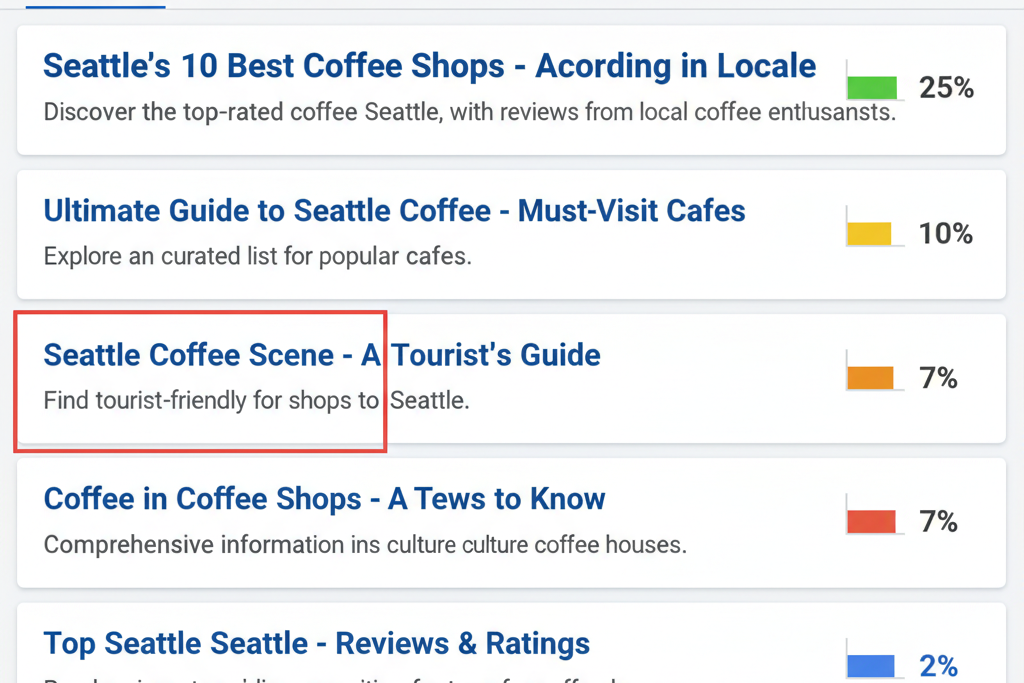
The primary technical factor is the character limit for your title tag, which Google uses to generate the main headline displayed in search results. While there isn't a strict character count, Google typically displays titles that fit within a pixel width of approximately 600 pixels. This generally translates to about 50-60 characters for most languages, though narrower characters allow for more. Exceeding this limit often results in your headline being truncated with an ellipsis (...), which can obscure important keywords or the main benefit of your content.
Mobile optimization further accentuates this concern. With a significant portion of web traffic now originating from mobile devices, headlines need to be concise and impactful on smaller screens. A headline that looks fine on a desktop might be severely truncated on a smartphone, diminishing its effectiveness. Therefore, prioritize getting your core message, primary keyword, and a strong hook within the first 50-55 characters.
While the headline (title tag) is paramount, meta descriptions also play a crucial role in SERP display. Although meta descriptions do not directly impact rankings, a well-crafted description that complements your headline can significantly boost CTR. It provides a secondary opportunity to elaborate on your content's value proposition, answer a user's query, or encourage a click. Aim for meta descriptions between 150-160 characters for optimal display.
Finally, consider featured snippets. These prominent search results often pull content directly from a webpage, including headlines or subheadings. Structuring your content with clear, concise, and question-answering <h2> and <h3> tags, alongside an optimized title tag, increases the likelihood of securing these coveted positions, which can provide an enormous boost to visibility and CTR.
Power Words and Emotional Triggers
To truly maximize the impact of your headlines, integrate "power words"—words that carry strong emotional connotations and compel action. These words amplify the psychological triggers discussed earlier, making your headlines irresistible. Categorizing them helps in strategic deployment:
-
Urgency Words
These create a sense of immediacy and the fear of missing out (FOMO).
Now,Instant,Immediately,Limited-Time,Today,Quickly,Don't Miss,Act Fast,Ends Soon.- Example:
Claim Your Free AI Content Audit Now!
-
Benefit Words
These words clearly articulate the positive outcome or advantage the reader will gain.
Ultimate,Essential,Proven,Guaranteed,Easy,Simple,Transform,Boost,Master,Unlock,Achieve,Skyrocket,Maximize.- Example:
Unlock Your Blog's Full Potential with AI Automation
-
Curiosity Words
These pique interest and create a desire to learn more by hinting at secrets, surprises, or exclusive information.
Secret,Hidden,Unveiled,Shocking,Surprising,Mysterious,Bizarre,Confessions,Little-Known.- Example:
The Hidden SEO Tactic Google Doesn't Want You to Know
-
Authority Words
These build trust and credibility, positioning your content as authoritative and reliable.
Expert,Guide,Research-Backed,Official,Certified,Masterclass,Definitive,Comprehensive.- Example:
The Definitive Expert Guide to AI-Powered Content Creation
-
Emotional Words
These directly appeal to the reader's feelings, creating a stronger connection and driving engagement.
Amazing,Incredible,Fantastic,Terrifying,Warning,Powerful,Exciting,Heartbreaking.- Example:
The Shocking Truth About Your Content Marketing Strategy
Strategically weaving these power words into your headline formulas can dramatically increase their persuasive appeal, converting passive browsers into active clickers. However, use them judiciously to avoid sounding overly sensational or "clickbaity," which can erode trust over time.
A/B Testing Your Headlines for Maximum Impact
While formulas and power words provide a strong starting point, the ultimate measure of a headline's effectiveness is its performance with your specific audience. This is where A/B testing, also known as split testing, becomes indispensable. A/B testing allows you to systematically compare different versions of a headline to determine which one yields the highest Click-Through Rate and other desired metrics.
The methodology for A/B testing headlines involves creating two or more distinct headline variations for the same piece of content. These variations are then presented randomly to different segments of your audience, and their performance is tracked. For blog articles, headline A/B testing can occur in several contexts:
- Search Engine Results Pages (SERPs): While direct A/B testing on Google's actual SERP display is not feasible for individual pages, you can test different title tags over time and monitor their CTR performance in Google Search Console.
- On-Page Headlines: For the
<h1>or primary<h2>that appears once a user lands on your page, you can use dedicated A/B testing tools (e.g., Google Optimize, Optimizely, VWO) to show different headlines to different visitors. - Social Media Shares: Platforms like Facebook and Twitter often allow you to customize the headline displayed when sharing a link. You can test multiple versions and observe which generates more engagement.
- Email Subject Lines: For content distributed via email, A/B testing subject lines is a common practice to optimize open rates, which is analogous to headline CTR.
When conducting A/B tests, several factors are critical for valid results:
- Isolate Variables: Test only one significant change at a time (e.g., compare a number list headline with a question-based one, not a headline with different subheadings).
- Sample Size: Ensure a statistically significant sample size to draw reliable conclusions. Small audiences may lead to results driven by chance rather than actual performance.
- Duration: Run tests for a sufficient period to account for daily and weekly traffic variations.
- Clear Metrics: Define what "maximum impact" means. For headlines, CTR is usually the primary metric, but you might also consider time on page, bounce rate, or conversion rates if the headline leads to a specific action.
Interpreting results involves analyzing the data to identify the winning variation. The headline with the highest CTR, all else being equal, is the most effective. Continuously A/B testing your headlines, especially for evergreen content or high-traffic pages, is a powerful strategy for ongoing optimization and sustained traffic growth. It moves your headline strategy from assumption to data-driven certainty.
AI-Powered Headline Generation: The Future is Here
The landscape of content creation is rapidly evolving, with artificial intelligence emerging as a transformative force. AI-powered tools are no longer just for generating body text; they are becoming increasingly sophisticated at optimizing crucial elements like headlines, offering unparalleled efficiency and performance enhancements.
AI's capability to generate and optimize headlines stems from its ability to process vast amounts of data, identify patterns in successful content, and understand natural language nuances. Machine learning algorithms can analyze historical performance data (which headlines received the most clicks, conversions, or engagement), competitive landscapes, and target audience preferences to suggest or create highly optimized headline variations. This process goes beyond simple keyword inclusion; AI can understand search intent, emotional resonance, and even detect potential "clickbait" tendencies to ensure quality and relevance.
One of the most compelling demonstrations of AI's power in headline optimization comes from a Danish news agency's experiment. By employing an AI system to generate and test headlines for their articles, they observed a significant 59% improvement in Click-Through Rates compared to manually written headlines. This remarkable leap in performance illustrates AI's potential to identify and craft more effective headlines at scale, something that would be incredibly time-consuming and labor-intensive for human marketers alone.
AI tools can:
- Generate Multiple Variants: Quickly produce dozens of headline options based on different formulas, tones, and keyword focuses.
- Predict Performance: Some advanced AI models can even predict the potential CTR or engagement of a generated headline based on learned patterns.
- Analyze and Learn: Continuously improve their suggestions by learning from the real-world performance data of the headlines they've created.
- Ensure SEO Compliance: Automatically optimize for character limits and keyword density.
For businesses, agencies, and content creators, integrating AI into the headline generation process means not only saving significant time but also accessing an optimization engine that continuously learns and adapts. This translates into more engaging content, higher CTRs, and ultimately, stronger organic traffic. Platforms like Articfly are at the forefront of this innovation, bringing sophisticated AI capabilities directly into your content creation workflow, making professional, SEO-optimized content production effortless.
Real-World Examples: Before and After Headlines
Theory is valuable, but concrete examples demonstrate the power of headline transformation. Here are several "before and after" scenarios illustrating how applying the principles discussed can dramatically improve a headline's appeal and potential for higher CTRs across different content types:
-
Blog Post: General Topic
- Before:
About Digital MarketingAnalysis: Vague, unspecific, offers no clear benefit or reason to click. It merely describes the topic.
- After:
Master Digital Marketing: 7 Proven Strategies to Skyrocket Your Online PresenceAnalysis: Uses a strong verb ("Master"), incorporates a number list, clearly states the benefit ("Skyrocket Your Online Presence"), and adds authority ("Proven Strategies"). This headline uses the Number List and Benefit-Focused formulas.
- Before:
-
Product Page: Software Tool
- Before:
Our New Project Management SoftwareAnalysis: Generic, focuses on the company/product rather than the user's need. Lacks excitement or urgency.
- After:
Boost Your Team's Productivity by 30%: The Ultimate AI Project Management SolutionAnalysis: Quantifies a clear benefit ("Boost Productivity by 30%"), uses a power word ("Ultimate"), highlights innovation ("AI Solution"), and targets a specific audience need. This is a strong Benefit-Focused headline with an authority word.
- Before:
-
News Article: Industry Update
- Before:
New Report on E-commerce TrendsAnalysis: Factual but dry. Gives no indication of the report's findings or why it's important.
- After:
Shocking E-commerce Trends of 2024: What Every Business Needs to Know (Before It's Too Late)Analysis: Uses emotional words ("Shocking"), creates urgency ("Before It's Too Late"), and implies critical, need-to-know information, leveraging the Curiosity Gap and Urgency. This transforms a dull announcement into a must-read.
- Before:
-
Service Page: Consulting
- Before:
Business Consulting ServicesAnalysis: Purely descriptive, offers no unique value proposition or problem resolution.
- After:
Struggling with Growth? Our Expert Consultants Deliver a Custom Strategy to Double Your ROIAnalysis: Identifies a common problem ("Struggling with Growth?"), offers a clear solution and benefit ("Custom Strategy to Double Your ROI"), and establishes authority ("Expert Consultants"). This blends Problem-Solution with Benefit-Focused elements.
- Before:
These examples illustrate that a headline's transformation often involves injecting specific benefits, emotional triggers, clear numbers, or a compelling question, moving from simple description to persuasive communication. The key is to think about what would make a potential reader pause and click.
Implementing Headline Strategy with Articfly
For content teams, agencies, and businesses aiming for peak efficiency and performance, integrating headline optimization into a streamlined workflow is paramount. This is where Articfly's AI platform provides a significant advantage, automating and enhancing the entire content creation process, including the critical aspect of headline generation.
Articfly is designed to empower users by transforming ideas into engaging, data-driven articles in minutes. Our proprietary AI system doesn't just write; it optimizes. When you outline a blog post or specify a target keyword, Articfly's AI automatically applies sophisticated strategies for headline generation:
- Search Intent Analysis: The platform analyzes the core search intent behind your chosen topic, ensuring headlines are highly relevant to what users are actively searching for.
- Formulaic Generation: Articfly's AI is trained on successful headline formulas, allowing it to generate multiple compelling options that leverage psychological triggers, power words, and established structures like number lists, how-to guides, and curiosity gaps.
- SEO Best Practices Integration: Headlines are optimized for SERP display, adhering to character limits and incorporating relevant keywords naturally, without stuffing.
- Variant Testing (Conceptual): While Articfly doesn't perform live A/B testing on your site, it generates diverse headline options that you can then easily test manually or integrate into your chosen A/B testing platform, significantly reducing the initial brainstorming effort.
- Consistency and Quality: By automating headline generation, Articfly ensures that every piece of content produced maintains a high standard of optimization, consistently aiming for high CTRs and improved SEO performance across your blog.
By leveraging Articfly, you eliminate the guesswork and time-consuming manual effort typically associated with headline optimization. Our platform provides you with a suite of meticulously crafted headlines, allowing you to select the most impactful option or use them as a robust starting point for further refinement. This integration ensures that from the very first impression, your content is positioned for maximum visibility and engagement, driving higher organic traffic and supporting your overall content marketing goals.
Conclusion and Next Steps
Optimizing your headlines is not merely a content refinement task; it is a fundamental pillar of effective SEO and a direct driver of your Click-Through Rates. We've explored how headlines influence user psychology and Google's ranking signals, dissected the science behind click-worthy titles, provided proven formulas, detailed SERP optimization techniques, and highlighted the impact of power words. Furthermore, we've seen the transformative potential of AI in streamlining this crucial process.
The journey to higher organic traffic and improved search visibility begins with a compelling headline. By implementing the strategies outlined in this guide—understanding your audience's psychology, applying proven formulas, respecting technical SERP constraints, and leveraging advanced tools—you can significantly enhance your content's performance.
Your actionable next steps:
- Audit Your Existing Content: Review your current blog posts and identify opportunities to revise headlines using the formulas and power words discussed.
- Implement A/B Testing: Systematically test different headline variations for new and high-traffic articles to gather data-driven insights.
- Explore AI Integration: Discover how Articfly can automate headline generation and optimize your overall content creation workflow, saving time and boosting performance.
Take control of your content's first impression. Begin optimizing your headlines today and watch your traffic growth accelerate. Explore Articfly's capabilities to transform your content strategy with intelligent automation.