Google E-E-A-T for Bloggers: Proving Expertise Without Credentials
Key Takeaways
| E-E-A-T Pillar | What It Means | Specific Action Item |
|---|---|---|
| Experience | First-hand involvement in the subject matter. | Include original photos, personal anecdotes, or "lessons learned" sections. |
| Expertise | Deep knowledge or formal credentials. | Cite peer-reviewed studies or professional certifications where applicable. |
| Authoritativeness | Reputation as a go-to source in your niche. | Build topical clusters and earn mentions from industry-relevant websites. |
| Trustworthiness | The overall reliability and honesty of the site. | Maintain clear About, Contact, and Privacy Policy pages. |
Decoding E-E-A-T: Why the 'Extra E' Changes Everything for Bloggers
The evolution of Google's Quality Rater Guidelines has shifted the landscape for independent publishers. For years, E-A-T (Expertise, Authoritativeness, and Trustworthiness) was the gold standard for how Google evaluated content quality. By adding the second "E" for Experience, the search engine acknowledged that formal degrees aren't the only way to provide value to a reader.
Experience focuses on the actual hands-on usage of a product or the real-world navigation of a situation. This is a significant win for creators who may not have a PhD but have spent years testing software, traveling to remote locations, or managing household budgets. You no longer have to compete solely on academic credentials if you can prove you have "been there and done that."
There are several niches where first-hand experience is often more valuable to a reader than theoretical expertise:
- Travel blogging: Practical knowledge of local customs and transit beats a general guide.
- Tech and software reviews: Actual UI testing and bug reporting provide more value than a spec sheet.
- Lifestyle and parenting: Real-world solutions to daily problems resonate more than clinical advice.
- Outdoor gear testing: Knowing how a tent performs in a storm is better than knowing the fabric's chemical makeup.
The Difference Between 'Expertise' and 'Experience'
Distinguishing between expertise and experience is the first step in auditing your content strategy. While expertise often relies on "blueprints" and theoretical mastery, experience is rooted in "dirt and sweat." Google looks for signals that indicate a writer has actually handled the subject matter rather than just aggregating what others have written.
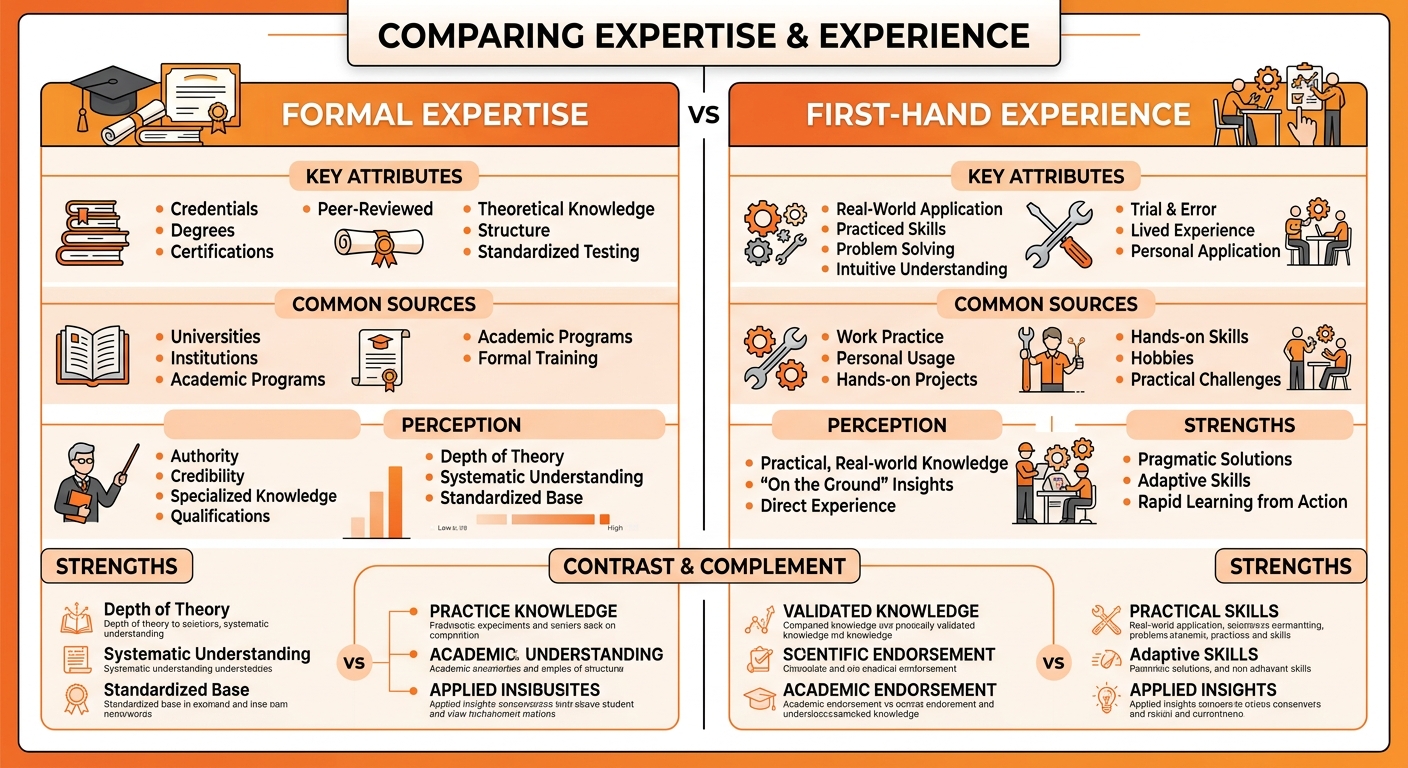
When you write from a place of experience, you include details that are difficult to fake. This includes mentioning specific challenges encountered during a project, unique observations about a product's build quality, or nuanced opinions that go against the consensus. These details serve as proof that you are a credible source of information.
| Feature | Expert Approach (Theoretical) | Experience Approach (Practical) |
|---|---|---|
| Source of Truth | Textbooks, certifications, and formal research. | Testing, usage, and trial-and-error. |
| Content Focus | Definitions, standards, and universal laws. | Edge cases, personal results, and workflows. |
| Visual Evidence | Diagrams and stock photography. | Original photos, screenshots, and videos. |
| Tone | Formal and objective. | Direct, honest, and perspective-driven. |
How to Source and Cite Authority When You Aren't the Source
Curating authority from external sources allows you to build a bridge between your personal experience and established industry standards. You do not need to be the primary expert if you are skilled at synthesizing the work of those who are. This process, often called "curated authority," involves finding the best data available and presenting it in a way that serves your audience.
Citing your sources properly does more than just avoid plagiarism; it shows Google that your content is grounded in fact. When you reference a study or a quote from a professional, you are effectively "borrowing" their E-E-A-T to reinforce your own claims. This is particularly effective when you combine a professional's data with your own practical application of that data.
"The value of a modern creator often lies in their ability to act as a filter. Curated authority isn't about copying; it's about providing a reliable lens through which complex information becomes actionable."- Editorial Perspective on Content Curation
Always prioritize primary sources over secondary ones. If a news article mentions a study, find the original study. This level of rigor signals to both readers and search engines that you are committed to accuracy, which is a core component of the "Trustworthiness" pillar.
Visible Trust Signals: The Checklist for Your Blog Layout
Optimizing your website's structural elements is a critical part of demonstrating trustworthiness. Before a visitor reads a single word, they make a split-second judgment based on your site's layout and the transparency of its operations. Technical trust signals are often overlooked by bloggers who focus solely on the text, but these elements are the foundation of E-E-A-T.

A transparent blog should make it easy for a user to answer three questions: Who wrote this? Why are they qualified? How can I reach them? If these answers are buried or non-existent, your E-E-A-T score will likely suffer. High-quality sites maintain a professional standard in their administrative pages to prove they are a legitimate entity.
Essential UI Trust Elements
- Detailed Author Bios: Include a photo, a brief summary of relevant experience, and links to social profiles.
- Comprehensive About Page: Explain the mission of the site and the methodology used for testing or research.
- Functional Contact Information: Provide a real email address or a working contact form, rather than just a social media link.
- Clear Editorial Policy: Disclose how you handle corrections, updates, and fact-checking.
- Privacy and Terms: Standard legal pages that show you respect user data and local regulations.
Leveraging External Experts and Case Studies
Incorporating third-party validation through expert quotes and case studies can transform a standard blog post into an authoritative resource. If you are writing about a complex topic, reaching out to a professional for a brief comment can provide the necessary weight to rank for competitive terms. This "borrowed authority" helps fill the gaps in your own credentials.

Case studies are equally powerful. By documenting the results of a specific experiment or a client’s journey, you provide concrete evidence that your advice works in the real world. This moves the content from the realm of "opinion" into the realm of "proven methodology."
The Role of Transparency in Building Content Authority
Being honest about your process is one of the fastest ways to build trust with a skeptical audience. Google’s guidelines emphasize that users should understand how a piece of content was created. This includes disclosing whether you received a product for free, if you have an affiliate relationship, or how long you actually spent testing a specific solution.
Transparency acts as a safeguard against "thin content" penalties. When you detail your testing methodology-such as the specific tools used, the time frame of the test, and the specific metrics measured-you are providing the "Experience" signal that search engines crave. This level of detail is almost impossible for low-quality content farms to replicate at scale.
Decision Guide: When to Disclose Methodology- Product Reviews: Always disclose how you obtained the product and how long you used it.
- Financial Advice: Disclose any personal stakes or professional affiliations.
- Health/Wellness: State clearly that you are not a medical professional (if applicable) and cite your sources.
- AI-Assisted Content: Be transparent about the use of AI tools in your research or drafting process if they played a major role.
FAQ
Can I rank for YMYL topics without being a doctor or financial advisor?
Ranking for Your Money Your Life (YMYL) topics is difficult without formal credentials. However, you can rank by focusing on the "Experience" aspect-sharing your personal journey or the results of specific actions-while carefully citing experts for any medical or financial claims. Do not give direct advice; instead, document your process.
Does using AI content automatically hurt my E-E-A-T?
Google has stated that it rewards high-quality content however it is produced. AI content only hurts your E-E-A-T if it is generic, inaccurate, or lacks the "Experience" factor. Using AI to structure your thoughts while adding your own unique insights and data is a perfectly valid strategy for building authority.
How long does it take for Google to recognize my blog's authority?
Authority is not built overnight. It typically takes several months of consistent publishing, building topical clusters, and earning high-quality backlinks for search engines to establish a trust profile for your site. Consistency in your niche is more important than the volume of posts.
Should I use a pen name or my real name for better E-E-A-T?
Using a real name is generally better for building long-term E-E-A-T. A real person can be linked to other professional profiles (LinkedIn, social media, other publications), which helps Google verify your identity and expertise. If you must use a pen name, ensure that the persona has a consistent and verifiable history on your site.
Put this into practice
Auditing your existing content for E-E-A-T gaps is the fastest way to improve your rankings without writing new articles from scratch. Look at your top-performing posts and identify where you can add "Experience" signals, such as original photos or specific data points from your own tests. Strengthening these trust signals often leads to a more stable presence in search results.
You can use the ARTICFLY dashboard to identify which posts are showing signs of content decay and need a refresh. Our internal link mapping and SEO tools help you build strong topical clusters, which is a major signal of authoritativeness to search engines. By organizing your WordPress site into clear hierarchies of knowledge, you demonstrate that you are a comprehensive resource in your niche.
Take an hour today to review your About page and author bios. Ensure they clearly state your experience and why you are qualified to write on your chosen topics. This simple administrative task can have a significant impact on how both users and search engines perceive your site's credibility.
Want the system behind this content?
Join the top 1% of SEOs generating programmatic, high-converting organic traffic completely on auto-pilot.
DEPLOY ARTICFLYMore Articles
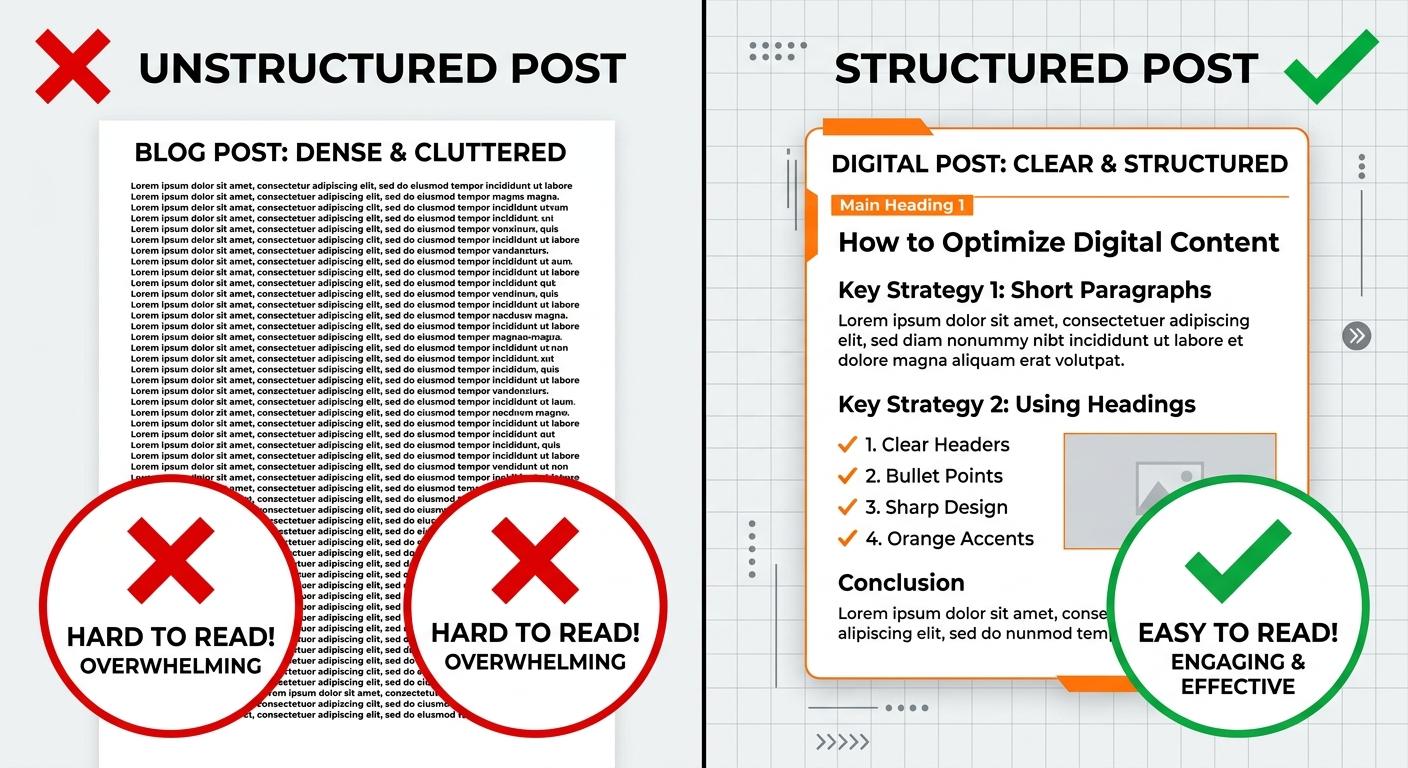
Why People Stop Reading Your Blog Post After 30 Seconds (and How to Fix It)
Most readers decide to stay or leave a blog post within the first 30 seconds. If your bounce rates are high, it's likely due to structural friction, poor hooks, or a lack of immediate value. Learn how to diagnose engagement killers and use AI-driven optimization to keep readers scrolling.
READ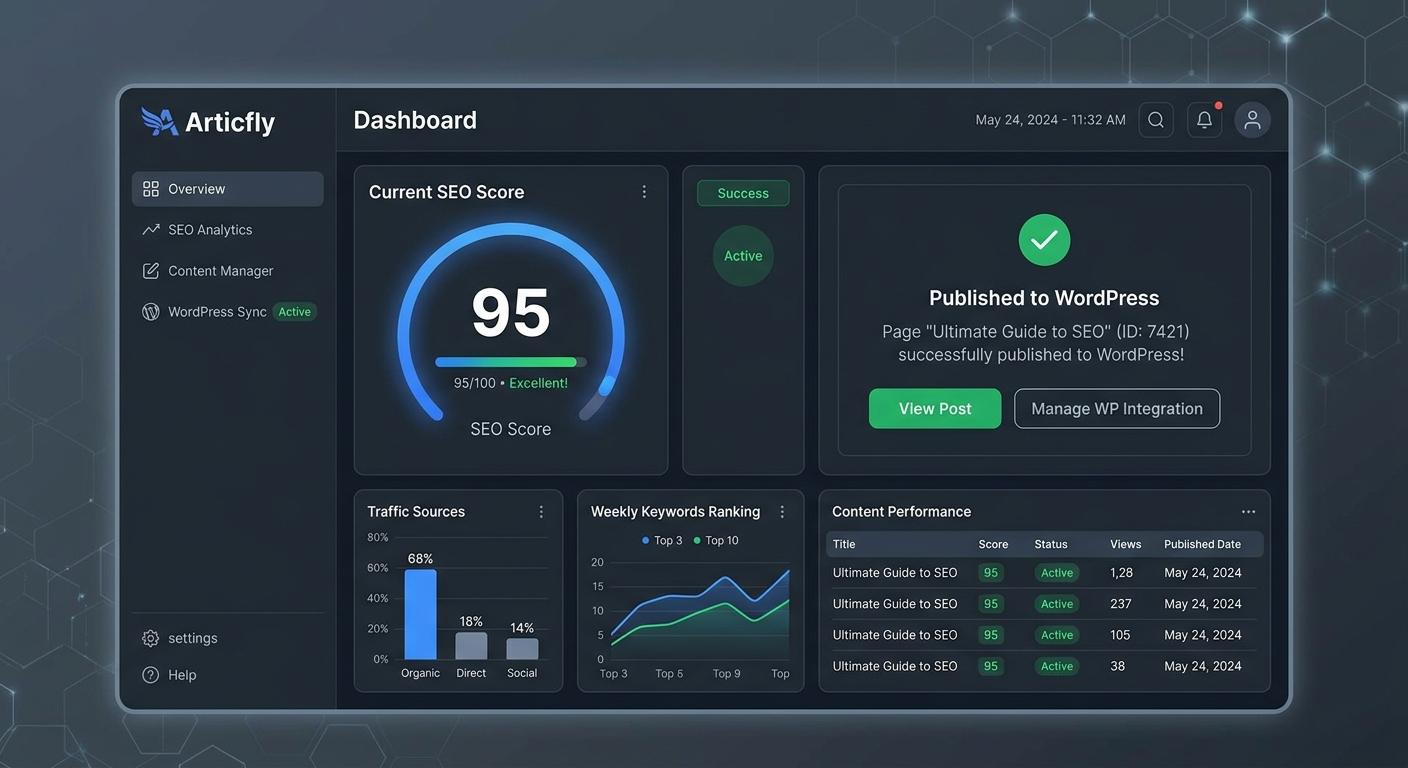
The $15 Blog Post That Brings in $2,000/Month: How AI Content Delivers 130x ROI
Discover the unit economics of high-scale AI publishing. Learn how to leverage Articfly to produce $15 blog posts that generate $2,000 in monthly recurring revenue through SEO optimization, automated publishing, and strategic content refreshing.
READ
Brand Voice in AI Content: How to Stop Your Blog from Sounding Like a Robot
Generic AI content is killing brand authority. Learn how to use Articfly’s Brand Voice Analyzer and Advanced Mode to produce high-scale, SEO-optimized content that sounds like your team, not a machine.
READ