TL;DR: Boosting Website Traffic
Understanding the difference between paid and organic marketing is crucial for sustainable website growth. While paid marketing offers immediate, targeted results, organic strategies like SEO, social media, and blogging build long-term trust and cost-effective visibility. Leveraging tools like Articfly for AI-powered content creation can significantly enhance your organic efforts, making high-quality content generation scalable and efficient. A balanced approach combining both paid and organic tactics often yields the best results.
Table of Contents
- Introduction to Website Traffic Growth
- What Is Paid Marketing?
- What Is Organic Marketing?
- Strategies to Increase Organic Traffic Using Social Media
- How to Increase Organic Traffic Through Blogging
- Conclusion: Integrating Paid and Organic Strategies for Maximum Traffic
Introduction to Website Traffic Growth
For any online business, brand, or creator, website traffic serves as the lifeblood of digital success. It represents the number of users who visit your site, acting as a direct indicator of your online visibility and potential for engagement, lead generation, and conversions. Without consistent traffic, even the most innovative products or services remain unseen by their target audience.
Website traffic is simply the flow of visitors to your website. These visitors can arrive through various channels, each offering distinct advantages and requiring different strategic approaches. Understanding these channels is fundamental to developing an effective digital marketing strategy that drives sustainable growth. The two primary categories of website traffic generation are paid marketing and organic marketing.
Paid marketing involves investing in advertisements to drive immediate visitors, while organic marketing focuses on earning traffic through strategies that build long-term authority and relevance. Both play critical roles, but their mechanisms and outcomes differ significantly. This article will delve into these distinctions, providing a clear understanding of when and how to leverage each. Furthermore, we will specifically explore actionable strategies to significantly boost your organic traffic through effective social media engagement and high-quality blogging.
In the realm of content creation, platforms like Articfly are transforming how businesses approach organic growth. By facilitating the generation of professional, SEO-optimized blog articles automatically, Articfly empowers content teams to produce high-quality content at scale, directly contributing to enhanced organic visibility and traffic.
What Is Paid Marketing?
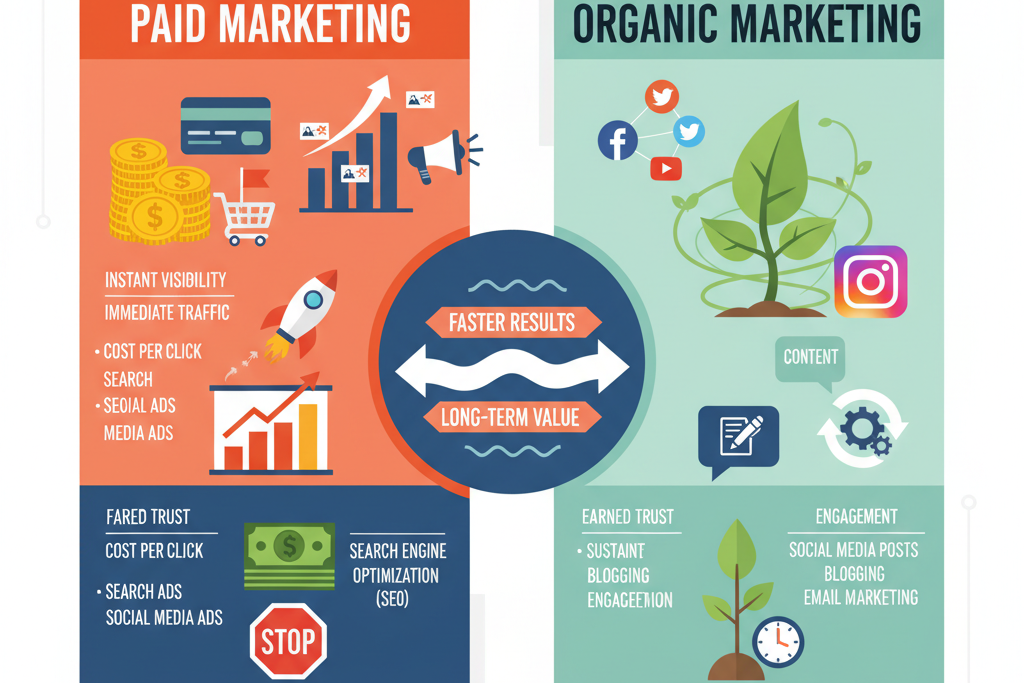
Paid marketing, often referred to as paid advertising or performance marketing, encompasses any strategy where businesses pay to display promotional messages to their target audience. The core principle is straightforward: you allocate a budget to advertising platforms, and in return, your ads are shown to users who fit specific demographic, interest, or behavioral criteria. This approach offers immediate visibility and allows for precise targeting, making it a powerful tool for rapid traffic generation.
Common types of paid marketing include:
- Pay-Per-Click (PPC) Advertising: Predominantly seen on search engines like Google Ads, where advertisers bid on keywords. Your ad appears when users search for those terms, and you only pay when someone clicks on your ad.
- Display Advertising: These are visual ads (banners, images, videos) that appear on websites, apps, and other digital platforms within ad networks. They are effective for brand awareness and retargeting users who have previously visited your site.
- Social Media Advertising: Platforms such as Facebook Ads, Instagram Ads, LinkedIn Ads, and TikTok Ads allow businesses to create highly targeted campaigns based on user data, including demographics, interests, and behaviors. These ads integrate seamlessly into users' feeds.
- Sponsored Content: While often more subtle, this involves paying publishers or influencers to feature your brand or product within their content.
The advantages of paid marketing are compelling. It offers immediate results, as ads can go live quickly and start driving traffic almost instantly. The targeting options are incredibly sophisticated, allowing businesses to reach very specific audiences based on detailed criteria, minimizing wasted ad spend. Furthermore, paid campaigns provide extensive control over budget, allowing advertisers to set daily or lifetime caps and adjust bids to optimize performance. This direct control makes it an excellent choice for A/B testing different messages, visuals, and calls to action.
Paid marketing offers immediate results, as ads can go live quickly and start driving traffic almost instantly, providing extensive control over budget and targeting.
Paid marketing is particularly effective in scenarios such as launching a new product or service, promoting limited-time offers, quickly generating leads, or gaining immediate visibility in a competitive market. For instance, an e-commerce store launching a holiday sale can use social media ads to target potential customers with direct purchase links, while a B2B SaaS company might leverage LinkedIn Ads to reach decision-makers for lead generation.
What Is Organic Marketing?
In stark contrast to paid marketing, organic marketing refers to strategies designed to attract visitors to your website without direct payment for ad placements. It focuses on earning visibility and traffic through natural, non-paid methods, building a sustainable presence and fostering genuine audience engagement. The goal is to rank higher in search engine results, gain visibility on social media, and cultivate a reputation that naturally draws users to your site.
Key components of organic marketing include:
- Search Engine Optimization (SEO): This involves optimizing your website and content to rank higher in search engine results pages (SERPs) for relevant keywords. It includes technical SEO (site speed, mobile-friendliness), on-page SEO (keyword usage, content quality), and off-page SEO (backlinks).
- Content Marketing: Creating and distributing valuable, relevant, and consistent content (blog posts, articles, videos, infographics, e-books) to attract and retain a clearly defined audience. This content aims to answer questions, solve problems, and provide information that genuinely helps users.
- Social Media Engagement: Building a community and interacting with users on social media platforms. This involves sharing valuable content, participating in discussions, responding to comments, and encouraging shares, all of which can drive referral traffic back to your website.
- Email Marketing: Building an email list and sending regular newsletters or promotional emails to an opted-in audience. While not strictly "organic" in the same way as SEO, it relies on earned trust and relationship-building rather than paid acquisition to drive traffic.
The benefits of organic marketing are significant and long-lasting. It builds trust and credibility with your audience because content that ranks highly or is shared widely is often perceived as authoritative and valuable. Unlike paid ads that disappear when the budget runs out, organic efforts, once established, continue to generate traffic over time, making it a highly sustainable strategy. While it requires an initial investment in time and resources for content creation and optimization, it proves to be highly cost-effective in the long run, yielding a better return on investment over months and years.
The fundamental difference from paid marketing lies in its timeline and nature. Paid marketing offers instant gratification and precise control over reach, making it ideal for short-term campaigns and rapid lead generation. Organic marketing, conversely, is a marathon, not a sprint. It demands patience, consistency, and a deep understanding of your audience's needs, but it ultimately cultivates a loyal following and a robust digital footprint that endures beyond any specific advertising budget.
Organic marketing is a marathon, not a sprint, demanding patience, consistency, and a deep understanding of your audience's needs.
Strategies to Increase Organic Traffic Using Social Media
Social media platforms are powerful conduits for driving organic traffic to your website, provided you employ a strategic and audience-centric approach. It's not merely about having a presence, but about actively engaging and offering value that compels users to explore your broader content.
Choosing the Right Social Platforms
The first step is identifying where your target audience spends their time. Research demographics and user behavior across platforms. For B2B audiences, LinkedIn is indispensable. For visual brands, Instagram and Pinterest are key. Younger demographics often gravitate towards TikTok and YouTube, while Facebook remains a broad platform suitable for many niches. Focus your efforts on 2-3 platforms where you can genuinely connect and deliver value, rather than spreading yourself thin across too many.
Posting Engaging, Valuable Content Regularly
Consistency is paramount. Develop a content calendar that schedules diverse post types. Share blog posts, behind-the-scenes glimpses, polls, questions, industry insights, and user-generated content. The goal is to provide value that solves problems, entertains, or informs. High-quality visuals (images, videos, infographics) significantly increase engagement. Remember the 80/20 rule: 80% value, 20% promotional content.
Using Hashtags and SEO-Friendly Captions
Hashtags are essential for discoverability. Research relevant, trending, and niche-specific hashtags. Don't overuse them; typically 5-10 well-chosen hashtags perform better than 30 generic ones. For captions, think like a search engine. Include relevant keywords naturally in your descriptions, especially on platforms like LinkedIn and Pinterest, where search functionality is robust. Craft compelling introductory sentences to hook your audience and encourage clicks to your website.

Engaging with Followers and Influencers
Social media is a two-way street. Respond to comments and messages promptly, ask questions, and run polls to foster a sense of community. Actively seek out and engage with influencers or thought leaders in your niche. A genuine interaction might lead to a share, a mention, or even a collaboration, expanding your reach to their audience. Participating in relevant groups or communities also positions you as an expert and builds trust.
Leveraging Social Media Analytics to Optimize Efforts
Don't guess; analyze. All major social platforms provide analytics tools that offer insights into post performance, audience demographics, and peak engagement times. Use this data to understand what content resonates most, which hashtags are driving traffic, and when your audience is most active. Adjust your content strategy, posting schedule, and calls to action based on these insights to continuously improve your organic reach and website referrals.
For example, a clothing brand might notice that Instagram Reels showcasing styling tips perform exceptionally well, leading to higher click-through rates to product pages. They would then prioritize creating more video content of this type. A B2B software company might see that LinkedIn articles featuring industry reports generate significant leads, prompting them to invest more in long-form thought leadership content on that platform.
Another powerful tactic is to integrate social media directly with your website content. Add share buttons to your blog posts and product pages, encourage user reviews on social platforms, and run contests that require sharing your content to enter. By making it easy for your audience to spread your message, you amplify your organic reach significantly. Remember to always include clear calls to action (CTAs) in your social media posts that direct users to your website, whether it's "Read More," "Shop Now," or "Learn How."
How to Increase Organic Traffic Through Blogging
Blogging remains one of the most potent and sustainable strategies for driving organic traffic to your website. A well-executed blog functions as a content hub, attracting visitors through search engines, establishing authority, and nurturing relationships with your audience. The essence lies in providing consistent, high-quality content that directly addresses your target audience's needs and questions.
Importance of Keyword Research and Targeting
The foundation of effective blogging for organic traffic is thorough keyword research. Identify the terms and phrases your target audience uses when searching for information related to your industry, products, or services. Utilize tools like Google Keyword Planner, SEMrush, or Ahrefs to discover high-volume, low-competition keywords. Focus on a mix of short-tail (broad) and long-tail (specific) keywords. Long-tail keywords, while having lower search volume, often indicate higher search intent and are easier to rank for, bringing more qualified traffic.
Creating High-Quality, Relevant Articles
Once keywords are identified, the next step is to create comprehensive, well-researched, and engaging articles. Each blog post should aim to be the definitive resource on its chosen topic, offering unique insights, actionable advice, or in-depth analysis. Content must be valuable to the reader, answering their questions fully and addressing their pain points. Avoid keyword stuffing; instead, integrate keywords naturally within your article to maintain readability and provide true value.
Optimizing Blog Posts with SEO Best Practices
Beyond keyword integration, several SEO best practices are crucial for blog post optimization:
- Title Tags: Craft compelling titles that include your primary keyword, encouraging clicks from search results.
- Meta Descriptions: Write concise, keyword-rich summaries that entice users to click, even if they don't directly influence rankings.
- Header Tags (H2, H3, etc.): Structure your content with clear, descriptive headers. This improves readability for users and signals to search engines the hierarchy and topics within your article.
- Image Optimization: Use relevant images with descriptive alt text that includes keywords. Compress images to ensure fast loading times.
- URL Structure: Create short, descriptive URLs that include your main keyword.
- Readability: Use short paragraphs, bullet points, and clear language. Search engines favor content that is easy for humans to read and digest.
Using Engaging Titles, Meta Descriptions, and Internal Linking
An engaging title is the first hook. It should be informative, intriguing, and accurately reflect the content. A well-crafted meta description acts as a mini-advertisement for your article in search results. Internal linking is another powerful SEO tactic. By linking to other relevant articles on your blog, you not only help search engines discover and index more of your content but also keep visitors on your site longer, reducing bounce rates and indicating content authority. Strategically link to your most important pages, products, or services from your blog posts.

Leveraging Articfly’s AI-Powered Content Creation to Save Time and Maintain Quality
Producing high-quality, SEO-optimized blog content consistently can be a time-consuming and resource-intensive endeavor. This is where Articfly provides a transformative solution. Our AI-powered platform automates the content creation process, allowing businesses, agencies, and creators to generate professional blog articles based on any topic or keyword in minutes. Articfly's proprietary AI system analyzes search intent, applies SEO best practices, and structures complete blog posts, ensuring they are ready-to-publish and tailored to your brand's tone. This automation saves significant time and costs, enabling you to maintain a consistent publishing schedule without compromising on quality, directly accelerating your organic traffic growth efforts.
Regular Posting Schedule and Content Promotion
A consistent blogging schedule signals to search engines that your site is active and regularly updated with fresh content. This can positively impact your rankings. Beyond publishing, active promotion is vital. Share your new blog posts across all your social media channels, include them in your email newsletters, and consider outreach to industry partners or influencers for potential backlinks. The more your content is seen and shared, the greater its potential to attract organic traffic.
Conclusion: Integrating Paid and Organic Strategies for Maximum Traffic
Successfully increasing website traffic is not about choosing between paid and organic marketing, but rather understanding how to integrate both for a comprehensive and robust digital strategy. Paid marketing offers the advantage of immediate visibility, precise targeting, and quick returns, making it ideal for launching campaigns, testing new markets, or rapidly generating leads. Organic marketing, conversely, builds long-term authority, trust, and cost-effective, sustainable traffic through consistent content creation, SEO, and genuine social engagement.
The most effective approach often involves a complementary relationship between the two. Use paid campaigns to give initial boosts to new content, quickly test keyword performance, or promote high-value organic assets. Simultaneously, continuously invest in your organic strategy to build a foundational presence that will continue to attract visitors long after your ad budgets are spent. Data-driven decisions are crucial; consistently monitor the performance of both your paid campaigns and organic efforts, adjusting your strategies based on what yields the best results for your specific goals.
Empower your content strategy by streamlining your organic content creation. Leverage Articfly’s AI-powered platform to generate high-quality, SEO-optimized blog articles effortlessly, saving time and resources while significantly enhancing your organic visibility. Start planning a content strategy that combines the immediacy of paid marketing with the enduring power of organic growth to achieve maximum website traffic.