
TL;DR: Optimizing Content for AI Search
In the evolving landscape of AI-driven search, moving beyond simple keyword matching to deeply understand and cater to search intent is paramount. This article explores the four core types of search intent—informational, navigational, commercial, and transactional—and provides actionable strategies for identifying them. It details how to craft content formats, adjust tone and style, and measure success for each intent, ensuring high user satisfaction and SEO performance. Discover how advanced AI platforms, like Articfly, automate this complex process, transforming raw ideas into meticulously optimized, ready-to-publish articles.
Table of Contents
- Beyond Keywords: Optimizing Content for Search Intent in the AI-Driven Search Era
- The Four Types of Search Intent
- How to Identify Search Intent
- Content Formats for Each Intent Type
- Tone and Style Adjustments for User Intent
- Measuring Success and Optimizing Intent-Based Content
- Articfly's AI Approach to Intent Optimization
Beyond Keywords: Optimizing Content for Search Intent in the AI-Driven Search Era
The digital search landscape is undergoing a profound transformation, driven by advancements in Artificial Intelligence. Gone are the days when merely stuffing keywords into content was a viable SEO strategy. Today, search engines, empowered by sophisticated AI algorithms, no longer just match keywords; they interpret context, understand natural language, and, critically, decipher the underlying search intent of a user's query. This shift marks a pivotal moment for content creators and marketers: success in the AI search era hinges on a deep comprehension and meticulous optimization for search intent.
Search intent, at its core, refers to the "why" behind a search query. It's the goal a user is trying to achieve when they type something into a search engine. Are they looking for information, trying to navigate to a specific website, researching a product, or ready to make a purchase? Answering these questions is no longer an optional best practice but a fundamental requirement for achieving content relevance and ensuring user satisfaction. When content precisely aligns with a user's intent, it not only ranks higher but also delivers a superior user experience, leading to longer dwell times, lower bounce rates, and increased conversions.
The advent of AI-driven search, characterized by technologies like Google's BERT, MUM, and generative AI features, means that search engines are becoming increasingly adept at understanding the nuances of human language. They can discern synonyms, interpret complex phrases, and even anticipate follow-up questions. This enhanced understanding necessitates a paradigm shift in content strategy. Instead of focusing solely on the literal keywords, content creators must now prioritize understanding the psychological and practical motivations behind those keywords. This holistic approach ensures that content not only appears in relevant search results but also genuinely fulfills the user's needs once they land on the page.
Optimizing for search intent is about crafting content that resonates deeply with the user's immediate goal. It involves strategic content planning, nuanced writing, and a continuous feedback loop of analysis and refinement. This article will delve into the critical aspects of search intent, providing a comprehensive guide for navigating the complexities of the AI search era and positioning your content for unparalleled success.
The Four Types of Search Intent
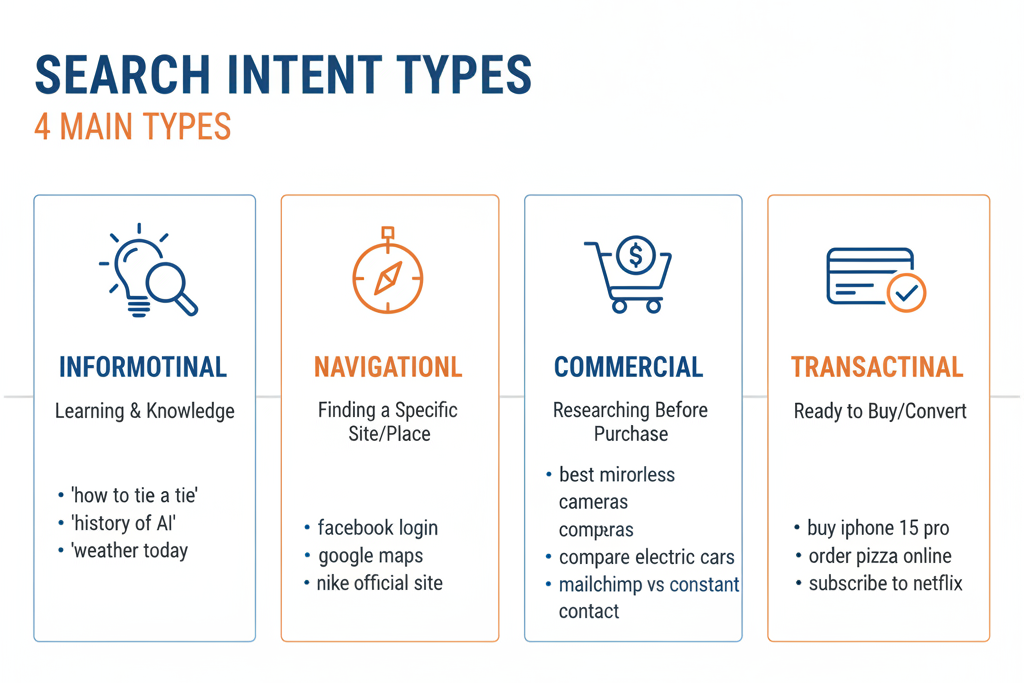
Understanding search intent begins with recognizing its fundamental categories. SEO professionals and content strategists commonly categorize search intent into four primary types: informational, navigational, commercial investigation, and transactional. Each type signifies a distinct user objective and demands a tailored approach to content creation and optimization.
Informational Intent
Users with informational intent are seeking knowledge or answers to specific questions. They are typically in the early stages of their buyer's journey, exploring a topic, learning something new, or trying to solve a problem. Examples include "how to tie a tie," "what is quantum computing," "best practices for content marketing," or "symptoms of common cold."For informational queries, search engines prioritize comprehensive, accurate, and easily digestible content. The goal is to provide a complete answer or detailed explanation without necessarily pushing a product or service directly. Content formats that typically satisfy informational intent include blog posts, guides, tutorials, encyclopedic articles, and FAQs.
Navigational Intent
Navigational intent occurs when a user is attempting to reach a specific website or web page. They already know where they want to go and are using the search engine as a shortcut to get there quickly. Common examples include "Facebook login," "Articfly website," "Amazon customer service," or "CNN news."For these queries, the ideal content is typically the specific page the user is looking for, often the homepage, a login page, or a specific product/service page of a known brand. Optimizing for navigational intent primarily involves ensuring your brand name and key page names rank prominently for direct searches.
Commercial Investigation Intent
Users with commercial investigation intent are actively researching products or services. They are considering a purchase but are not yet ready to commit. Their searches often involve comparisons, reviews, best-of lists, or queries about specific features and benefits. Examples include "best CRM software," "iPhone 15 vs. Samsung Galaxy S24," "Articfly features review," or "pros and cons of cloud storage."Content for commercial investigation intent must be thorough, unbiased (or appear unbiased), and provide ample information for users to make an informed decision. This includes detailed reviews, comparison articles, buyer's guides, case studies, and feature breakdowns. The aim is to build trust and educate the user, positioning your offering as a strong contender without immediate transactional pressure.
Understanding the "why" behind a search query is not merely an SEO tactic; it's the foundational principle for delivering genuinely valuable content in the AI search era.
Transactional Intent
Transactional intent signifies a user's readiness to complete an action, usually a purchase or a sign-up. These users are at the final stage of their journey and are looking for product pages, pricing information, sign-up forms, or checkout pages. Examples include "buy Nike running shoes," "subscribe to Articfly," "discount codes for software X," or "order pizza online."For transactional queries, content must be direct, clear, and facilitate the desired action with minimal friction. This means optimizing product pages, service pages, landing pages, and checkout flows. Strong calls-to-action (CTAs), clear pricing, and straightforward processes are crucial. Providing immediate access to the purchase or conversion point is key.
How to Identify Search Intent
Accurately identifying search intent is a critical skill for effective content optimization. While intuitive understanding can help, a systematic approach involving data analysis provides the most reliable insights. The primary methods for determining the user intent behind search queries include keyword analysis, SERP analysis, and examining user behavior data.
Keyword Analysis
Begin by analyzing the keywords themselves. Certain phrases strongly suggest a specific intent:- Informational: "how to," "what is," "guide," "learn," "examples," "ideas," "tutorial," "why."
- Navigational: Brand names, specific website names, "login," "account," "careers."
- Commercial Investigation: "best," "review," "comparison," "vs," "alternative," "top X," "features," "price."
- Transactional: "buy," "shop," "deal," "discount," "order," "subscribe," "sign up," "download," "pricing."
Using keyword research tools can help identify long-tail keywords that often reveal more specific intent than short, broad terms. For instance, "digital marketing" is broad (informational/commercial), but "best digital marketing tools for small business" clearly indicates commercial investigation intent.
SERP Analysis
The Search Engine Results Page (SERP) itself is arguably the most powerful intent signal. Google's algorithms are designed to deliver the most relevant results for a query, meaning the top-ranking pages often reflect the dominant intent Google has identified. Analyze the following aspects of the SERP:- Top-Ranking Content Types: Are the top results mostly blog posts, product pages, videos, or comparison guides? This indicates the type of content Google believes best satisfies the intent.
- Featured Snippets: If there's a "How-to" or "What is" featured snippet, it strongly suggests informational intent. Product carousels or shopping ads indicate commercial or transactional intent.
- PAA (People Also Ask) Boxes: These questions reveal related informational queries that users frequently ask, helping to flesh out comprehensive informational content.
- Shopping Results/Ads: The presence of Google Shopping results or paid ads for specific products often points to commercial or transactional intent.
By mimicking the successful formats and content types found on the first page, you can align your content strategy with Google's understanding of user intent.

User Behavior Data
Post-click user behavior provides valuable insights into whether your content successfully met user intent. Metrics from tools like Google Analytics can serve as powerful intent signals:- Dwell Time: Longer dwell times (time spent on page) generally indicate that users found the content relevant and engaging, fulfilling their intent.
- Bounce Rate: A high bounce rate, especially for non-transactional pages, can signal that users did not find what they were looking for, suggesting a mismatch in intent.
- Conversion Rates: For commercial and transactional pages, high conversion rates directly demonstrate successful intent fulfillment.
- Page Flow/Exit Pages: Analyzing how users navigate through your site or where they exit can reveal if your content is leading them towards their goal or if they are abandoning the journey.
By combining these analytical approaches, you can move beyond assumptions and make data-driven decisions about the intent behind various queries, allowing for more precise content optimization.
Content Formats for Each Intent Type
Once search intent is identified, the next strategic step is to select and structure the content format that best serves that intent. Different content types inherently align better with specific user goals, maximizing relevance and user satisfaction.
For Informational Intent: Blog Posts, Guides, and FAQs
Content designed for informational intent should be comprehensive, educational, and easy to consume.- Blog Posts: Ideal for answering specific questions, explaining concepts, or exploring industry trends. They can range from short articles to in-depth analyses. Structure with clear headings, subheadings, bullet points, and visuals.
- Comprehensive Guides/Tutorials: For complex topics that require step-by-step instructions or extensive explanations. These often become evergreen content pieces that attract continuous organic traffic.
- FAQs (Frequently Asked Questions): Directly address common user queries, providing concise and clear answers. Can be standalone pages or sections within broader articles.
- Resource Hubs: Curated collections of articles, videos, and tools around a central topic, positioning your site as an authority.
For Navigational Intent: Homepages and Branded Pages
Navigational intent is the most straightforward to address. Users are looking for a specific destination.- Homepages: The primary destination for branded searches like "Articfly." Ensure it clearly communicates your brand, offers, and provides easy navigation.
- Specific Product/Service Pages: If a user searches for a specific product name (e.g., "Articfly content creator"), they expect to land directly on that product's dedicated page.
- Contact/Login Pages: For queries like "Articfly login," ensure the direct login page is accessible and ranks well.
For Commercial Investigation Intent: Comparison Guides and Reviews
Users in the commercial investigation phase need detailed, comparative information to make informed decisions.- Comparison Guides: Pitting your product/service against competitors (e.g., "Articfly vs. Competitor X"). These should highlight strengths, weaknesses, and unique selling propositions.
- Detailed Reviews: In-depth analyses of products or services, covering features, benefits, user experience, and potential drawbacks. Often include ratings, testimonials, and multimedia.
- Buyer's Guides: Comprehensive articles that help users understand what to look for when purchasing a specific type of product (e.g., "How to Choose the Best AI Content Platform").
- Case Studies: Demonstrating real-world success stories of how your solution solved a client's problem, building credibility and trust.
For Transactional Intent: Product Pages and Landing Pages
When a user has transactional intent, they are ready to act. The content must facilitate this action efficiently.- Product/Service Pages: Optimized to convert. This includes clear product descriptions, high-quality images/videos, pricing, availability, compelling CTAs, customer reviews, and easy "Add to Cart" or "Buy Now" buttons.
- Dedicated Landing Pages: For specific campaigns or offers (e.g., "Sign up for a free trial of Articfly"). These pages should have a single, clear call-to-action and minimal distractions.
- Pricing Pages: Transparent and easy-to-understand pricing structures, often with different tiers and a clear path to purchase.
- Checkout Pages: Streamlined, secure, and user-friendly checkout processes are paramount to prevent abandonment.
Tone and Style Adjustments for User Intent
Beyond the content format, the tone, style, and overall presentation of your content play a crucial role in fulfilling search intent and enhancing the user experience. Tailoring these elements ensures that your message resonates effectively with the user's current mindset.
Tone Adaptation
The emotional and intellectual feel of your writing should match the user's intent:- Informational Content: Adopt an authoritative, educational, and objective tone. The language should be clear, concise, and easy to understand, without being overly technical unless the audience demands it. Focus on clarity and factual accuracy.
- Navigational Content: The tone is less about writing style and more about directness. It should be helpful and immediate, guiding the user directly to their desired destination without unnecessary preamble.
- Commercial Investigation Content: Here, the tone should be persuasive yet balanced. It's informative but also aims to build trust and highlight benefits. Use a confident, knowledgeable, and empathetic voice that addresses user concerns and showcases solutions. Avoid overly aggressive sales language, focusing instead on value proposition and differentiation.
- Transactional Content: The tone should be urgent, encouraging, and reassuring. It needs to instill confidence in the user that they are making the right choice. Use active verbs and clearly state the benefits of immediate action. Ensure the language is straightforward, focusing on completing the transaction smoothly.
Adapting your content's tone and style to align with search intent isn't just a stylistic choice; it's a strategic imperative that directly impacts user engagement and conversion rates.
Call-to-Action (CTA) Adjustments
CTAs must be appropriate for the intent:- Informational: CTAs are softer and educational, such as "Read More," "Download Our Guide," "Subscribe for Updates," or "Learn More." They encourage further engagement with content, not immediate purchase.
- Navigational: CTAs are implicit in the site navigation itself, or direct links like "Login" or "Go to Account."
- Commercial Investigation: CTAs encourage deeper engagement with the product/service, such as "Compare Features," "Request a Demo," "Read Reviews," "Get a Free Trial," or "View Pricing."
- Transactional: CTAs are direct and urgent, focusing on conversion: "Buy Now," "Add to Cart," "Sign Up Today," "Get Started," or "Order Now."
Content Presentation and User Experience
The visual layout and interactive elements also require adaptation:- Informational: Emphasize readability with ample white space, clear typography, and logical structure. Use bullet points, numbered lists, images, and videos to break up text and aid comprehension.
- Navigational: Clean design, fast loading times, and prominent branding are key. The primary goal is efficient access.
- Commercial Investigation: Professional design, clear feature tables, comparison charts, client testimonials, and interactive elements (e.g., configurators) can enhance the user's research process. High-quality visuals are essential.
- Transactional: Streamlined design, minimal distractions, trust signals (security badges, customer reviews), clear progress indicators for forms, and a responsive layout across devices are crucial for conversion.

By meticulously adjusting tone, CTAs, and presentation, content creators can craft experiences that not only satisfy search engines but, more importantly, genuinely fulfill the diverse needs of their human audience, regardless of their current intent.
Measuring Success and Optimizing Intent-Based Content
Optimizing content for search intent is an iterative process that requires continuous measurement and refinement. Success is not merely about ranking; it's about whether the content genuinely satisfies the user's intent once they arrive on the page. By tracking specific metrics, content creators can evaluate performance and identify areas for further optimization.
Key Metrics for Intent-Based Content
Different intent types will emphasize different success metrics:- Dwell Time / Time on Page: For informational content, a longer dwell time indicates that users are finding the content engaging and comprehensive, suggesting their informational intent is being met. Conversely, for navigational intent, a very short dwell time might be a positive sign if users quickly found their desired page.
- Bounce Rate: A low bounce rate generally signifies that the content is relevant to the user's query. For informational and commercial investigation content, a high bounce rate suggests a mismatch between intent and content. For transactional pages, a high bounce rate indicates friction in the conversion process.
- Conversion Rates: This metric is paramount for transactional and commercial investigation content. It directly measures the percentage of users who complete a desired action (e.g., purchase, sign-up, demo request). High conversion rates confirm that the content effectively guided users to their goal.
- Click-Through Rate (CTR): While not solely an on-page metric, a high CTR from the SERP indicates that your title and meta description effectively communicated relevance to the user's intent, enticing them to click.
- Pages Per Session: For informational or commercial investigation content, a higher number of pages per session indicates that users are exploring related content on your site, suggesting deeper engagement and successful intent fulfillment beyond the initial query.
- Engagement Rate: This can include interactions like video plays, form submissions, or comments. For all content types, higher engagement rates suggest that the content is compelling and meeting user expectations.
Content Optimization Strategies
Based on the insights gained from performance metrics, various optimization strategies can be employed:- Content Refinement: If informational content has a high bounce rate, consider expanding on key points, adding more visuals, or clarifying explanations. If commercial investigation content isn't leading to conversions, strengthen your value proposition or address common objections more directly.
- CTA Placement and Wording: Experiment with different CTA placements (above the fold, mid-content, at the end) and variations in wording to see what resonates best with the specific intent.
- Internal Linking Structure: Improve internal links to guide users with informational intent to related articles, or users with commercial investigation intent to relevant product pages, facilitating their journey.
- A/B Testing: Test different headlines, layouts, image placements, and even tone variations to see which combinations yield better results for specific intent types.
- User Feedback: Directly solicit feedback through surveys or polls to understand what users found helpful or lacking, providing qualitative data to complement quantitative metrics.
- SERP Feature Optimization: Actively optimize content to appear in featured snippets, 'People Also Ask' sections, or rich results, as these directly address specific intents and increase visibility.
Articfly's AI Approach to Intent Optimization
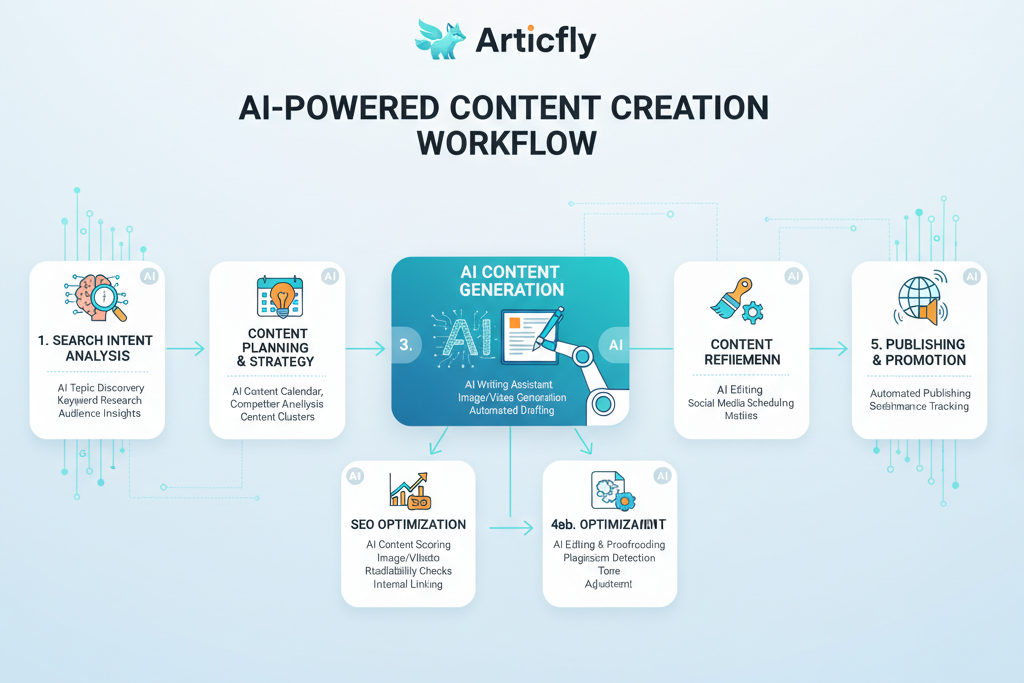
Navigating the complexities of search intent and manually optimizing content for each type can be a time-consuming and resource-intensive endeavor. This is where Articfly’s AI-powered platform provides a significant advantage, automating the intricate process of intent analysis and content creation to deliver highly relevant and effective articles.
Articfly is a SaaS company specializing in AI-powered blog content creation, designed to empower businesses, agencies, and creators. Our proprietary AI system transforms the way blogs are built, turning raw ideas or keywords into engaging, data-driven articles in minutes. A cornerstone of this system is its sophisticated intent analysis capability.
Automated Intent Analysis and Content Creation
The Articfly platform begins by performing a deep dive into search queries and SERP data, much like an experienced SEO specialist but with unmatched speed and scale. Our AI system automatically:- Identifies Primary Intent: For any given topic or keyword, Articfly's AI accurately discerns the dominant search intent (informational, navigational, commercial investigation, or transactional) by analyzing vast datasets of successful content and user interactions.
- Structures Content for Intent: Based on the identified intent, the AI system then plans and structures the complete blog post. For informational intent, it will generate a comprehensive guide with explanatory sections. For commercial investigation, it might suggest a comparison article format. This automated optimization ensures the content's architecture is inherently aligned with user expectations.
- Generates Relevant Content: Articfly's AI then proceeds to write the article, populating the structured outline with highly relevant, factual, and engaging text. It incorporates keywords naturally, answers anticipated questions, and provides the depth required for the specific intent.
- Applies SEO Best Practices: Beyond intent, the system integrates a wide array of SEO best practices, including optimal heading structures, internal linking suggestions, and meta-data considerations, all designed to maximize search visibility and content relevance.
Tailored Tone and Brand Identity
Articfly goes a step further by tailoring content not only to intent but also to the client's specific tone and brand identity. This means that whether your brand is precise and factual, or vibrant and colloquial, the AI system adapts its writing style to maintain consistency, ensuring the generated articles feel authentically yours.By leveraging Articfly’s AI content creation platform, businesses can achieve high-quality, SEO-optimized blog articles that are meticulously tailored to search intent, automatically. This saves significant time, reduces costs, and ensures a consistent output of content that truly resonates with the target audience, making high-quality content production effortless and scalable for startups, agencies, and growing brands alike.
Future-Proofing Your Content Strategy with Intent
In the dynamic landscape of AI-driven search, understanding and optimizing for search intent is no longer a luxury but a fundamental requirement for digital success. Moving beyond mere keywords to embrace the "why" behind user queries allows content to be more relevant, engaging, and ultimately, more effective. By dissecting the four types of intent, employing robust identification methods, tailoring content formats, and refining tone and style, content creators can ensure their efforts yield measurable results and foster genuine user satisfaction.
The strategic application of intent-focused content not only enhances user experience but also future-proofs your SEO strategy against evolving AI algorithms. Platforms like Articfly exemplify how automation can empower content teams, transforming the complex art of intent optimization into an efficient, scalable process. Embrace intent-driven content creation to build a resilient and impactful online presence. Ready to transform your content strategy? Explore how Articfly can automate your intent-optimized content generation today.