
Why SEO Still Matters in the 2026 AI Landscape

Search engine relevance remains the primary driver for long-term digital growth even as artificial intelligence transforms how content is produced. While AI tools can generate high volumes of text, search engines continue to prioritize authority and intent-matching that generic outputs cannot achieve on their own. Maintaining organic visibility provides a distinct competitive advantage in an increasingly crowded digital marketplace.
SEO acts as the strategic layer that ensures content is not just created, but discovered by the right audience. As AI saturates search results, the need for technical optimization and human-centric relevance becomes more critical for brand distinction. Businesses that treat SEO as a foundation rather than an afterthought will see more sustainable traffic.
| Feature | AI-Only Content | SEO-Optimized AI Content |
|---|---|---|
| Search Intent Alignment | Low | High |
| Organic Ranking Potential | Variable | Consistent |
| Authority Building | Limited | Strategic |
For more information, see Articfly’s AI‑Powered Content Creation page and the Search Engine Journal 2025 report.
Understanding Leadership Priorities and Concerns

Executive alignment is essential when presenting a business case for marketing investment. C-level leaders are focused on revenue growth, cost efficiency, and the mitigation of long-term business risks. By framing SEO as a tool for reducing customer acquisition costs (CAC) and improving brand authority, you speak directly to these priorities.
Many executives harbor misconceptions about the cost and speed of SEO compared to paid advertising. It is important to demonstrate how organic traffic builds cumulative value over time, unlike paid channels where traffic stops as soon as the budget is exhausted. This shift from an expense mindset to an asset mindset is key for approval.
"Strategic digital investment is not about spending more; it is about building the infrastructure that makes every dollar work harder for the long term."Public Executive Interview
Reference our internal case study on cost savings or the Harvard Business Review article on tech investment decisions for additional context.
Building a Data‑Driven Business Case for SEO
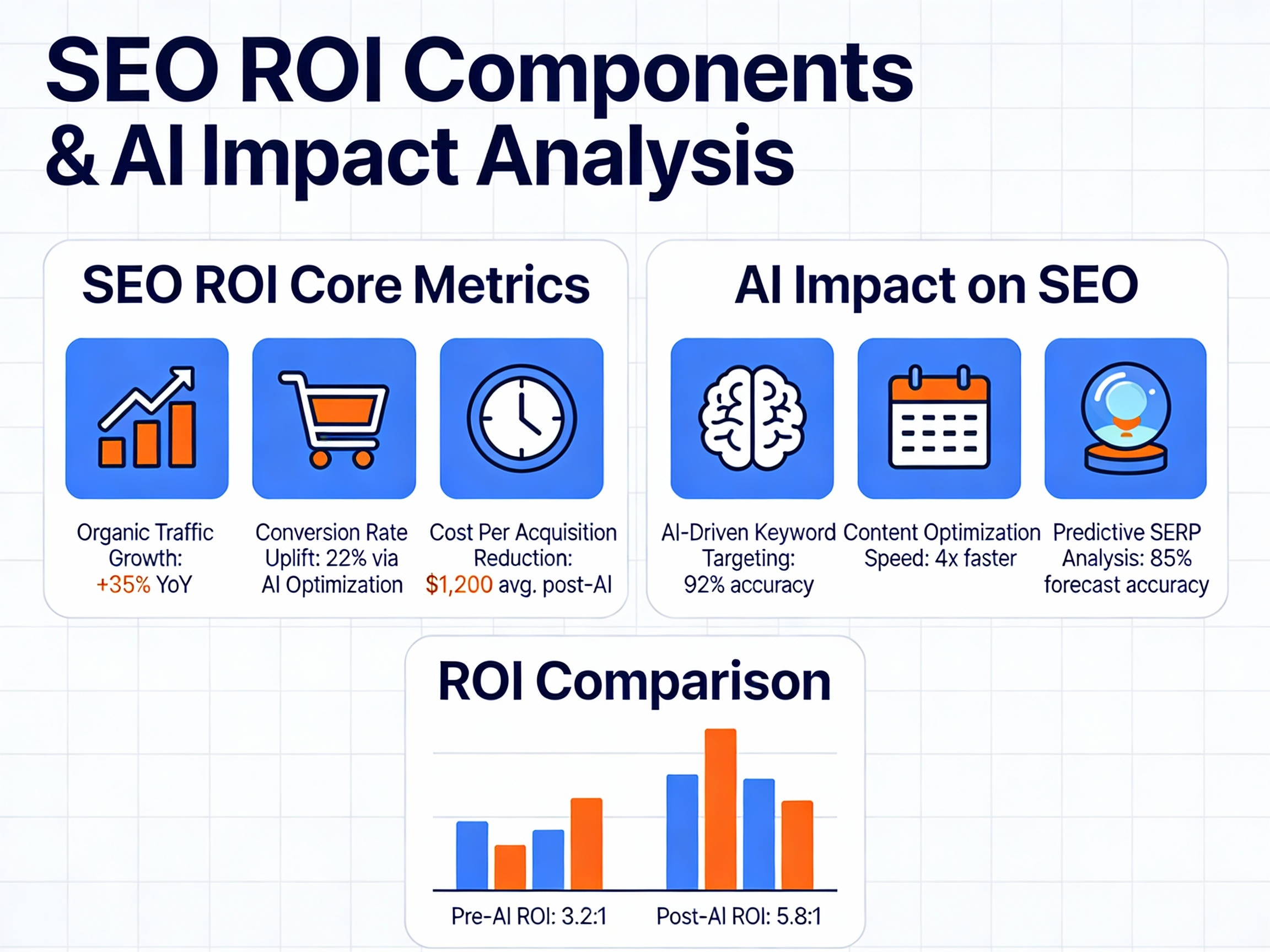
Quantifiable growth frameworks provide the necessary evidence to support a request for increased budget or resources. To build a solid case, you must first identify baseline metrics such as current organic traffic and conversion rates. Translating these figures into potential revenue impact allows stakeholders to see the financial benefit of the investment.
AI-driven efficiency gains should also be factored into the business case to show cost avoidance. By using automation, content teams can reduce writer hours and streamline production workflows significantly. This combination of increased output and reduced overhead creates a compelling argument for resource allocation.
| Metric Category | Current Baseline | Projected Lift | Estimated Value |
|---|---|---|---|
| Organic Traffic | [Fill Value] | 5-15% | [Fill Value] |
| Conversion Rate | [Fill Value] | [Fill Value] | [Fill Value] |
| Content Cost | [Fill Value] | -30% to -50% | [Fill Value] |
Utilize Articfly’s ROI calculator or Moz’s SEO metrics guide to refine these estimates.
Quantifying ROI Without Exact Numbers
Projected traffic growth should be presented in ranges to maintain credibility while acknowledging market fluctuations. Using terminology such as "potential growth" or "estimated lift" helps manage executive expectations. Citing reputable industry averages provides a benchmark for what success looks like in your specific sector.
- "Based on industry trends, we anticipate a potential 5-15% increase in organic reach."
- "The projected ROI is modeled on a range of performance outcomes."
- "These estimates are based on industry-standard benchmarks for comparable markets."
Further data can be found via Statista SEO statistics.
Benchmarking Against Competitors
Competitive gap analysis serves as both a defensive and offensive tool in your strategic arsenal. By analyzing search engine result page (SERP) coverage, you can highlight exactly where competitors are capturing market share that your brand is missing. This visualization of "lost opportunity" is often a strong motivator for leadership action.
Competitor Keyword Gap Analysis (Text Representation):
Competitor A: |||||||||||||||||||| (80% Coverage)
Competitor B: |||||||||||||| (60% Coverage)
Your Brand: |||||| (25% Coverage)
Check the competitor analysis feature of Articfly for more detailed insights.
Communicating Value: Storytelling Techniques for Executives

Narrative-driven communication transforms raw data into a strategic vision that leadership can easily support. Using the Problem-Solution-Benefit framework ensures that every technical metric is tied back to a business outcome. This approach humanizes the data and makes the long-term value of SEO more relatable.
Creating a concise executive summary is the final step in the communication process. This one-pager should distill the most important points into an easily digestible format. It ensures that busy decision-makers can grasp the core value proposition without getting bogged down in technical jargon.
| Section | Objective / Focus |
|---|---|
| Strategic Header | Summary of the primary goal |
| Key Metrics | Traffic, conversion, and ROI estimates |
| Action Items | Specific next steps and timeline |
Download our template or view the storytelling guide from Stanford for more tips.
Using Analogies to AI Automation
Bridge technical concepts by using familiar analogies that explain the relationship between search strategy and AI output. Comparing SEO to a navigation system for a vehicle helps stakeholders understand that AI generates the "power" while SEO provides the "direction." This clarifies why both are necessary for success.
"If AI content is the engine, SEO is the steering wheel; one provides the volume, the other ensures you reach the destination."
Crafting One‑Pager Summaries
Streamlined summary formats allow for rapid decision-making by presenting only the most critical information. A successful one-pager includes the objective, projected metrics, estimated ROI, and immediate next steps. This brevity shows respect for executive time while providing all necessary data points.
| Objective: Increase organic market share by 10% in Q4. |
| Key Metric: 15% reduction in CAC via organic search growth. |
| ROI Estimate: Potential 3x return on investment over 12 months. |
Access the Articfly template download for a ready-to-use version.
Leveraging AI‑Powered Tools to Reduce Costs
Operational efficiency is the most immediate benefit of integrating AI into an SEO strategy. Platforms like Articfly automate time-consuming tasks such as topic research and the generation of detailed content briefs. This automation allows content teams to scale their output without a proportional increase in headcount.
Using AI-drafting can potentially cut writer hours by up to 50%, allowing for a higher volume of optimized content at a lower price point. Because SEO best practices are embedded into the generation process, the resulting articles are ready for publication much faster. This efficiency is a core component of the business case for modern content teams.
Workflow Savings Infographic (Text):
Manual Workflow: Research (3h) -> Brief (2h) -> Draft (6h) -> SEO (2h) = 13 Hours
AI Workflow: Articfly Research/Brief (0.5h) -> AI Draft (1h) -> Human Edit (2h) = 3.5 Hours
Visit the Articfly product page or read the Gartner report on AI in content creation for more details.
Addressing Common Objections and Risk Mitigation
Strategic risk mitigation involves identifying and answering potential pushback before it happens. Common concerns include the time it takes for SEO to show results or the fear that AI will eventually make SEO obsolete. Addressing these directly shows that the strategy is well-considered and robust.
To mitigate budget constraints, propose a phased investment rather than a massive upfront cost. Demonstrating short-term wins through synergy with paid search can help prove the value of the organic strategy early on. This incremental approach reduces the perceived risk for financial stakeholders.
- Concern: SEO takes too long to see results. Response: We will target low-competition keywords for early wins.
- Concern: AI will replace search. Response: Search intent is evolving, and SEO ensures we are found in AI-driven results.
- Concern: We don't have the budget. Response: AI tools reduce production costs, making SEO more affordable than before.
Consult our pricing page or the McKinsey article on AI adoption risks for more information.
Action Plan: Securing Budget Approval
Budget approval checklists provide a clear roadmap for the final presentation to leadership. The process begins with data collection, specifically focusing on traffic, conversion rates, and the gaps identified in competitor analysis. Having these numbers ready ensures the conversation stays grounded in business reality.
- Assemble comprehensive data on current traffic and conversion benchmarks.
- Draft an executive one-pager that highlights ROI and cost avoidance.
- Schedule a formal presentation with the CFO or CEO to review the proposal.
- Establish a timeline for a pilot program to demonstrate initial results.
Refer to our project management template for a detailed execution plan.
Key Takeaways
Core strategic insights emphasize that SEO is not just a technical task but a vital business asset. As AI changes the volume of content online, the quality and structure provided by SEO become the deciding factors in visibility. A well-constructed business case focuses on efficiency, competition, and clear financial returns.
- Strategic Pillar: SEO remains essential for visibility in an AI-saturated market.
- Data Focus: Framing ROI through cost avoidance and revenue lift wins buy-in.
- AI Synergy: Tools like Articfly reduce production overhead while maintaining quality.
- Risk Management: Addressing objections early builds confidence with leadership.
FAQ
Common implementation queries help clarify the nuances of an AI-enhanced SEO strategy for stakeholders. These questions address the most frequent points of curiosity or concern that arise during the budget approval process.
How quickly can SEO show measurable results?While long-term growth takes time, identifying and optimizing for low-competition keywords can often show movement within 3 to 6 months.
Can AI‑generated content rank without SEO optimization?Unoptimized AI content lacks the structure and intent-matching required to rank consistently; SEO is the necessary guide for AI output.
What budget range is realistic for a mid‑size company?Budgets vary, but a phased approach using AI tools often allows for a high-impact strategy at a lower cost than traditional manual content creation.
How does Articfly ensure content quality?Articfly uses proprietary AI that analyzes search intent and brand tone to produce high-quality, ready-to-publish articles.
What metrics should I track post‑implementation?Focus on organic impressions, keyword rankings, click-through rates, and ultimately, conversions and cost per lead.
Read more in our knowledge base articles for each FAQ.
Ready to take action?
To begin implementing these strategies, start a free 14-day trial of Articfly and explore how AI can streamline your content creation. You can also download our comprehensive SEO Executive Playbook in PDF format to share with your leadership team. For those who prefer a personalized walkthrough, please use our contact form to schedule a demo of the platform and see how it fits your specific brand needs.
Start Free Trial
Search for Articfly on reputable review sites to see how other companies are scaling their content.