TL;DR: Mastering Product-Led Content
Product-led content shifts the focus from overt selling to providing immense value, naturally integrating your solution as the answer to audience challenges. This strategy builds trust, attracts highly qualified leads, and significantly boosts conversion rates and ROI by showcasing your product's utility through educational and problem-solving content. It requires strategic planning, audience understanding, and a nuanced approach to balancing valuable insights with subtle product demonstration.
Table of Contents
- The Art of Subtle Product Integration
- Why Product-Led Content Works: Benefits and ROI
- Planning Your Product-Led Content Strategy
- Content Creation Techniques: The How-To Guide
- Real-World Examples and Case Studies
- Balancing Value and Promotion: The Golden Ratio
- Measuring Success and Optimization
- Best Practices and Common Pitfalls to Avoid
- Implementing Product-Led Content with Articfly
The Art of Subtle Product Integration
In today's saturated digital landscape, content marketing faces an increasingly formidable challenge: cutting through the noise. Businesses vie for attention, often resorting to aggressive promotional tactics that alienate potential customers. The modern consumer is discerning, seeking genuine value and solutions to their problems, not relentless sales pitches. This shift in consumer behavior necessitates a more sophisticated approach, one where content serves as a guide, an educator, and a problem-solver, with the product emerging as the natural answer.
This is precisely where product-led content distinguishes itself. Product-led content is a strategic methodology that focuses on creating blog posts and other content assets that provide significant standalone value to the reader, while organically showcasing how a specific product or service solves the problems addressed within the content. It's about demonstrating utility and expertise through practical application rather than direct selling. The core concept is to deliver actionable insights, tutorials, or analyses where the product is not merely advertised but is integral to the solution being presented.
The importance of this approach cannot be overstated. By embedding your product within valuable content, you establish credibility and trust. Readers engage with your brand because they perceive genuine help, not just a sales funnel. This methodology transforms your blog from a mere marketing channel into a comprehensive resource that anticipates user needs and subtly guides them towards your solution. It builds a foundation of trust and demonstrates the product's value in a contextually relevant and non-intrusive manner, fostering a stronger, more authentic connection with your audience. This strategy moves beyond traditional content marketing, aligning the product directly with the informational needs of the user, leading to more meaningful engagement and, ultimately, higher conversions.
Ultimately, product-led content is about educating and empowering your audience. It helps them understand their challenges better and illustrates how your solution fits seamlessly into their workflow or problem-solving process. This subtle yet powerful integration ensures that by the time a reader considers purchasing, they already understand the inherent value and practical application of your offering, leading to a more informed and willing customer. It transforms passive readers into active users, paving a clear path from awareness to advocacy through valuable, product-centric storytelling.

Why Product-Led Content Works: Benefits and ROI
The shift towards product-led content is not simply a trend; it is a strategic imperative driven by measurable benefits and a clear return on investment (ROI). By integrating your product as a solution within valuable content, businesses unlock several key advantages that translate directly into improved performance and sustainable growth.
One of the primary benefits is significantly higher conversion rates. When customers discover a product through content that addresses their specific pain points and demonstrates a solution, they are pre-qualified and inherently more receptive. They've experienced the product's utility first-hand, albeit indirectly, fostering a deeper understanding and desire. Data from HubSpot indicates that companies that blog generate 67% more leads than those that don't, and product-led content amplifies this by ensuring those leads are genuinely interested in the problem your product solves.
Secondly, product-led content leads to better qualified leads. Unlike broad marketing campaigns, this approach targets users actively seeking solutions to the exact problems your product addresses. By educating them through your content, you filter out casual browsers and attract individuals who are further along the buying journey, understand their needs, and see your product as a viable answer. This efficiency reduces wasted marketing spend and shortens sales cycles.
Thirdly, it cultivates improved trust and authority. When your brand consistently provides valuable, unbiased information and positions its product as a helpful tool rather than a sales target, you build credibility. Consumers trust brands that educate them. A study by Edelman found that 81% of consumers say they need to trust a brand to buy from them. Product-led content effectively builds this trust by demonstrating expertise and prioritizing customer needs, establishing your brand as a thought leader in its niche.
"By integrating your product within valuable content, you establish credibility and trust. Readers engage with your brand because they perceive genuine help, not just a sales funnel."
Furthermore, product-led content contributes to a longer content lifespan. Evergreen content, which remains relevant over time, is a hallmark of this strategy. When content focuses on solving fundamental problems using your product's capabilities, it maintains its value long after publication. For instance, a tutorial demonstrating how to achieve a specific outcome with your software will remain useful as long as the problem exists and the software feature is relevant. This reduces the constant need for new content creation and maximizes the value of existing assets.
Finally, this approach delivers stronger SEO performance. Product-led content is naturally rich in relevant keywords related to user problems and solutions. By addressing specific queries and demonstrating product utility, you create highly relevant, authoritative content that search engines favor. This boosts organic visibility, drives targeted traffic, and positions your brand as the go-to resource for specific challenges. Google's algorithm prioritizes content that best answers user intent, and product-led content is inherently designed to do just that, leading to higher rankings and sustained organic growth.
Planning Your Product-Led Content Strategy
A successful product-led content strategy is not accidental; it is the result of meticulous planning and a deep understanding of your audience. Establishing a robust framework ensures that every piece of content serves a purpose, aligns with business objectives, and genuinely helps your prospective customers.
Audience Research and Problem Identification
The foundational step is to thoroughly understand your target audience. Go beyond demographics to delve into psychographics: what are their daily challenges, professional goals, and pain points? Conduct interviews, analyze forum discussions, review customer support tickets, and use tools like keyword research to uncover common questions and problems. Your content should directly address these identified issues. For instance, if your product helps automate social media, identify specific challenges like "scheduling posts manually takes too long" or "struggling with content ideas for social media."
Content Mapping to the Customer Journey
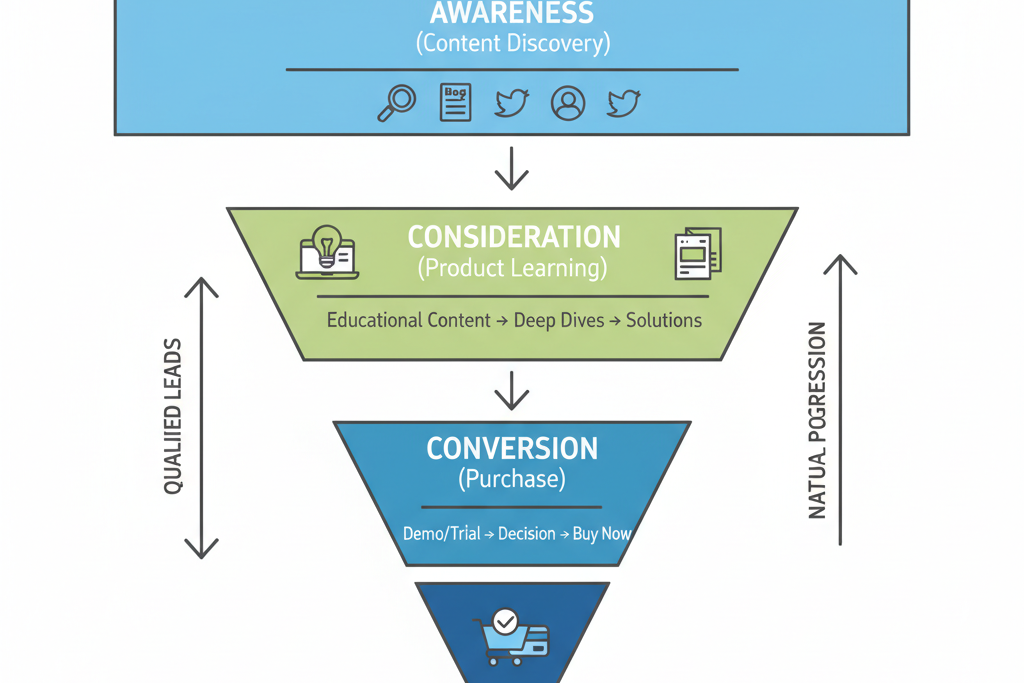
Once problems are identified, map them to different stages of the customer journey: awareness, consideration, and decision. Content for the awareness stage might focus on broad problem education, with the product subtly hinted at as a potential solution. Consideration stage content would delve deeper into specific solutions, showcasing how your product directly addresses these. Decision stage content might involve comparisons or in-depth tutorials that seal the deal. This mapping ensures content relevance at every touchpoint.
Product Feature Alignment
Identify which specific features of your product resolve the identified problems. Each piece of content should ideally highlight one or more features as integral to the solution. This is not about listing features but demonstrating their utility in context. For example, if your product has an AI-powered content calendar, a blog post could discuss "How to Never Run Out of Blog Post Ideas" and subtly showcase the calendar feature as the mechanism for consistent ideation and scheduling.
Content Calendar Planning and Worksheet Approach
Organize your insights into a comprehensive content calendar. This calendar should detail content topics, target audience segments, customer journey stage, relevant product features, keywords, and publication dates. A practical worksheet approach can streamline this: for each potential blog post, fill out sections such as:
- Problem: What specific pain point does this content address?
- Solution: How does our product, specifically [feature X], solve this problem?
- Content Type: (e.g., How-to guide, Listicle, Tutorial)
- Target Keyword: Primary and secondary keywords.
- Customer Journey Stage: (Awareness, Consideration, Decision)
- Call to Action (Subtle): What is the next logical step for the reader?
This structured approach ensures consistency, maximizes relevance, and aligns all content efforts with your overarching product strategy, transforming your blog into a powerful lead-generation and nurturing engine. By proactively planning, you prevent content gaps and ensure every article contributes to guiding potential customers towards your solution effectively.

Content Creation Techniques: The How-To Guide
Crafting effective product-led content requires more than just knowing what to write; it demands mastery of specific techniques that seamlessly integrate your solution without resorting to overt sales tactics. Here are several practical approaches and writing formulas to elevate your product-led content.
Problem-Solution Framework
This is the most fundamental technique. Start by clearly articulating a common problem your audience faces. Dedicate a significant portion of the content to exploring the nuances, impacts, and common misconceptions about this problem. Then, introduce your product's feature(s) as the elegant, efficient, or superior solution. The product isn't forced; it emerges naturally from the discussion of the problem. A simple formula is: Problem -> Agitation -> Solution (with product) -> Benefits.
Case Study Integration
Instead of a standalone case study, weave mini-case studies or examples of customer success directly into your blog posts. For instance, in an article about "Boosting Team Productivity," you might include a section detailing "How Company X Achieved 30% Higher Output Using [Your Product's Feature]." This shows tangible results through real-world application, making the product's value undeniable.
Feature Demonstration in Context
Avoid dry feature lists. Instead, demonstrate how a specific product feature works within a practical scenario. If your product is project management software, a post titled "Simplifying Complex Project Workflows" could walk through a typical project lifecycle, showing how your Gantt chart feature organizes tasks, or how your communication tools streamline team collaboration. Use screenshots or short embedded videos to illustrate the feature in action, making its utility clear.
"Crafting effective product-led content requires more than just knowing what to write; it demands mastery of specific techniques that seamlessly integrate your solution without resorting to overt sales tactics."
Educational Tutorials
Tutorials are inherently product-led, provided they focus on teaching a skill or achieving an outcome where your product is the primary tool. A post like "How to Create an Engaging Social Media Calendar in 30 Minutes" could guide users step-by-step through setting up and populating a calendar using your social media scheduling software. The value is in the "how-to," and your product is the enabler.
Comparison Content
While often seen as decision-stage content, comparison articles can be product-led by highlighting your product's unique advantages in a balanced way. A post comparing "CRM Software for Small Businesses" could objectively discuss various options, but subtly emphasize where your CRM excels in areas that directly address the target audience's specific needs, like ease of use or integration capabilities.
Customer Success Stories
Similar to case studies, these focus on a narrative of transformation. A blog post on "Overcoming Content Creation Bottlenecks" could feature a story about how a client struggled with content generation until they adopted your AI writing platform, detailing their journey and the specific benefits they experienced. These stories resonate emotionally and logically, demonstrating real-world impact.
By employing these techniques, your content provides immediate value while naturally positioning your product as the most effective path to achieving the desired outcome. The key is to always lead with the problem and the solution, letting the product's utility speak for itself.

Real-World Examples and Case Studies
Examining successful implementations of product-led content provides invaluable insights into effective strategies. These real-world examples demonstrate how diverse companies leverage their content to educate, engage, and ultimately convert customers without resorting to overt sales.
Ahrefs Blog Strategy
Ahrefs, a prominent SEO toolset, is a prime example of product-led content done right. Their blog is a goldmine of highly technical, actionable SEO guides and tutorials. Almost every article, while incredibly valuable on its own, uses Ahrefs' tools to illustrate concepts or perform analyses. For instance, an article on "How to Find Low-Competition Keywords" will demonstrate step-by-step how to use Ahrefs' Keyword Explorer or Site Explorer. The product is not just mentioned; it's the indispensable instrument that enables the reader to apply the advice. This strategy generates massive organic traffic and positions Ahrefs as the authority in SEO, naturally attracting users who understand the value of their tools.
Trello's Educational Content
Trello, a project management and collaboration tool, excels at product-led content through educational tutorials and use cases. Their blog features articles like "How to Manage a Remote Team with Trello" or "Using Trello for Editorial Calendars." These posts don't just talk about Trello's features; they show readers how to accomplish specific tasks and solve common organizational problems using Trello boards, cards, and lists. By providing practical, step-by-step guidance, Trello helps users envision themselves successfully utilizing the product, driving adoption and engagement.
Slack's Problem-Solving Approach
Slack's content strategy focuses heavily on solving communication and collaboration challenges that businesses face. Their blog often discusses topics like "Improving Team Communication" or "Streamlining Workflow Efficiency." Within these articles, Slack is presented as the ultimate solution for achieving these goals, showcasing specific features like channels for organized discussions, integrations for centralized information, or huddles for quick calls. They articulate the problem, agitate the pain points, and then present Slack as the natural, intuitive solution, demonstrating its utility rather than just describing its capabilities.
Articfly's Own Content Strategy
As an AI-powered blog content creation platform, Articfly embodies product-led content through demonstrating how automation solves the core problems of content marketers. Our blog features articles like "Generating SEO-Optimized Articles in Minutes" or "Scaling Content Production with AI." These posts don't just explain what Articfly does; they show how our proprietary AI system analyzes search intent, structures content, and applies SEO best practices to produce ready-to-publish articles. By illustrating the efficiency, quality, and scalability achieved through Articfly's platform, we directly address the challenges of time, cost, and consistency in content production, positioning Articfly as the essential tool for modern content teams. The measurable result is increased platform trials and subscriptions from users who understand and value the direct application of AI to their content workflow.
These examples highlight a consistent theme: successful product-led content prioritizes solving the user's problem, with the product acting as the hero of that solution. This approach resonates deeply with audiences, leading to genuine interest and conversion.
Balancing Value and Promotion: The Golden Ratio
The essence of product-led content lies in its delicate balance between providing immense standalone value and subtly promoting your solution. Veer too far one way, and your content becomes generic; lean too heavily the other, and it transforms into a transparent sales pitch. Achieving this "golden ratio" is crucial for maintaining trust and efficacy.
The 80/20 Rule for Content Value vs. Promotion
A widely accepted guideline is the 80/20 rule: approximately 80% of your content should be dedicated to providing pure, unbiased value, while 20% can subtly incorporate your product. This means the vast majority of your article should focus on educating, informing, or entertaining the reader without direct product mentions. When your product is introduced, it should be in the context of solving a problem that has been thoroughly explored, making its inclusion feel natural and helpful, not intrusive.
Timing and Placement of Product Mentions
Strategic timing and placement are critical. Avoid leading with your product. Instead, begin by empathizing with the reader's problem, providing background information, and exploring potential generic solutions. Introduce your product or its specific features only when it becomes logically necessary or demonstrably superior in solving the discussed problem. This often occurs after the problem has been fully elucidated and the reader is actively seeking a resolution. Product mentions can be integrated into examples, case studies, or tutorial steps, always ensuring they enhance the content's value rather than detract from it.
Psychological Principles of Persuasion
Effective product-led content leverages several psychological principles without being manipulative:
- Reciprocity: By consistently providing valuable content, you invoke a sense of obligation in the reader, making them more likely to consider your offering.
- Authority: Demonstrating deep knowledge of a problem and its solutions, often through your product, establishes your brand as an expert.
- Social Proof: Integrating customer success stories or testimonials within your content subtly persuades readers through the actions and experiences of others.
- Liking: Content that genuinely helps and resonates with the audience builds affinity for your brand.
These principles work in concert to build a natural path to conversion, driven by trust and perceived value, rather than overt sales pressure.
Guidelines for Avoiding Hard Selling
To prevent your content from sounding like a sales brochure:
- Focus on benefits, not just features: Explain what the product does for the user, not just what it is.
- Use "show, don't tell": Instead of saying "Our product is easy to use," demonstrate its ease through a quick GIF or screenshot within a tutorial.
- Maintain an educational tone: Your primary role is to teach and inform, not to convince.
- Offer alternatives (where appropriate): Sometimes, acknowledging other solutions (even if inferior) can enhance credibility.
- Keep calls to action soft: Instead of "Buy Now!", use "Learn More," "Try for Free," or "Explore the Feature."
By adhering to these guidelines, product-led content maintains its integrity and effectiveness, converting readers into loyal customers through genuine value and subtle, intelligent integration.

Measuring Success and Optimization
To truly understand the impact of your product-led content, it is essential to establish clear metrics and consistently track performance. This data-driven approach allows for continuous optimization, ensuring your content strategy remains effective and contributes to your business objectives.
Key Metrics to Track
- Conversion Rates: This is paramount. Track how many readers convert into leads, sign-ups, free trial users, or paying customers directly from your product-led content. Use UTM parameters and dedicated landing pages to attribute conversions accurately.
- Time on Page: Longer engagement indicates that readers are finding your content valuable and are spending time digesting it. High time on page often correlates with higher interest.
- Lead Quality: Are the leads generated from product-led content better qualified than those from other channels? Monitor their progression through the sales funnel and their ultimate conversion into customers.
- Content Engagement: Metrics like bounce rate, pages per session, and scroll depth provide insights into how interactive and captivating your content is. Comments and shares can also indicate strong engagement.
- ROI Measurement: Ultimately, link your content efforts back to revenue. Calculate the cost of content creation versus the revenue generated from the leads and customers it influenced. This demonstrates the tangible financial impact of your strategy.
- Product Feature Usage: If your content highlights specific product features, track whether those features see increased adoption or usage after the content is published. This directly validates the content's effectiveness in demonstrating value.
A/B Testing Approaches
A/B testing is crucial for refining your product-led content. Experiment with different elements:
- Call-to-Action (CTA) Placement and Wording: Test whether a subtle CTA embedded mid-article performs better than one at the end, or if "Try for Free" outperforms "Learn More."
- Product Integration Depth: Experiment with how prominently or subtly your product is featured. Some articles might benefit from more explicit demonstrations, while others require a lighter touch.
- Content Formats: Compare the performance of text-heavy guides versus those incorporating more visuals, videos, or interactive elements for product demonstrations.
- Headlines and Introductions: Test different hooks to see which ones attract more initial engagement and lead to lower bounce rates.
Continuous Improvement Strategies
Data from your tracking and A/B tests should feed directly into a cycle of continuous improvement. Regularly review your analytics to identify underperforming content and areas for enhancement. Update outdated statistics, refine product examples, or expand on sections that resonate strongly with your audience. Solicit feedback from your sales team regarding lead quality and common questions, as this can inform future content topics. By treating your content strategy as an evolving process, you ensure it remains responsive to market changes and consistently delivers maximum value to both your audience and your business.

Best Practices and Common Pitfalls to Avoid
Implementing a successful product-led content strategy requires adherence to specific best practices and an awareness of common mistakes that can derail your efforts. By focusing on quality and audience needs, you can maximize impact.
Best Practices for Product-Led Content
- Authenticity and Transparency: Always be genuine. Your goal is to help, not to trick. Let the product's value speak for itself through honest demonstration.
- Customer Focus Above All: Every piece of content should start and end with the customer's problem and how to solve it. Your product is merely the best tool for that solution.
- Consistency in Value Delivery: Don't just produce one great piece; consistently provide high-quality, valuable content that educates and assists your audience over time.
- Deep Product Knowledge: Content creators must have an intimate understanding of the product's features and, more importantly, its benefits and use cases.
- Visual and Interactive Engagement: Use screenshots, videos, GIFs, and interactive elements to demonstrate your product in action, making the content more engaging and the solution clearer.
- Clear, Soft Calls-to-Action: Guide readers to the next logical step (e.g., "Learn more," "Try our solution," "Get a demo") without being overly aggressive.
Common Pitfalls to Avoid
- Over-Promotion and Hard Selling: This is the most critical mistake. If your content sounds like an advertisement, it will lose credibility and drive readers away. The product should be a natural extension of the solution, not the sole focus.
- Ignoring Audience Needs and Problems: Creating content about product features that don't directly address a recognized customer pain point will fail to resonate. Research is paramount.
- Inconsistency in Content Quality: Sporadic, low-quality content undermines authority and trust. A product-led strategy requires a sustained commitment to excellence.
- Lack of Clear Integration: Simply mentioning your product without demonstrating its utility in context is ineffective. The connection between problem and product solution must be explicit but elegant.
- Measuring Vanity Metrics Only: Focusing solely on page views or likes without tracking deeper metrics like conversion rates or lead quality means you're not understanding the true business impact.
- Creating Content in Isolation: Your content team should collaborate closely with product, sales, and customer support teams to ensure content addresses real customer questions and aligns with product development.
By adhering to these best practices and diligently avoiding common pitfalls, businesses can craft a product-led content strategy that not only attracts but also converts and retains customers by consistently delivering tangible value.

Implementing Product-Led Content with Articfly
The journey to mastering product-led content is one of strategic planning, empathetic understanding of your audience, and meticulous execution. By prioritizing value and subtly integrating your product as an indispensable solution, businesses can build stronger relationships, generate higher-quality leads, and achieve superior conversion rates. This approach moves beyond traditional content marketing, establishing your brand as a trusted authority that genuinely helps customers solve their challenges.
However, the demands of consistent, high-quality content creation can be daunting. This is where Articfly transforms the landscape. Our AI-powered platform is specifically designed to empower businesses, agencies, and creators to implement robust product-led content strategies efficiently and at scale. Articfly's proprietary AI system takes your topics and keywords, analyzes search intent, and applies SEO best practices to craft comprehensive, engaging blog articles that naturally lend themselves to product integration.
Imagine generating a detailed "how-to" guide that subtly showcases your software's capabilities, or a problem-solution article that positions your service as the ideal answer, all within minutes. Articfly automates the planning, writing, and structuring of these articles, ensuring consistency in quality and tone. This frees up your content team to focus on strategic oversight and the nuanced integration of your product demonstrations, rather than the laborious writing process.
Embrace the power of automation to build your product-led content engine. Articfly helps you turn complex ideas into compelling, data-driven articles, enabling you to educate your audience, build trust, and drive conversions effortlessly. Transform your content strategy and unlock unprecedented growth.
Ready to scale your product-led content and see tangible results?
Start creating high-converting, product-led articles with Articfly today!