
Why Refreshing SEO Content Matters in 2026

Refreshing SEO content has become a cornerstone of sustainable digital growth as search engines prioritize relevance and accuracy. Google’s algorithm updates in 2026 favor intent-aligned material, meaning older posts often lose their competitive edge over time. By updating existing assets, businesses can maintain high SERP visibility and capture organic traffic without the high cost of starting from scratch.
Modern content strategies focus heavily on Why content freshness matters to stay ahead of the curve. Competitive advantages are gained when you update versus creating new posts, as existing URLs already hold established authority. This shift ensures that your impact on organic traffic remains positive while improving overall SERP visibility.
| Benefit | New Content | Refreshed Content |
|---|---|---|
| Indexing Speed | Can take weeks | Often within days |
| Ranking Potential | Starts from zero | Builds on existing authority |
| Resource Intensity | High (Research + Writing) | Moderate (Optimization) |
Consulting resources like Google Search Central on Freshness can provide deeper insights into how these algorithms function. Ultimately, the goal is to ensure every piece of content remains a valuable asset for the audience.
The Proven 5‑Step Framework for Content Refresh
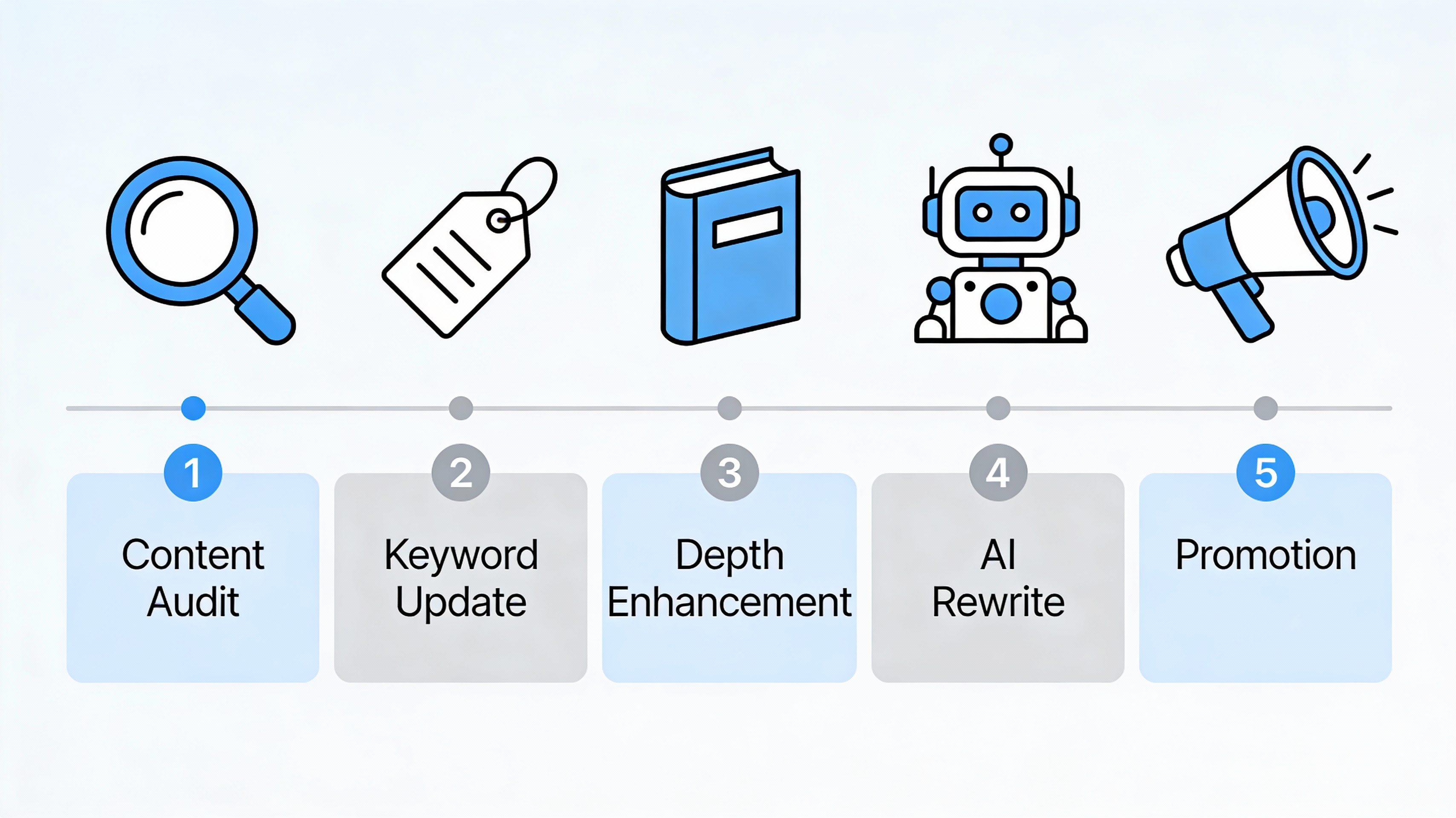
Executing a proven framework ensures that your content updates are systematic and result-driven rather than sporadic. By following a structured process, teams can predictably move old posts into the top-3 rankings. This methodology builds on existing data to refine the user experience and technical performance of every page.
The core of this strategy involves five specific stages that lead from initial discovery to final promotion. Each step is designed to build on the previous one, creating a compounding effect on SEO performance. Agencies often refer to a Content Refresh guide, such as the Moz guide, to validate these specific industry standards.
Step 1 – Audit Existing Content for Gaps
Conducting a thorough audit is the first priority to identify which posts are currently underperforming. You should use traffic, engagement, and keyword rankings to determine which articles require immediate attention. Prioritizing content that has seen a recent dip in performance often yields the fastest return on investment.
| Metric | Indicator for Refresh |
|---|---|
| Organic Traffic | Steady decline over 3-6 months |
| Keyword Ranking | Dropping from Page 1 to Page 2 |
| Bounce Rate | Significant increase compared to average |
The audit checklist must include identifying outdated data, thin content, and broken links. Utilizing specialized tools, like Articfly’s audit tool page, can streamline this data collection process. Focusing on high-potential gaps ensures that your time is spent where it will have the most significant impact on your bottom line.
Step 2 – Update Search Intent and Keywords
Updating search intent involves realigning your content with what users are actually looking for in 2026. Keywords that were effective two years ago may no longer serve the current market or the updated search engine landscape. Re-researching keywords ensures your content meets modern intent trends and captures new search volume.
Incorporate related questions from the People Also Ask section to address specific user concerns. Researching Search Intent in 2026 through Search Engine Journal can provide the necessary context for these changes. Aligning your headers and body text with these updated queries improves the likelihood of appearing in featured snippets.
- Primary Keyword: Core topic with 2026 search volume.
- Secondary Keywords: LSI terms and related variations.
- Intent Match: Informational, transactional, or navigational alignment.
- User Questions: Direct answers to common industry queries.
Step 3 – Enhance Content Depth & Structure
Improving content depth is essential for boosting E-E-A-T (Experience, Expertise, Authoritativeness, and Trustworthiness). Expand sections that are currently too brief, add expert quotes to provide authority, and embed multimedia to keep readers engaged. Readability is just as important as information density, so maintain a clean structure.
Utilize a clear H2 and H3 hierarchy to make the content easily skimmable for both users and search bots. Transitioning from generic advice to specific, actionable insights can be achieved through AI-enhanced writing features. This structural improvement ensures that the "after" version of your post is significantly more valuable than the "before" version.
Before: A short paragraph explaining a concept with no examples.
After: A comprehensive section including a definition, a real-world case study, and a list of implementation steps.
Step 4 – Leverage AI Tools for Rewrites (Articfly)
Utilizing AI tools like Articfly can drastically accelerate the rewriting process while maintaining high quality. AI can generate revised drafts, optimize meta tags, and suggest internal links based on your existing content library. This allows content teams to scale their refresh efforts without increasing their manual workload.
Maintaining brand voice is critical, and customization options within AI platforms allow for this consistency. You can view the Articfly pricing page to see how these automation features fit into your budget. Evidence from a case study on AI-assisted SEO suggests that integrated automation leads to faster turnaround times and more consistent ranking improvements.
Articfly empowers content teams with automation, making high-quality content production effortless and scalable by turning ideas into data-driven articles in minutes.
Articfly Platform
Step 5 – Re‑publish & Promote for Rankings
Republication and promotion are the final actions needed to signal to search engines that your content is new and improved. Simply saving the draft is not enough; you must update the publish date and submit the URL to Google Search Console. This triggers a re-crawl of the page, allowing the new optimizations to be indexed quickly.
Once the post is live, amplify it through social media channels, email newsletters, and new backlinks. Following a Request Indexing guide can help expedite this process if rankings don't shift immediately. Active promotion ensures that the refreshed content reaches both new and returning audiences.
- Update the "Last Updated" timestamp.
- Submit the updated URL to Google Search Console.
- Share on LinkedIn, Twitter, and relevant niche communities.
- Include the link in the next scheduled email newsletter.
Common Pitfalls to Avoid When Refreshing Posts

Avoiding common mistakes during the refresh process can prevent your rankings from stagnating or dropping. One frequent error is over-optimizing for keywords, which can lead to a robotic reading experience and potential search penalties. It is vital to keep the user experience at the forefront of every update you make.
Ignoring changes in user intent is another pitfall that can render your updates ineffective. Always refer to Articfly’s best practices article to stay aligned with current standards. Forgetting to update internal links throughout the site can also lead to a fragmented user journey and missed SEO opportunities.
- Do NOT: Keyword stuff your headers or paragraphs.
- Do NOT: Change the URL slug without setting up a 301 redirect.
- Do NOT: Keep outdated statistics or references to defunct technologies.
- Do NOT: Ignore mobile formatting and loading speeds.
Measuring Success: Metrics That Prove Top‑3 Rankings
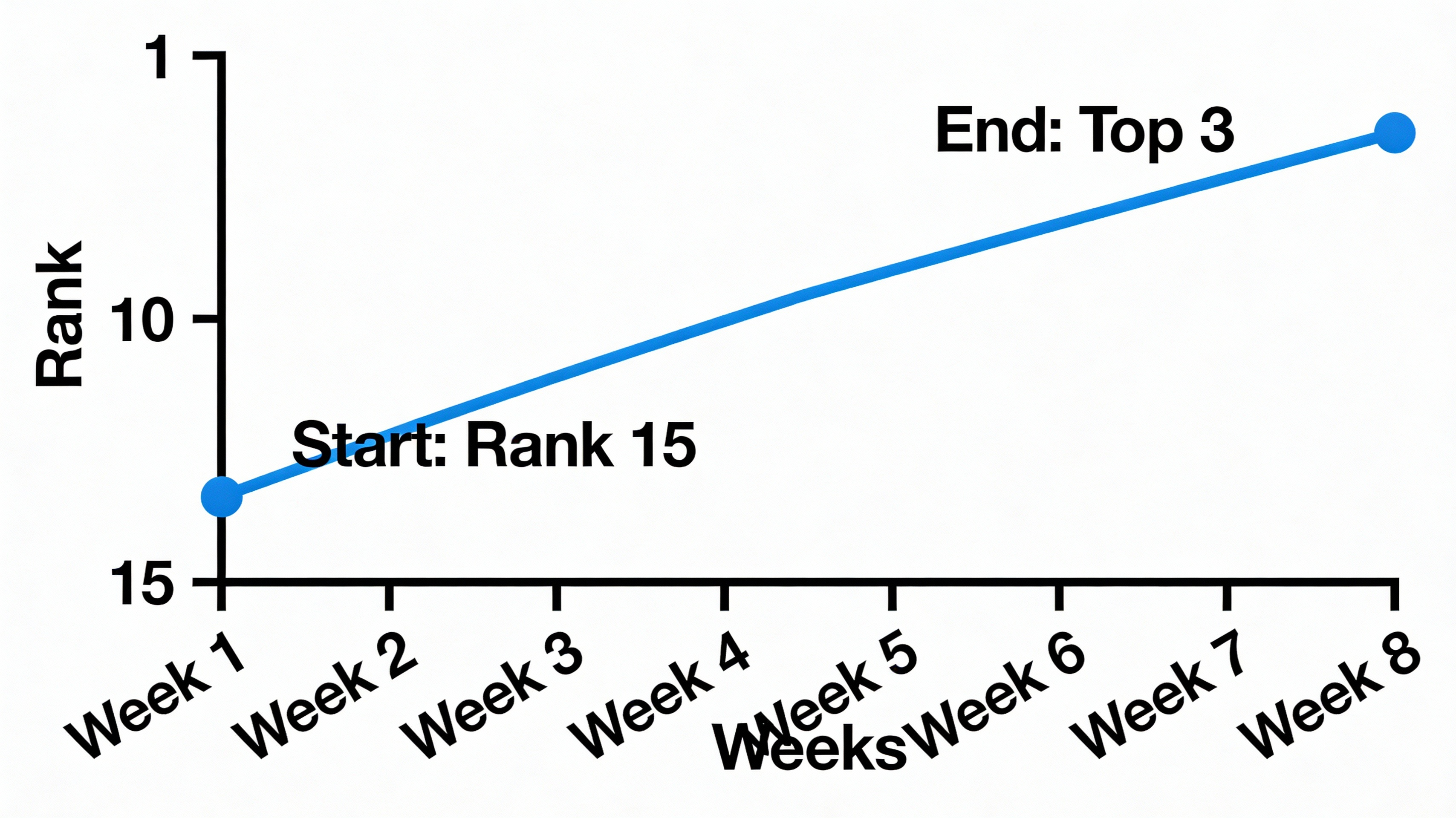
Tracking success metrics provides the data needed to prove the ROI of your content refresh strategy. Position tracking should be monitored weekly to see how the post climbs the SERPs following its update. Organic traffic lift and Click-Through Rate (CTR) improvements are the primary indicators of a successful execution.
Utilize Google Search Console alongside a reputable rank-tracking tool overview to get a complete picture of your performance. A successful refresh typically shows a sharp upward trend in impressions followed by a steady climb in average position. This data allows you to refine your approach for future refreshes and double down on what works.
Visualizing your progress: A successful refresh strategy results in a line chart where the vertical axis (rank) moves closer to position 1 over a period of 4 to 8 weeks, while the horizontal axis (time) shows a corresponding increase in organic clicks.
Key Takeaways
Mastering the refresh process is about consistency, data-driven decisions, and the right tools. By treating your blog as a living asset rather than a static archive, you ensure long-term visibility in a competitive market. Integrating AI automation helps you stay ahead of 2026 SEO trends without overwhelming your content team.
- Framework: Follow the 5-step process from audit to promotion.
- Intent: Always realign content with current user search behavior.
- AI Integration: Use Articfly to scale updates and maintain brand voice.
- Monitoring: Use GSC to track position and traffic improvements.
- Consistency: Regularly audit your top-performing posts for decay.
For more details, you can refer to the internal PDF checklist to keep your team on track during every update.
FAQ
Frequently asked questions regarding content refreshes often center on timing and the role of technology. Understanding these nuances helps in planning a long-term content maintenance schedule. Below are the most common inquiries from digital marketers and SEO specialists.
How often should I refresh a blog post?Typically, high-traffic posts should be reviewed every 6 to 12 months. If a post starts to see a decline in rankings or traffic, it should be audited immediately regardless of its age.
Can AI rewrite my content without losing my brand voice?Yes, modern AI platforms like Articfly allow for tone and brand identity customization. This ensures the output matches your specific style while optimizing for SEO.
What’s the difference between a content audit and a refresh?A content audit is the process of evaluating your entire library to find opportunities. A content refresh is the actual act of updating a specific post to improve its performance.
How long does it take to see ranking improvements?While some changes are indexed in days, significant ranking improvements usually take between 2 and 8 weeks to fully stabilize after republication.
For further assistance, visit the Articfly support page for detailed guides and technical help.
Next steps for content refresh

Ready to take action? Start leveraging the power of automation to revitalize your existing blog assets. Articfly’s proprietary AI system plans and structures your updates to ensure every post is ready to compete for the top spots on Google. By automating the heavy lifting, your team can focus on strategy and growth.
You can head to the sign-up page today to begin your journey. We offer a 30-day satisfaction guarantee to ensure you see the results you expect. Turn your old content into high-ranking traffic drivers and experience the efficiency of AI-powered content management.