
TL;DR: Small teams can't compete with big brands in SEO using traditional methods due to capacity, budget, and technical limitations. AI content automation levels the playing field by enabling 10x content production, identifying niche opportunities, and automating technical SEO. By implementing a strategic 4-step AI workflow and selecting the right tools, small teams can achieve significant organic growth and compete on intelligence and speed, not just resources.
Spis treści:
- The Uneven SEO Playing Field: Why Small Teams Struggle Against Giants
- The 5 Biggest Challenges Small Teams Face in SEO Content Creation
- How AI Content Automation Levels the Playing Field
- 4-Step AI Content Automation Strategy for Small Teams
- Tools and Implementation: Building Your AI-Powered SEO Stack
- Case Studies and Results: Small Teams Winning with AI
- Your 30-Day Action Plan for AI-Powered SEO Success
The Uneven SEO Playing Field: Why Small Teams Struggle Against Giants
In the vast digital landscape, search engine optimization (SEO) stands out as a powerful growth engine, promising an impressive 8x return on investment. Yet, for many small teams, this promise often feels out of reach. A stark reality in SEO is that nearly 96.55% of all web pages receive zero organic traffic from Google. This isn't just a challenge; it's a symptom of a deeply uneven playing field where only a few contenders capture the majority of the rewards.
The "winner-takes-most" nature of search results is undeniable. The #1 organic position in Google can command between 27.6% and 39.8% of all clicks, leaving minimal scraps for pages further down the ranking. For small businesses, whose average SEO spend hovers around $497 per month, competing with enterprise-level brands that deploy unlimited resources and massive teams is an uphill battle. This disparity in budget and human capital makes it incredibly difficult to produce the volume and quality of content needed to rank consistently.
Adding another layer of complexity, Google's continuous evolution, particularly with the integration of AI features like featured snippets and knowledge panels, has led to a significant shift. A staggering 58.5% of Google searches now result in zero clicks, as users find their answers directly on the search results page. This diminishes the potential traffic even for pages that manage to rank, making every click more valuable and harder to earn.
However, amidst these challenges lies a significant opportunity often overlooked by larger players: long-tail keywords. These highly specific, often longer search queries account for approximately 70% of all search traffic. While big brands typically focus on high-volume, competitive head terms, small teams can strategically target these less contested long-tail keywords. This niche-focused approach is precisely where AI content automation can transform the competitive landscape, empowering small teams to find and dominate specific corners of the market that their larger rivals ignore.
The 5 Biggest Challenges Small Teams Face in SEO Content Creation
Navigating the complex world of SEO content creation presents unique and formidable challenges for small teams. Unlike large enterprises with dedicated departments and extensive budgets, lean operations must contend with a different set of obstacles that often hinder their ability to compete effectively. Understanding these pain points is the first step toward finding a viable solution.
Capacity and Burnout
The vast majority of B2B content teams, around 54%, consist of just 2 to 5 individuals. These small groups are responsible for an immense range of tasks: content strategy, writing, editing, graphic design, distribution across multiple channels, and performance measurement. This broad scope often leads to capacity limitations and burnout, making it impossible to produce the consistent volume of high-quality, SEO-optimized content needed to gain traction.
Budget Constraints
As previously highlighted, the average small business allocates approximately $497 per month to SEO. This figure pales in comparison to the virtually unlimited resources available to enterprise-level organizations. Such budget restrictions limit access to advanced SEO tools, prevents the hiring of specialized talent, and restricts the capacity for paid promotions, forcing small teams to rely heavily on organic strategies.
Volume vs. Quality Dilemma
Blog posts remain a cornerstone for 79% of B2B marketers. However, the digital space is saturated, meaning simply publishing content isn't enough. Small teams constantly grapple with the dilemma of needing to produce content at scale to compete for search visibility, while simultaneously ensuring that content is high-quality, engaging, and unique enough to stand out. Achieving both volume and quality with limited resources is a perpetual struggle.
Technical Sophistication Gap
Effective SEO extends far beyond just writing good content; it requires a strong grasp of technical elements. Yet, 57% of enterprises report that limited in-house SEO skills are their top challenge, a problem often magnified for smaller teams. This gap means crucial aspects like site speed optimization, schema markup, internal linking structures, and mobile responsiveness are frequently overlooked, eroding potential ranking improvements.
AI Content Quality Concerns
While AI offers promising solutions, there's also a prevalent concern about its output. A significant 82.1% of respondents indicate they can recognize AI-generated content. This perception underscores the need for human oversight to ensure factual accuracy, maintain brand voice, and add the nuanced insights that only a human writer can provide. Simply generating content with AI without a robust quality control process risks damaging credibility.

How AI Content Automation Levels the Playing Field
The challenges facing small SEO teams are significant, but they are not insurmountable. AI content automation emerges as a transformative solution, directly addressing these pain points and empowering smaller operations to not only compete but thrive against larger, resource-rich adversaries. The data supports this shift: 65% of companies report achieving better SEO outcomes after integrating AI tools into their digital strategies.
One of the most profound impacts of AI is its ability to dramatically increase content production. With AI, teams can achieve a 10x increase in output using the same team size. This is possible through the automation of time-consuming tasks such as keyword research, content brief generation, initial drafting, and optimization processes. What once took hours or days can now be accomplished in minutes, freeing up human talent to focus on strategic oversight and creative refinement.
AI also shifts the focus from a raw volume of content to strategic targeting. Instead of guessing which topics might rank, AI tools can analyze vast datasets to identify low-competition, high-opportunity niches and long-tail keywords that align perfectly with commercial intent. This precision allows small teams to publish highly relevant content that directly addresses specific user needs, circumventing the need to battle for highly competitive, broad terms.
The technical SEO sophistication gap, a common hurdle for small teams, is also significantly narrowed by AI. Advanced AI tools can automatically generate optimized meta tags, suggest internal linking opportunities, and even assist with schema markup – all without requiring deep coding knowledge. This automation ensures that content is not only well-written but also technically optimized for search engines, improving visibility and crawlability.
Finally, AI offers unparalleled cost efficiency. While enterprise SEO budgets can exceed $2000 per month, small teams can build a powerful AI-powered SEO stack for just $200-$300 monthly. This dramatic reduction in operational costs allows small businesses to access advanced capabilities previously reserved for larger entities, delivering a superior return on investment and transforming how they allocate their resources for maximum impact.

4-Step AI Content Automation Strategy for Small Teams
Implementing AI content automation doesn't require a massive overhaul; it demands a structured, step-by-step approach. For small teams, a focused 4-step strategy can transform content production, leading to measurable SEO success within months. This framework combines AI's efficiency with human intelligence, ensuring both scale and quality.
Step 1: Niche Domination Strategy
Begin by leveraging AI to uncover underserved long-tail topics with clear commercial intent. Forget competing head-on for high-volume, highly competitive keywords. Instead, use AI tools to perform deep semantic analysis of your market, identify gaps in competitor content, and pinpoint specific questions or problems your target audience is searching for. This allows your team to create highly relevant, low-competition content that quickly gains traction and establishes authority in specialized niches.
Step 2: Content Assembly Line
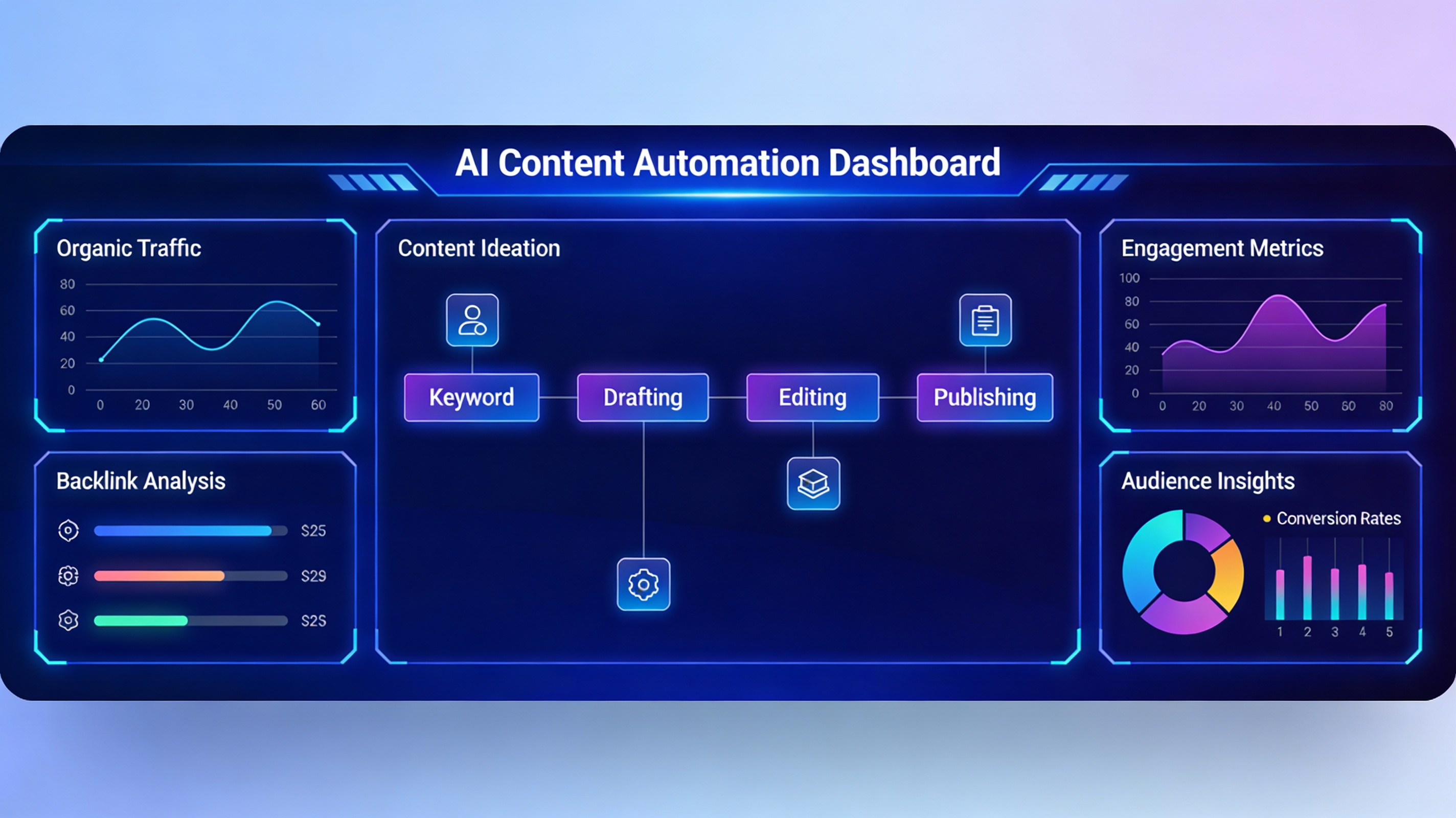
Build an efficient AI-powered workflow that streamlines content creation from conception to publication. This assembly line starts with AI-driven research to gather data and identify key discussion points. Next, AI assists in generating a comprehensive outline, ensuring logical flow and addressing all relevant subtopics. The AI then drafts the initial content, rapidly producing articles based on the outline. Finally, AI tools can optimize the draft for SEO, suggesting keyword density, readability improvements, and internal linking opportunities.
Step 3: Quality Control System
While AI accelerates production, human expertise remains indispensable for quality. Implement a robust quality control system where AI's efficiency is complemented by human oversight. After the AI generates a draft, a human editor reviews and refines the content for accuracy, brand voice consistency, factual correctness, and unique insights. This human touch ensures that every piece of content is not only SEO-optimized but also engaging, credible, and truly represents your brand's expertise.
Step 4: Performance Optimization Loop
The journey doesn't end at publication. Utilize AI-powered analytics tools to continuously monitor content performance. Track metrics like organic traffic, keyword rankings, dwell time, and conversion rates. AI can help identify which content pieces are performing well, which need updates, and what new opportunities are emerging. This data-driven feedback loop allows your team to iterate, refine your strategy, and continuously improve content based on real-world performance, ensuring sustained growth.
By following this 4-step strategy, small teams can expect to move from initial setup to launching their first AI-powered content in as little as 30 days. Measurable ROI, in terms of increased organic traffic and leads, can typically be observed within 3 to 6 months. This systematic approach transforms content creation from a bottleneck into a powerful, scalable growth engine.
Tools and Implementation: Building Your AI-Powered SEO Stack
Building an effective AI-powered SEO stack doesn't require an exorbitant budget; it's about selecting the right tools that offer maximum impact for small teams. The key is to integrate solutions that automate mundane tasks, enhance content quality, and provide actionable insights, enabling your team to focus on strategy and creativity.
Starter Stack ($100-$300/month)
For teams just beginning their AI SEO journey, a foundational stack can deliver significant value. We recommend SE Ranking for comprehensive SEO auditing, keyword research, competitor analysis, and rank tracking. Pair this with Frase, an AI-powered content optimization tool that helps research, outline, and write SEO-friendly content briefs. This combination provides robust SEO insights and a strong start to content optimization at a manageable cost.
Growth Stack ($300-$800/month)
As your team expands its content efforts and budget, upgrading your stack can unlock greater potential. Supplement your starter tools by adding Surfer SEO. Surfer excels at on-page content optimization, providing data-driven recommendations for word count, keyword usage, headings, and overall content structure to outrank competitors. This stack elevates your content's competitive edge and analytics capabilities, driving deeper insights and better performance.
AI Workflow Platforms
For teams looking to create highly customized and scalable automation workflows, platforms like AirOps are invaluable. These tools allow you to build custom SEO automation workflows without requiring extensive coding knowledge. You can automate tasks like content brief generation, meta description writing, or even entire content series based on specific triggers and data inputs, tailored precisely to your operational needs.
Content Creation Tools: Articfly
To truly streamline and scale content creation, a dedicated AI content platform is essential. Articfly specializes in end-to-end AI content planning, writing, and optimization. Our proprietary AI system analyzes search intent, applies SEO best practices, and generates professional, ready-to-publish articles tailored to your brand's tone. Articfly empowers your team to produce high-quality, data-driven blog posts automatically, saving time and costs while maintaining consistent quality.
Integration Strategy
Successfully implementing these tools requires a coherent integration strategy. Connect your AI content tools with your existing Content Management System (CMS), such as WordPress or Webflow, to facilitate seamless publishing. Integrate analytics platforms like Google Analytics or Search Console to track the performance of your AI-generated content. Furthermore, ensure these tools fit within your team's communication and project management workflows (e.g., Slack, Asana) to maximize adoption and efficiency. A well-integrated stack ensures that AI automation enhances, rather than disrupts, your existing operations.
Case Studies and Results: Small Teams Winning with AI
The theoretical benefits of AI content automation are compelling, but real-world results truly underscore its transformative power for small teams. Across various industries, businesses are leveraging AI to not only survive but thrive in competitive SEO landscapes, achieving remarkable growth and efficiency.
Case Study 1: SaaS Startup's Explosive Organic Growth
A 3-person SaaS startup in the niche project management software space faced intense competition from established players. By adopting an AI content automation strategy focused on long-tail keywords and implementing a rapid content production workflow, they achieved a stunning 300% increase in organic traffic within just six months. The AI platform allowed them to publish over 50 high-quality, targeted articles each month, a volume that would have been impossible with their limited team.
Case Study 2: Agency Scales Client Load Without Adding Staff
A small digital marketing agency, struggling to scale its content services, integrated AI-powered content workflows into its operations. This strategic move enabled the agency to manage content creation for 50 clients, up from just 5, without needing to hire additional staff. The AI automated initial drafts and SEO optimization, allowing their human writers and editors to focus on client strategy, quality assurance, and unique insights, significantly boosting profitability and service capacity.
Case Study 3: E-commerce Brand Competes with Giants
An e-commerce brand specializing in sustainable home goods found itself up against retail behemoths like Amazon. Leveraging AI to generate detailed, SEO-optimized product descriptions and informational blog content at scale, they successfully carved out niche categories. This allowed them to rank for thousands of long-tail product queries, driving targeted traffic and sales, proving that even in highly competitive markets, smart content automation can create a strong competitive advantage.
Measurable Revenue Increases
These individual successes are part of a broader trend. Research indicates that 40% of marketers who applied AI to their SEO strategies reported a significant 6-10% increase in revenue. This demonstrates that AI isn't just about efficiency; it's a direct contributor to the bottom line, providing a tangible return on investment for businesses of all sizes.
Key Success Factors
The common threads among these success stories are clear: strategic niche selection, leveraging AI to identify and target specific opportunities; effective human-AI collaboration, where AI handles the heavy lifting and humans provide crucial oversight and refinement; and continuous optimization, using data to constantly improve content performance. These factors combined create a powerful formula for small teams to win big in SEO.
Your 30-Day Action Plan for AI-Powered SEO Success
The future of SEO for small teams isn't about outspending big brands; it's about outsmarting them with intelligence and efficiency. AI content automation offers a clear path to achieving this competitive advantage. To help you get started, here's an actionable 30-day plan designed to kickstart your journey toward AI-powered SEO success.
Week 1: Audit and Opportunity Identification
Begin by conducting a thorough audit of your current SEO performance. Use AI-powered SEO tools to analyze your existing content, identify ranking gaps, and pinpoint 3-5 high-opportunity, underserved niche topics or long-tail keywords where your brand can quickly establish authority. This week is about strategic insight, not production.
Week 2: Stack Setup and Workflow Design
Select and set up your core AI content automation stack. Start with one comprehensive tool, such as Articfly, for end-to-end content planning, writing, and optimization, or a combination like SE Ranking and Frase. Design your initial AI-powered content workflow, outlining the steps from keyword research to content drafting and human review. Focus on integration with your existing systems.
Week 3: Implement First Workflow with Quality Control
Put your designed workflow into action. Use your chosen AI tools to generate your first batch of content, focusing on the niche opportunities identified in Week 1. Crucially, establish a robust quality control process. Ensure human editors review all AI-generated content for factual accuracy, brand voice consistency, and strategic refinement. This collaboration ensures high-quality, publishable output.
Week 4: Launch, Measure, and Optimize
Launch your first AI-powered content pieces. Integrate your analytics tools to immediately begin tracking performance data, including organic traffic, keyword rankings, and user engagement metrics. Based on these initial results, iterate and optimize your content and workflow. This continuous feedback loop is vital for long-term success and rapid improvement.
Embracing AI content automation marks a pivotal shift in how small teams compete in the digital arena. By transitioning from a resource-intensive approach to one driven by intelligence and speed, you can unlock unprecedented growth. Start your 30-day action plan today and transform your SEO strategy, building an effortless and scalable content engine that rivals even the biggest brands.
Ready to revolutionize your content strategy and compete with the biggest players? Explore how Articfly's AI content automation platform can help your small team generate high-quality, SEO-optimized blog articles automatically, saving you time, reducing costs, and empowering your growth today.