
Why Updating Old Content Is a Game-Changer in 2026
Content refreshes are now more valuable than publishing new content due to how modern search algorithms prioritize freshness for evergreen topics. By revisiting existing articles, you leverage established authority and backlinks, giving your site a significant head-start over entirely new URLs. This approach ensures that your time-to-value is dramatically shorter, allowing for faster gains in organic visibility.
"Freshness is the new relevance" — Google Search Central

Many digital marketing teams find that their older posts have lost relevance as market trends shift. By following Articfly’s Content Refresh strategies and consulting Moz’s guide on content updates, brands can reclaim lost positions. Updating your library is the most efficient way to maintain a competitive edge without expanding your writing budget.
The SEO Benefits of Refreshing Existing Posts
Improved rankings for target keywords are a direct result of providing users with more accurate and timely information. When you update a post, you often see a 30–50% lift in traffic as a result of higher click-through rates from refined meta data. Additionally, adding richer media such as updated charts or videos helps increase dwell time, signaling to search engines that your content is high-quality.
| Metric | Before Refresh | After Refresh |
|---|---|---|
| Keyword Ranking | Page 2-3 | Top 5 Results |
| Click-Through Rate (CTR) | 1.5% | 3.8% |
| Monthly Organic Traffic | Baseline | Often see 30–50% lift |

Case studies featured on the Articfly blog demonstrate that consistent refreshes outperform heavy new-content schedules. To understand the broader industry impact, many professionals also reference the Search Engine Journal article on content refresh ROI. This data confirms that keeping your inventory updated is a cornerstone of modern SEO success.
Step-by-Step Process to Revamp Old Articles
Actionable workflows allow content teams to move from strategy to execution without getting bogged down in technical complexity. By identifying the right posts and applying targeted updates, you can transform stagnant pages into high-performing assets. Following a structured 5-step process ensures no SEO opportunity is missed during the revamp.
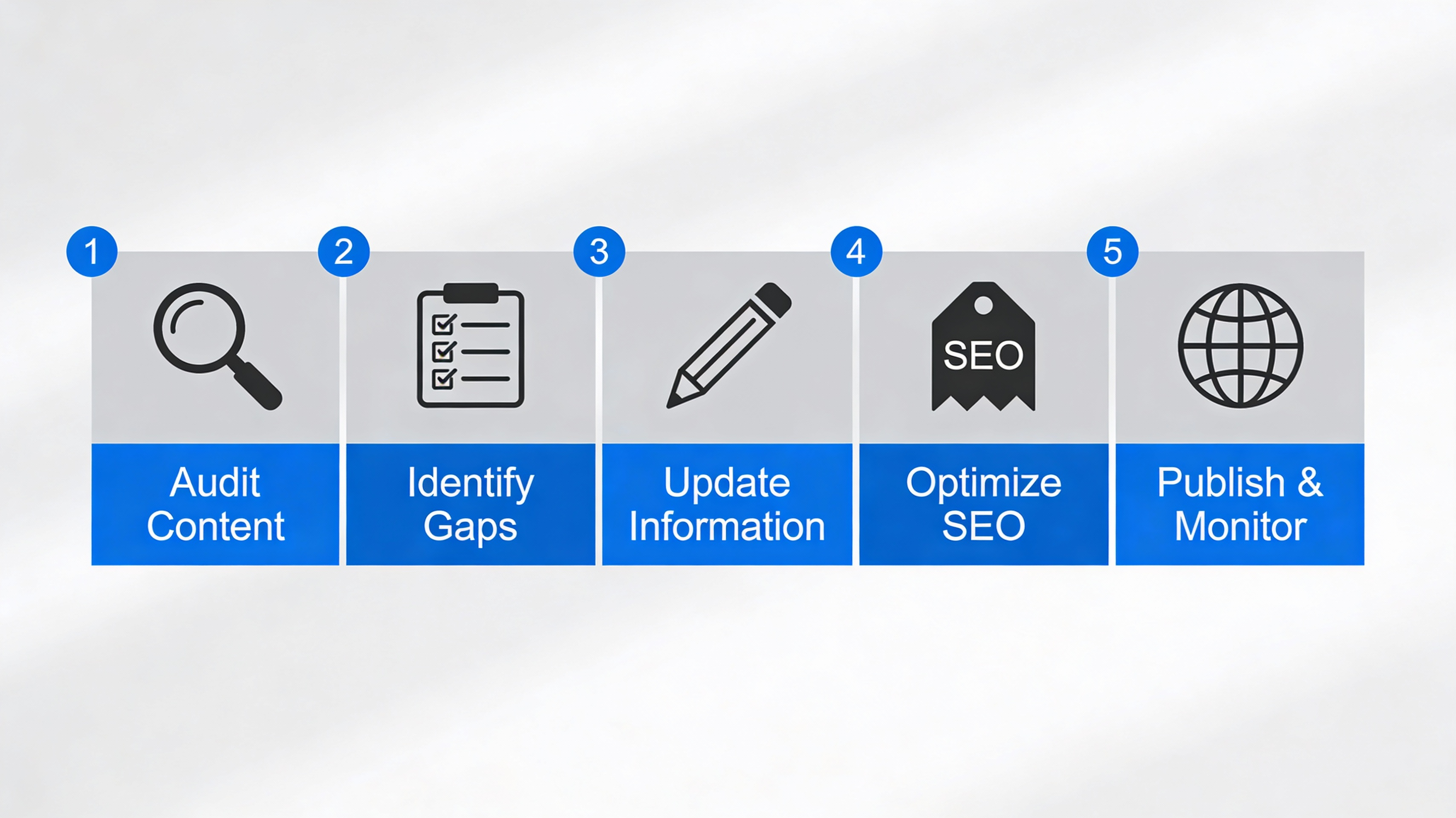
Speed is critical when managing a large content library, which is why many agencies utilize Articfly’s AI content planner. You may also find the Ahrefs’ content audit checklist helpful for ensuring your technical SEO remains sound throughout the process. Combining human strategy with automated efficiency creates a sustainable growth engine for any brand.
Audit Your Content Inventory
Baseline data is the first thing you need to gather before making any changes to your website. Use Google Search Console to identify pages that have high impressions but low click-through rates, as these are your best candidates for improvement. Creating a centralized spreadsheet for these URLs allows you to track dates, current traffic, and optimization goals.
- Export URLs from Google Search Console
- Filter by high impressions (>5,000)
- Identify pages with declining traffic trends
- Record current keyword rankings for comparison
Identify High-Potential Posts
Priority selection focuses your energy on the articles that will move the needle the most for your business. Look for posts that already have over 5,000 impressions and contain data that has become outdated since the original publish date. Ensuring the topic remains relevant in 2026 is vital for long-term organic growth.
- Post contains "2023" or "2024" in the title or body
- Topic is evergreen and still searched for by your audience
- The page currently sits on the second page of Google
- The content has at least a few high-quality backlinks already
Optimize for Current Search Intent
Search intent often shifts over time as users look for different types of answers to the same queries. Update your headings and subheadings to match the latest keywords that users are typing into search engines. This alignment ensures that both users and crawlers recognize your content as the most relevant answer available.
Example Before: "How to write a blog post in 2022"
Example After: "How to leverage AI for blog content creation in 2026"
Add Fresh Media & Internal Links
Engagement metrics can be improved by inserting new images, charts, or video embeds that provide additional value to the reader. Adding two to three contextual internal links to your more recent posts helps search engines discover your new content and distributes authority throughout your site. This simple step keeps users on your site longer and improves your overall SEO health.
Recommended media types for 2026 refreshes:
- High-resolution stock photography
- AI-generated data visualizations
- Short-form video summaries
- Interactive comparison tables
Leverage AI Tools (Articfly) for Speed
Automation technology like Articfly allows you to scale your content refreshes without hiring a massive team of writers. Our platform can generate updated sections based on new search data and run AI-assisted SEO checks to ensure your keywords are placed naturally. This significantly reduces the manual labor required to keep a blog library fresh.
"By automating the tedious parts of the update process, we allow content managers to focus on high-level strategy rather than rewriting paragraphs." — Articfly Product Lead
How to Measure Success After a Content Refresh
Tracking impact is essential to validate that your efforts are producing the desired increase in traffic and conversions. You should set baseline metrics for rankings and organic CTR before the refresh and then monitor them over a four-to-six-week period. This window allows search engines to crawl the new content and adjust their indexes accordingly.
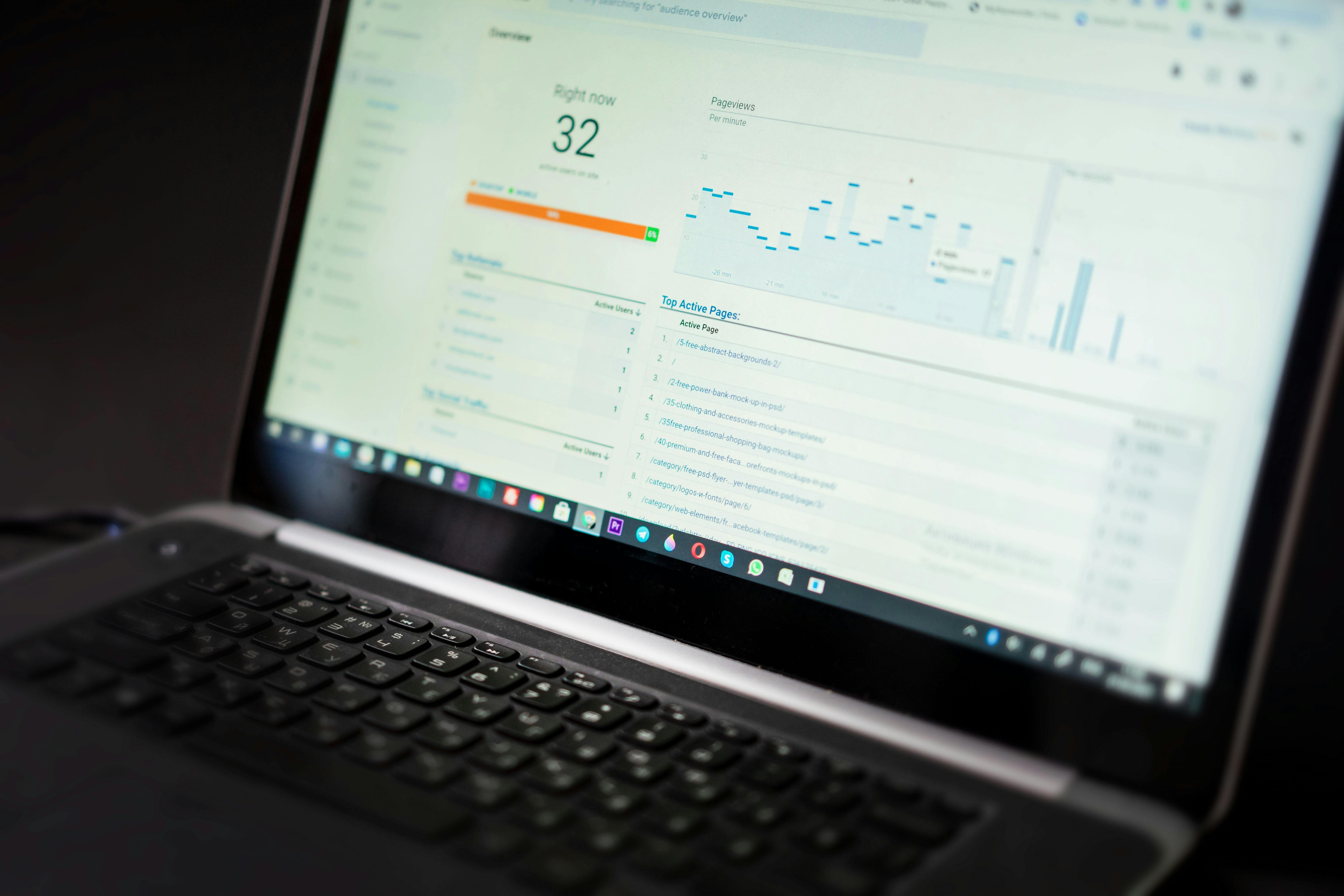
Using a simple KPI dashboard helps you visualize these changes and report them to stakeholders. For those looking for deeper data, exploring Articfly’s analytics integration page or Google’s Search Console help page can provide more advanced tracking techniques. Consistency in monitoring is what separates successful SEOs from those who guess.
Common Mistakes to Avoid When Updating Content
Over-optimizing keywords is a frequent error that can lead to search engine penalties instead of ranking gains. It is also important not to ignore shifts in user intent; if a query that used to be informational has become transactional, your content must reflect that change. Finally, always remember to update your meta titles and descriptions to encourage higher click-through rates.
| Do | Don't |
|---|---|
| Update meta titles for CTR | Stuff the same keyword 50 times |
| Check for broken internal links | Ignore new search intent shifts |
| Add fresh, relevant statistics | Keep the same 5-year-old images |
Resources like the Articfly best-practice blog or the HubSpot content update mistakes article offer deep dives into what to avoid. Keeping your strategy clean and focused on user value is the best way to ensure your updates result in positive growth. Avoid these pitfalls to maximize the ROI of your content maintenance efforts.
Key Takeaways
Sustainable growth is achievable by prioritizing your existing content library just as much as your new production schedule. A well-executed content refresh can double your traffic with significantly less effort than writing from scratch. By following a data-driven workflow and using AI to handle the heavy lifting, you can maintain high rankings indefinitely.
- Content refreshes leverage existing authority for faster SEO results.
- The 5-step workflow includes auditing, prioritizing, and optimizing for intent.
- AI tools like Articfly can automate the most time-consuming parts of the update.
- Success should be measured over a 4–6 week period using Google Search Console.
- Avoiding over-optimization and intent-mismatch is crucial for success.
FAQ
Common questions often arise when teams first start shifting their focus toward content refreshes. Understanding the nuances of the process can help you implement this strategy more effectively across your entire organization.
Do I need to rewrite the whole article?No, you do not need to rewrite the entire piece. Often, updating the introduction, subheadings, and a few outdated paragraphs is enough to signal freshness to search engines.
How often should I refresh content?High-traffic posts should be reviewed every 6–12 months. For topics that change rapidly, such as technology or software, a more frequent schedule may be necessary.
Can AI replace human editors in a refresh?AI tools like Articfly are designed to assist human editors by handling research and drafting. A human should still review the final output to ensure brand voice and accuracy.
What if the updated post still doesn’t rank?If a post doesn't move up after 6 weeks, re-examine the search intent. You may need to add more unique value or gain more high-quality backlinks to compete for the top spots.
Next steps for content refresh
Implementing a content refresh strategy is the fastest way to boost your organic traffic without the high costs of new content creation. Start your first automated content refresh with Articfly today – free trial.