TL;DR: SEO (Search Engine Optimization) and RAO (Relevance, Accuracy, Optimization) are critical for digital presence. SEO optimizes content for traditional search engines, focusing on keywords, backlinks, and technical aspects. RAO evolves this for AI-powered search, prioritizing factual accuracy and deep contextual relevance. Both are essential for visibility, organic traffic, and gaining a competitive edge. Articfly automates content creation, integrating these principles to deliver high-quality, scalable, and search-optimized blog articles, saving businesses time and resources.
Understanding SEO and RAO: Foundational Concepts for Digital Success
In the rapidly evolving digital landscape, achieving online visibility and connecting with target audiences requires more than just a website. It demands a strategic approach to how content is discovered, understood, and ranked by search engines. This foundational strategy rests upon two interconnected pillars: Search Engine Optimization (SEO) and Relevance, Accuracy, Optimization (RAO). While SEO has long been the cornerstone of digital marketing, the advent of sophisticated AI-powered search engines has necessitated an evolution, giving rise to RAO.
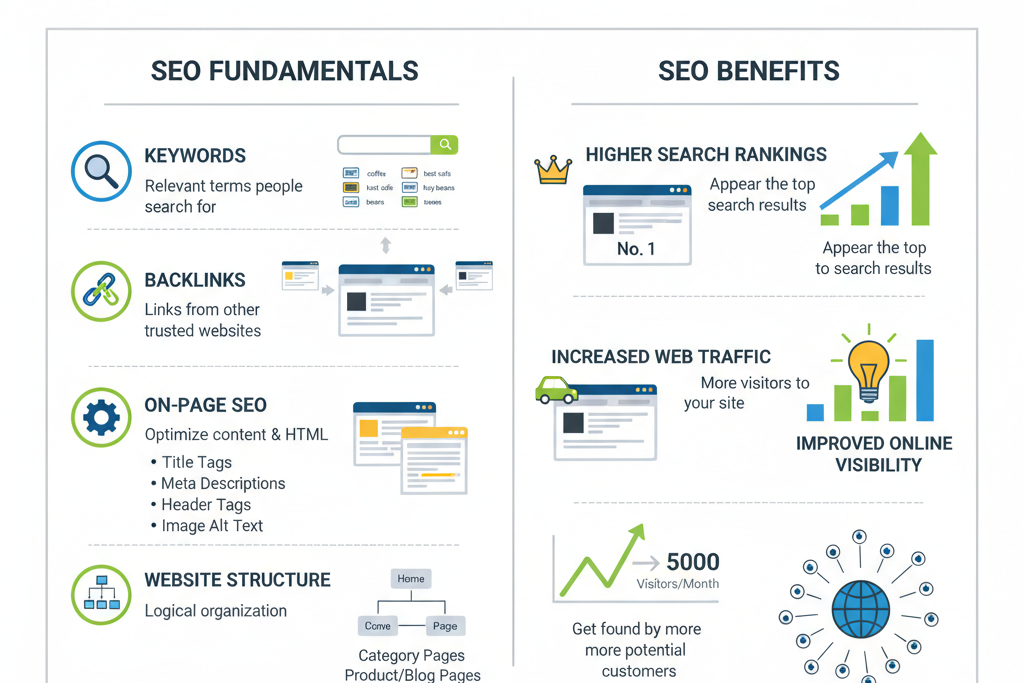
Search Engine Optimization (SEO) traditionally focuses on enhancing a website's visibility within search engine results pages (SERPs) like Google and Bing. Its primary role involves optimizing content and technical aspects to rank higher for specific keywords, thereby driving organic, unpaid traffic. For decades, businesses have relied on SEO to ensure their products, services, and information are readily discoverable by users actively searching for them. This discipline has encompassed a wide array of techniques, from meticulous keyword research to building authoritative backlinks and ensuring a website's technical health.
However, the digital search environment is undergoing a profound transformation. The rise of large language models (LLMs) and advanced AI algorithms in platforms like ChatGPT, Google's SGE, and Bing AI has shifted the paradigm. These AI-powered search engines are not merely looking for keyword matches; they are designed to understand intent, synthesize information, and provide direct, comprehensive answers. This is where Relevance, Accuracy, Optimization (RAO) enters the scene. RAO represents an adaptation of SEO principles, specifically tailored to meet the demands of AI. It emphasizes creating content that is not only optimized for traditional search queries but is also deeply relevant, factually accurate, and contextually rich, enabling AI systems to process and present information effectively. Understanding both SEO and RAO is no longer optional; it is a critical imperative for any business aiming to thrive in today’s complex and AI-driven digital world.

Exploring the Core Elements of Search Engine Optimization (SEO)
Search Engine Optimization (SEO) is a multifaceted discipline aimed at improving a website's position in search engine results organically, without paid advertisements. Its overarching goal is to make a website more appealing to search engine algorithms, thereby increasing its visibility and driving qualified traffic. SEO is not a one-time task but an ongoing process that encompasses several key areas, each contributing to a site's overall search performance.
One of the foundational elements of SEO is Keyword Research. This involves identifying the terms and phrases that your target audience uses when searching for information, products, or services related to your business. Effective keyword research goes beyond simply finding high-volume terms; it delves into user intent, long-tail keywords, and competitive analysis. Understanding what users are searching for allows content creators to tailor their material to directly address those needs, signaling relevance to search engines. Tools like Google Keyword Planner, Ahrefs, and Semrush provide invaluable data for this process, helping businesses uncover profitable keyword opportunities.
Next is On-Page SEO, which refers to optimizing individual web pages to rank higher and earn more relevant traffic in search engines. This includes optimizing elements directly on the page, such as title tags, meta descriptions, header tags (H1, H2, H3), URL structure, image alt text, and, crucially, the content itself. Content optimization involves incorporating target keywords naturally, ensuring readability, providing comprehensive information, and structuring the content logically. For instance, a well-optimized blog post about "eco-friendly cleaning products" would integrate this keyword naturally throughout the text, use relevant subheadings, and include high-quality images with descriptive alt text, all while offering genuine value to the reader.
SEO is not merely about keywords; it's about creating a seamless, valuable experience that both users and search engines can appreciate, building a bridge between user intent and relevant content.
Backlinking, or off-page SEO, focuses on external signals that indicate a website's authority and trustworthiness. Backlinks are essentially votes of confidence from other websites. When reputable and relevant websites link to your content, search engines interpret this as a sign of your content's quality and authority, which can significantly boost your rankings. Strategies for acquiring high-quality backlinks include creating linkable assets (e.g., in-depth guides, original research, compelling infographics), guest posting on authoritative blogs, and engaging in outreach to build relationships with other site owners. The quality and relevance of these links are far more important than their quantity.
Finally, Technical SEO ensures that a website is crawlable, indexable, and user-friendly for both search engines and human visitors. This involves optimizing site speed, ensuring mobile-friendliness, implementing structured data (schema markup), fixing broken links, using secure HTTPS protocols, and creating an XML sitemap. A technically sound website allows search engine bots to efficiently navigate and understand its content, making it easier for them to rank it appropriately. For example, a slow-loading website, even with excellent content, might be penalized by search engines due to a poor user experience.
The impact of SEO is substantial. Websites that consistently implement robust SEO strategies often see significant improvements in organic traffic and conversions. According to a study by BrightEdge, organic search drives 53% of all website traffic. Furthermore, businesses that rank on the first page of Google receive 90% of all search traffic. This demonstrates that SEO is not just about visibility; it's about positioning a business directly in front of its most engaged potential customers, often at the precise moment they are looking for solutions. A website for a local bakery that ranks for "best artisan bread near me" will naturally attract more local customers than one that doesn't, leading to increased foot traffic and sales without direct advertising costs.
Introducing RAO: Optimizing for AI-Powered Search Engines
While traditional SEO remains vital, the emergence of advanced artificial intelligence in search engines has introduced a new paradigm: Relevance, Accuracy, Optimization (RAO). RAO is not a replacement for SEO but rather an evolution, building upon SEO's foundational principles while adapting them for a world where AI-driven conversational agents and semantic search dominate. Its core focus is on ensuring content is deeply relevant, factually accurate, and optimally structured for AI algorithms that seek to understand context and provide direct, comprehensive answers.
Relevance in the context of RAO extends beyond simple keyword matching. AI-powered search engines, such as those powering ChatGPT, Google's Search Generative Experience (SGE), and Bing AI, are designed to understand the semantic meaning and intent behind a user's query. This means content must not only include relevant keywords but also cover a topic comprehensively, addressing related sub-topics and providing context that fully satisfies the user's implicit and explicit needs. For example, if a user asks "What is the best way to train a puppy?", an RAO-optimized piece wouldn't just list training methods. It would delve into different training philosophies, age-specific considerations, common challenges, and perhaps even recommend specific tools, all presented in a coherent, interconnected manner that demonstrates a deep understanding of the topic.
Accuracy has always been important, but with AI systems that synthesize information from various sources to generate direct answers, factual precision is paramount. Inaccurate information can lead to severe reputational damage and penalization by search engines. RAO emphasizes meticulous fact-checking, referencing credible sources, and presenting data clearly and unambiguously. AI models learn from the data they consume, and if that data is flawed or outdated, the AI's outputs will be similarly compromised. For businesses, this means ensuring all statistics, claims, and processes described in their content are verifiable and current. An e-commerce site detailing product specifications must ensure those details are 100% correct, as an AI might pull that information directly into a user's search summary.
Optimization for RAO involves structuring content in a way that AI systems can easily parse, understand, and extract key information. This goes beyond traditional HTML headings and includes clear definitions, organized lists, well-structured tables, and explicit answers to potential questions. It also involves using semantic markup where appropriate to provide context to specific data points. The goal is to make content machine-readable while maintaining human readability. For instance, when an AI-powered assistant is asked a question like "What are the benefits of eating blueberries?", RAO-optimized content would have distinct, concise answers to this and related questions (e.g., "blueberries' antioxidant properties," "impact on cognitive function," "vitamin content"), allowing the AI to quickly identify and present the most relevant snippets.
RAO pushes content creators to think like an AI: demanding not just information, but knowledge that is verifiable, interconnected, and readily digestible for intelligent systems.
The significance of RAO for AI search engines cannot be overstated. These systems aim to provide a conversational and highly contextual user experience, moving away from simple link lists towards direct answers and synthesized summaries. Content that is RAO-optimized is more likely to be selected by these AI models for inclusion in their generative responses, becoming the authoritative source from which the AI draws its information. This provides a significant competitive advantage. Businesses embracing RAO are positioning themselves to be the trusted information providers in the age of AI, ensuring their content is not just found, but directly utilized by the next generation of search experiences.

Why SEO and RAO Are Indispensable for Your Business and Website
In today's interconnected digital ecosystem, the confluence of traditional SEO and the emergent RAO is no longer a luxury but a fundamental necessity for the survival and growth of any business with an online presence. These strategies directly impact several critical aspects of business success, from basic visibility to competitive positioning and financial efficiency.
The most immediate and apparent impact of robust SEO and RAO strategies is on website visibility and organic traffic. Simply put, if your target audience cannot find your website through search engines, your business effectively remains invisible online. High rankings for relevant keywords and compelling, AI-optimized content ensure that when potential customers search for products, services, or information you provide, your website appears prominently. This organic traffic is highly valuable because it consists of users who are actively seeking solutions, making them more likely to convert into leads or customers. Businesses consistently ranking on the first page for industry-specific terms experience a steady influx of qualified visitors, providing a continuous pipeline for growth.
Beyond mere visibility, SEO and RAO significantly enhance the user experience (UX). Search engines prioritize websites that offer a seamless, fast, and satisfying experience. An SEO-optimized site is typically well-structured, loads quickly, is mobile-friendly, and offers clear navigation. RAO further complements this by ensuring the content itself is highly relevant, accurate, and easy for users to digest, even if synthesized by an AI. A positive UX not only encourages visitors to stay longer and explore more but also signals to search engines that your site is valuable, contributing to better rankings. For example, an e-commerce site with intuitive product filtering, fast page loads, and accurate product descriptions will naturally convert more visitors and rank higher than a clunky, slow competitor.
Adopting and refining SEO and RAO strategies also provides a substantial competitive advantage. In crowded markets, businesses that invest in these areas often outperform rivals who neglect them. By consistently outranking competitors for key search terms and establishing themselves as authoritative sources of information (especially for AI systems), businesses can capture a larger share of the online market. This proactive approach to digital presence helps in carving out a unique position and building brand authority over time, making it harder for new entrants to dislodge them.
From a financial perspective, SEO and RAO offer remarkable cost efficiency compared to paid advertising. While paid ads (PPC) can deliver immediate results, they require continuous expenditure. Organic traffic, driven by effective SEO and RAO, is "free" once the optimization work is done. Although there's an initial investment in time and resources for content creation and optimization, the long-term return on investment (ROI) from organic search often far surpasses that of paid campaigns. This makes it a sustainable strategy for businesses of all sizes, allowing them to allocate marketing budgets more strategically.
Finally, and increasingly critically, SEO and RAO are essential for adaptation to AI search trends. The digital landscape is not static; it is rapidly evolving with generative AI at its forefront. Businesses that understand and embrace RAO are future-proofing their content strategy. They are preparing for a future where AI assistants and conversational search become primary gateways to information, ensuring their content is not just found by traditional crawlers but actively chosen and presented by intelligent systems. Failing to adapt means risking obsolescence as search paradigms shift. By focusing on deep relevance, impeccable accuracy, and optimal structure for AI, businesses ensure they remain discoverable and authoritative, regardless of how search technology continues to develop.

How Articfly Supports SEO and RAO for Superior Content Creation
Articfly, as a specialized SaaS platform for AI-powered blog content creation, is engineered to directly address the evolving demands of both traditional SEO and the advanced requirements of RAO. Our proprietary AI system streamlines the content generation process, empowering businesses, agencies, and creators to produce high-quality, search-optimized articles that resonate with both human audiences and intelligent search algorithms.
At its core, Articfly offers an intuitive platform that transforms topics or keywords into complete, ready-to-publish blog posts automatically. This automation is not merely about generating text; it is deeply integrated with the principles of effective search optimization. When a user inputs a topic, Articfly's AI initiates a comprehensive analysis of search intent, looking beyond surface-level keywords to understand what users truly want to know. This intelligent approach ensures the resulting content is inherently relevant, a cornerstone of both SEO and RAO, as it directly answers user queries and fulfills informational needs.
Articfly applies robust SEO best practices from the outset. Our system automatically incorporates strategic keyword placement, optimizes heading structures (H2, H3, etc.), and ensures logical flow, making articles easy for search engine crawlers to understand and index. It also considers factors like content depth and semantic relevance, producing comprehensive articles that cover topics thoroughly, which is a key signal for search engines regarding content authority and quality. This means that blog posts generated by Articfly are structured to rank effectively, driving organic traffic through traditional search channels.
Crucially, Articfly is also designed with RAO principles in mind. The AI prioritizes factual accuracy by synthesizing information from credible sources, ensuring that the generated content is not only relevant but also reliable. This is critical for AI-powered search engines that demand precise, verifiable information to generate direct answers. Furthermore, the platform optimizes content for clarity and extractability, using clear definitions, bullet points, and well-organized paragraphs that allow AI models to easily parse and utilize key information. This structural optimization ensures that Articfly-generated content is well-prepared for inclusion in AI-driven search experiences like Google's SGE or ChatGPT's responses.
The benefits for businesses utilizing Articfly are substantial. Firstly, it offers unprecedented time and cost savings. Manual content creation, research, writing, and optimization are labor-intensive and expensive. Articfly automates these processes, reducing the time from idea to publication from hours or days to mere minutes. This allows marketing teams to significantly increase their content output without scaling up their human resources, translating into substantial cost efficiencies.
Secondly, Articfly helps businesses maintain consistent content quality and relevance. Our AI system ensures that every article adheres to a high standard of factual accuracy and contextual depth, while also being tailored to the client's specific tone and brand identity. This consistency is vital for building brand authority and fostering user trust across all digital touchpoints. By empowering content teams with automation, Articfly makes high-quality content production effortless and scalable, transforming how blogs are built and ensuring that businesses can consistently deliver engaging, data-driven articles optimized for the dual demands of SEO and RAO.

Embracing the Future of Search with SEO and RAO
The digital landscape is in perpetual motion, and the demands on online content are escalating. This article has underscored the indispensable roles of both traditional SEO and the advanced paradigm of RAO in securing and enhancing your business's online presence. SEO remains fundamental for driving organic visibility through established search engine algorithms, focusing on keywords, backlinks, and technical health. RAO, meanwhile, is the strategic evolution, meticulously tailoring content for the nuanced understanding and synthesis capabilities of AI-powered search engines, emphasizing deep relevance, unimpeachable accuracy, and optimal structure.
Failing to prioritize these integrated strategies risks rendering your content invisible in an increasingly competitive and AI-driven environment. Businesses that proactively embrace SEO and RAO will not only gain a significant competitive advantage but also ensure their content continues to be discovered, trusted, and utilized by the next generation of search experiences. As AI continues to shape how information is found and consumed, the synergy between robust SEO practices and forward-thinking RAO principles will dictate who wins the attention of online audiences.
If you are looking to scale your content production while ensuring every article is meticulously optimized for both human readers and AI systems, consider leveraging the power of automation. Explore how Articfly can transform your content strategy, providing scalable, high-quality, and SEO- and RAO-optimized blog articles that drive tangible results for your business.