
The Strategic Value of Automated Blogging for CFOs

The strategic value of automated blogging allows finance leaders to align marketing outputs directly with the company’s broader financial goals. By treating content as a measurable asset, CFOs can ensure that every post contributes to a positive return on investment. This approach shifts content creation from a discretionary expense to a predictable revenue driver.
Integrating automation into the content pipeline also serves as a critical risk mitigation strategy. Maintaining a consistent brand voice across all digital channels reduces the likelihood of non-compliance with industry regulations or brand standards. This centralized control provides a clear audit trail for every piece of content published.
| Feature | Traditional Content Process | Automated Blogging System |
|---|---|---|
| Production Speed | Weeks or months per campaign | Minutes for ready-to-publish posts |
| Cost Structure | High variable labor and agency fees | Predictable, scalable SaaS costs |
| Compliance | Manual review and high human error risk | Automated style guides and audit trails |
| SEO Strategy | Often fragmented or reactive | Data-driven and proactive planning |
Aligning Content ROI with Financial Goals
Mapping key performance indicators is the first step toward achieving content ROI. Finance teams can now track metrics such as lead acquisition costs and conversion lifts back to specific automated content clusters. This creates a transparent financial model where content spend is directly linked to revenue uplift.
Risk Mitigation and Brand Consistency
Automated style guides ensure that every article adheres to predefined legal and brand requirements. By using version control and automated audit trails, companies can significantly reduce the risk of brand dilution or regulatory fines. This consistency is vital for maintaining the integrity of enterprise-level digital assets.
How Automated Blogging Systems Deliver Cost Savings

How automated blogging systems deliver cost savings becomes evident when evaluating the reduction in high-cost manual labor. Organizations can decrease their reliance on expensive third-party agencies and large in-house writing teams. This shift allows marketing budgets to be reallocated toward high-impact strategic initiatives rather than basic production.
Beyond labor, automation addresses the financial impact of market-entry lag. Reducing the time-to-publish from weeks to minutes allows brands to respond to market trends in real-time. This agility captures demand that would otherwise be lost during lengthy traditional drafting and approval cycles.
- 📉 Lower Labor Overheads: Significant reduction in hourly rates paid to freelance contributors.
- ⏳ Operational Efficiency: Eliminates bottlenecked approval workflows and manual editing.
- 🚀 Market Responsiveness: Rapid deployment of content for seasonal or competitive shifts.
- 📊 Scalability: Increasing content volume without a proportional increase in headcount.
Reducing Labor and Agency Expenses
Headcount reduction scenarios often show that a single content manager using automation can match the output of an entire agency team. Comparing monthly agency retainers against a fixed platform subscription reveals significant annual savings for the finance department. These cost efficiencies are essential for maintaining lean operations during scaling phases.
Faster Time-to-Publish and Market Responsiveness
The transition from idea to published article happens in minutes rather than days. This speed is particularly impactful for seasonal campaigns where timing is a critical factor in conversion rates. Financial leaders value this responsiveness as it ensures the company remains competitive in fast-moving digital landscapes.
Enhancing SEO and Revenue Growth with AI-Generated Content

Enhancing SEO and revenue growth requires a data-driven approach to content planning that most manual processes lack. AI systems analyze search intent and keyword clusters to ensure that every article targets high-value traffic. This precision leads to higher search engine rankings and a more robust sales funnel.
On-page automation handles technical details such as meta tags, schema markup, and internal linking strategies. These technical elements are often overlooked by human writers but are vital for search engine visibility. By automating these tasks, companies ensure their content is always optimized for discovery.
Performance Snapshot: AI Adoption
Prior to automation, many organizations struggle with inconsistent traffic and low keyword visibility. After implementing an AI-driven strategy, companies typically observe a significant increase in organic sessions and a decrease in the cost per lead. This growth is achieved without increasing the marketing production budget.
Data-Driven Topic Selection
AI-powered clustering identifies exactly what your potential customers are searching for at every stage of the funnel. This ensures that content is not just filler, but a strategic tool designed to move users toward a purchase. Aligning topics with product funnels maximizes the financial value of every visitor.
On-Page SEO Automation
Automated meta descriptions and schema markup provide search engines with the precise data needed to index pages correctly. Furthermore, an AI-generated internal linking strategy strengthens the domain authority across the entire site. These technical optimizations contribute directly to long-term organic revenue growth.
Real-World Use Cases: CFOs Leveraging AI Blogging Platforms

Real-world use cases demonstrate how both startups and established enterprises use automation to achieve financial milestones. For startups, the focus is often on achieving rapid content volume with a limited budget to establish early market presence. For larger brands, the priority is centralized control and consistent thought leadership.
In the enterprise sector, finance leaders use these platforms to manage brand authority across multiple sub-brands or international regions. Centralized reporting allows the CFO to see exactly how much is being spent and what the return is across the entire portfolio. This level of visibility is rarely possible with decentralized manual teams.
The transition to an automated blogging system allowed us to scale our organic traffic while actually reducing our monthly content spend. It transformed our blog from a cost center into a reliable lead generation engine.
Based on Articfly client interviews
Startup Scaling Example
A growing startup used automation to publish daily insights, quickly building a library of high-ranking content. This strategy resulted in a measurable lead generation uplift without the need to hire a full marketing department. The capital saved was then reinvested into product development and customer acquisition.
Enterprise Brand Authority
Large organizations utilize automated systems to ensure a unified voice across diverse business units. Finance departments benefit from centralized reporting that tracks the ROI of content assets across different regions. This structure simplifies financial auditing and strategic planning for global marketing efforts.
Choosing the Right Automated Blogging Solution
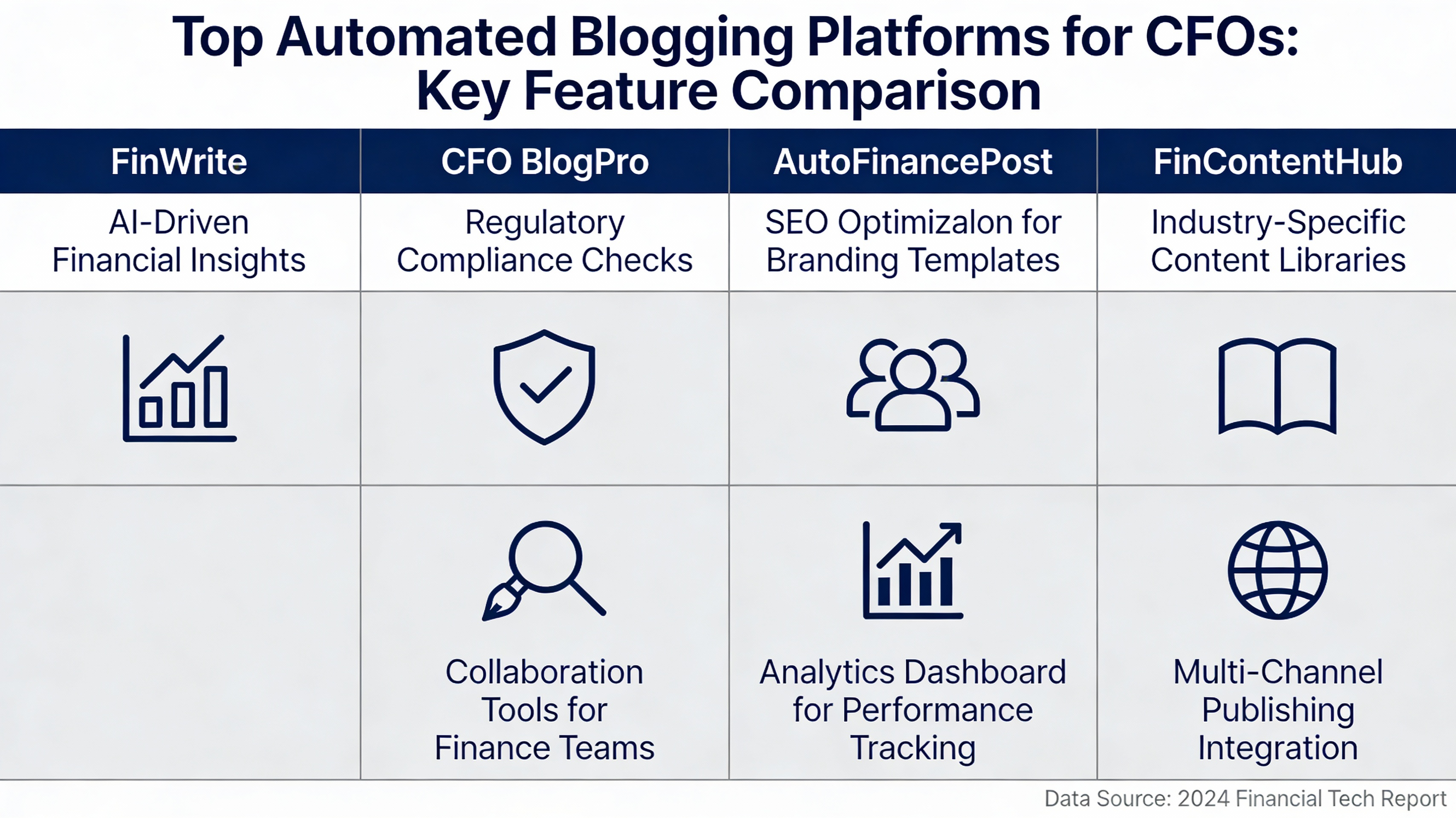
Choosing the right automated blogging solution involves evaluating more than just the quality of the writing. CFOs should look for platforms that offer robust compliance logs, deep SEO planning tools, and detailed analytics dashboards. Integration capabilities with existing ERP or finance tools are also a high priority for seamless reporting.
The ideal platform should act as an extension of your financial reporting system, providing clear data on content performance. Look for solutions that offer tone customization to ensure that the AI reflects your specific brand identity. A thorough evaluation checklist can help distinguish between basic tools and enterprise-grade systems.
Key Features to Evaluate
Financial leaders must prioritize platforms that include AI content planning and tone customization as standard features. Compliance logs are essential for industries that require a record of all published materials for regulatory purposes. Additionally, the ability to report on financial attribution helps justify the investment to the board.
Integration with Financial Reporting Tools
Modern blogging platforms can often export content spend data directly into accounting systems. This allows for real-time ROI dashboards that provide a constant view of marketing performance. Integrating content data with CRM and ERP tools ensures that the marketing strategy remains aligned with financial reality.
Key Takeaways
Summarizing the financial benefits of automated blogging highlights how technology can streamline modern marketing operations. By focusing on cost reduction, SEO performance, and risk management, CFOs can drive better results with less effort. Consider the following points for your evaluation:
- ✅ Efficiency: Automation reduces production time from weeks to minutes, lowering labor costs.
- ✅ Compliance: Centralized style guides and audit trails mitigate brand and legal risks.
- ✅ Growth: Data-driven SEO strategies drive measurable organic traffic and revenue.
- ✅ Visibility: Integration with financial tools allows for clear ROI tracking and attribution.
FAQ
Frequently asked questions regarding the implementation of AI-driven content systems often center on security and performance. Addressing these concerns early helps ensure a smooth transition for the entire executive team.
How does AI ensure brand compliance?The system utilizes automated style guides and predefined brand parameters to ensure every article matches your corporate voice. Every piece of content is logged, providing a clear audit trail for compliance teams.
What is the typical ROI timeline?While SEO results can take a few months to fully mature, the cost savings from reduced labor and agency fees are usually realized within the first billing cycle of adoption.
Can the platform integrate with our ERP?Many advanced platforms offer API access or direct integrations with common financial and reporting tools to ensure data flows seamlessly into your existing workflows.
Is there a risk of duplicate content?No, the proprietary AI systems generate unique content for every topic based on specific search intent and your brand’s unique data, ensuring original articles that rank well.
Next steps for automated blogging
Taking action now can help your organization capture more market share while reducing operational overhead. Schedule a demo today to see how Articfly can transform your content strategy into a predictable financial asset. Start your journey toward automated, SEO-optimized growth by exploring our platform features.