
Understanding Google’s Reward for Updated Content

The Helpful Content Update represents a significant shift in how search engines prioritize digital information. This algorithm focuses on rewarding content that provides a positive user experience while penalizing low-value, outdated pages. By maintaining a library of fresh information, businesses signal to Google that they remain authoritative and relevant in their specific niche.
What the Helpful Content Update Targets
User-centric value is the primary metric targeted by recent search updates. Google identifies whether a piece of content was created solely for search engines or to truly help a human reader. Content that fails to answer a user's query comprehensively or lacks depth often sees a decline in rankings during these core updates.
Why Freshness Matters for Rankings
Freshness signals tell search engines that your information is current and reliable for modern users. High crawl frequency is often observed on sites that update their content regularly, as Google wants to index the most recent data. Meeting user expectations for up-to-date facts and figures is essential for maintaining a competitive edge in the search results.
| Indicator | Old Content Performance | Refreshed Content Potential |
|---|---|---|
| Crawl Frequency | Infrequent / Stale | High / Priority |
| CTR (Click-Through Rate) | Low (outdated years) | High (current year) |
| User Bounce Rate | High due to irrelevance | Lower due to current value |
Data‑Driven Signals That Show Google’s Preference
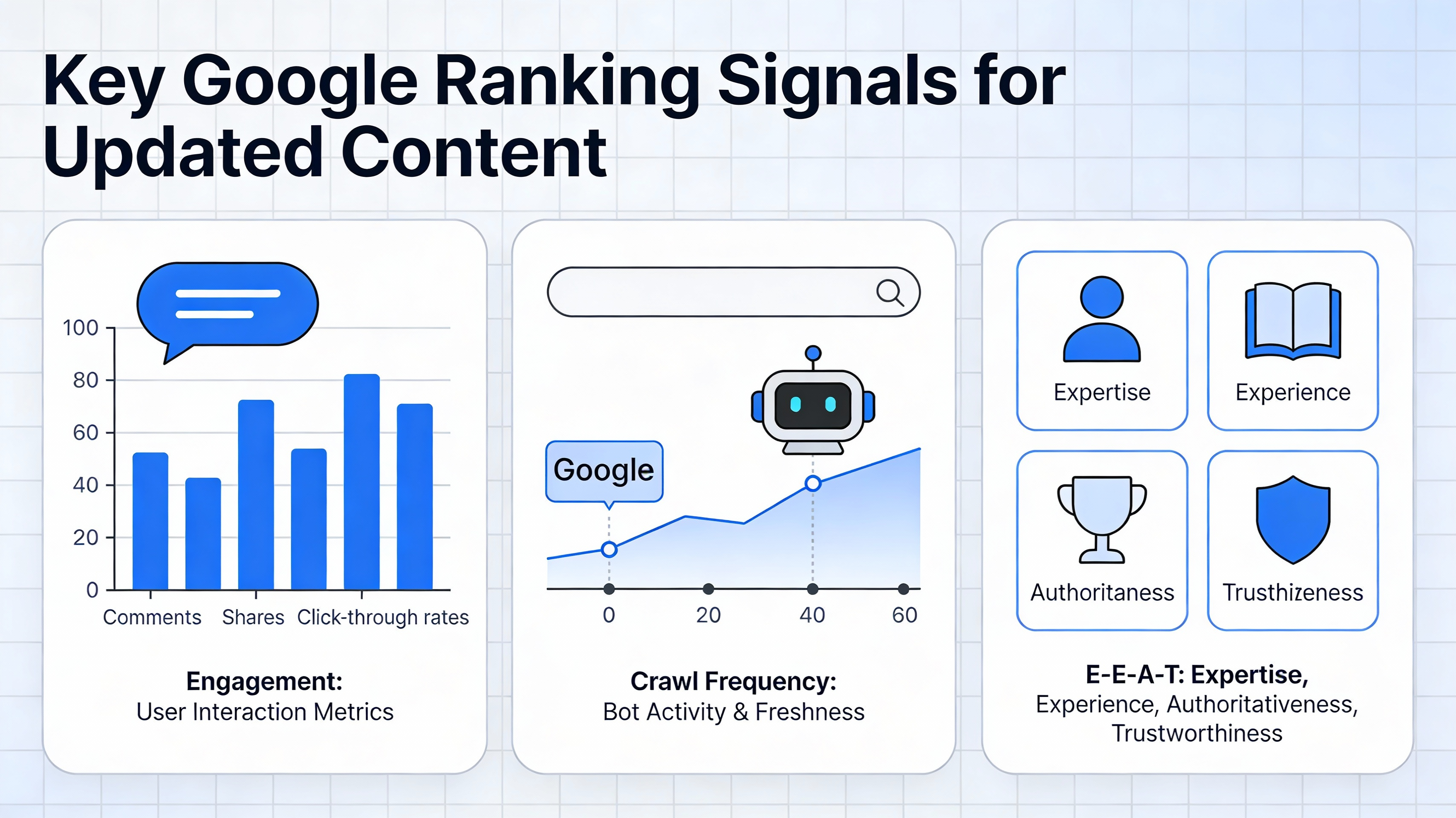
Measurable engagement metrics serve as clear indicators of how Google evaluates your content's quality post-update. When users spend more time on a page and interact with its elements, it sends a positive signal to search algorithms. Monitoring these signals allows marketers to identify exactly which articles need immediate attention and which are performing at their peak.
User Engagement Metrics
Dwell time and click patterns help search engines understand if your content satisfied the user's initial intent. If a visitor arrives at your page and immediately returns to the search results, Google may interpret this as a lack of depth or relevance. High engagement signals suggest that your revamped content is successfully meeting the needs of your target audience.
Crawl Frequency and Indexing
Rapid indexing is often a direct byproduct of consistent content updates and improvements. When you modify an existing URL with high-quality additions, search bots are more likely to revisit the page and update its cached version. This cycle ensures that your newest insights are visible to searchers as quickly as possible.
Content Quality Benchmarks
E-E-A-T principles—Experience, Expertise, Authoritativeness, and Trustworthiness—are the foundation of Google's content evaluation. Updated content allows you to incorporate first-hand experience and original insights that were not available when the post was first published. Demonstrating deep topical knowledge is a key factor in securing long-term ranking stability.
- Verify dwell time and bounce rate in Google Analytics.
- Check the "Last Crawled" date in Google Search Console.
- Review content for original research and updated statistics.
- Audit internal and external link health.
Step‑by‑Step Process to Revamp Your SEO Content
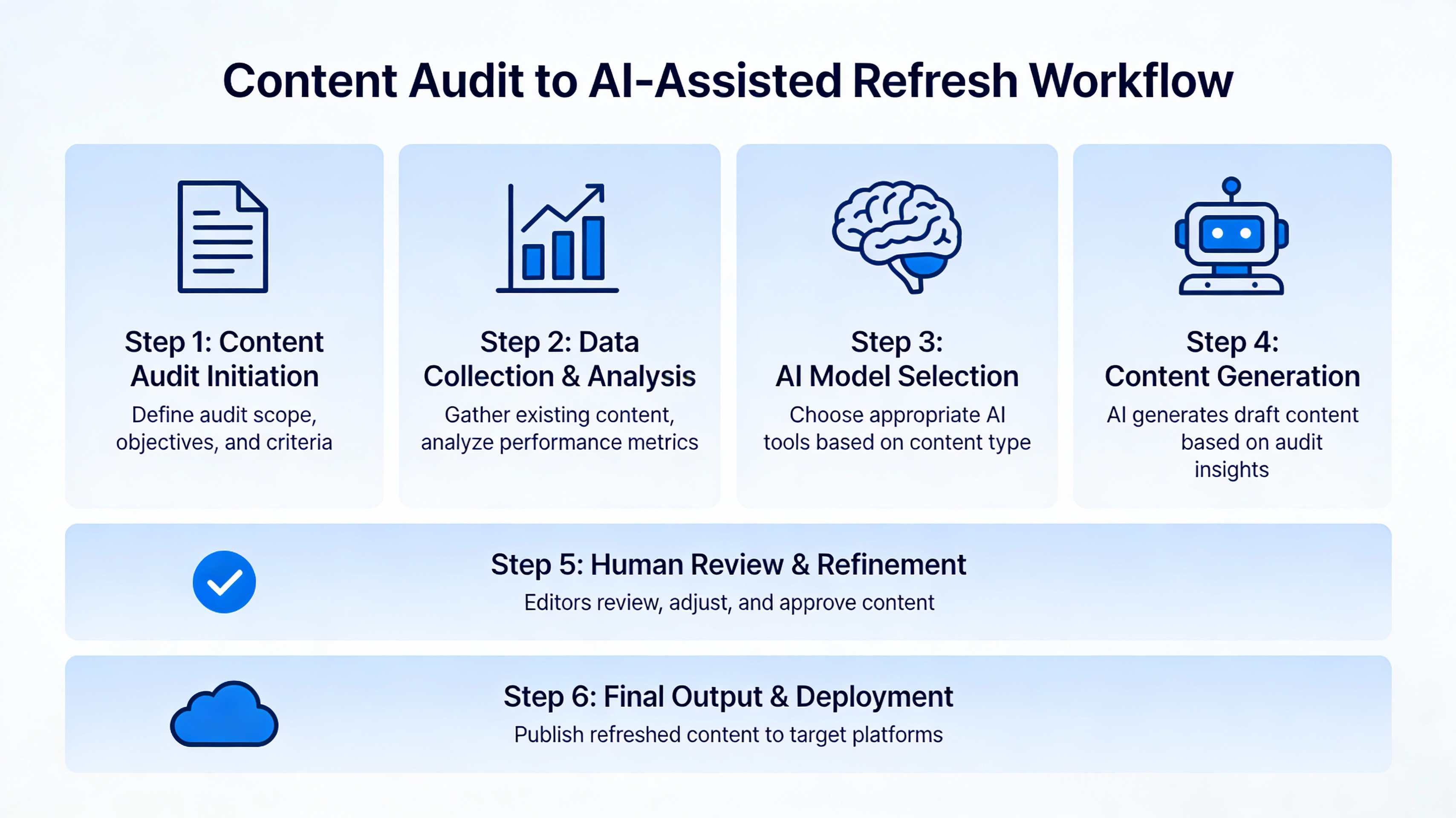
A structured workflow is necessary to ensure that content updates are efficient and produce measurable results. Rather than updating pages at random, a data-driven approach focuses your energy on the URLs with the highest potential for growth. Following a reproducible process helps maintain consistency across your entire blog or knowledge base.
Conduct a Content Audit
Identify Stale Pages
Google Search Console is the most effective tool for flagging pages that have lost significant impressions or clicks over the last six months. By filtering for declining traffic, you can pinpoint specific articles that have fallen out of favor with the current algorithm. These stale pages often provide the highest return on investment once they are properly refreshed.
Evaluate User Intent Alignment
Search intent can shift over time as new technologies or industry trends emerge. It is vital to check if your page still matches the primary intent categories, such as informational, navigational, or commercial. If the top-ranking results for your keyword have changed their format, your content should be updated to mirror what users are currently seeking.
Refresh and Expand Content
Add Current Data and Insights
Industry observations indicate that including the latest statistics and research can significantly boost a page's authority. If exact numbers are not readily available, using safe language to describe general trends still adds more value than keeping outdated 2018 data. Fresh insights demonstrate to both readers and search engines that you are an active participant in your industry.
Optimize for People-First Language
Direct answers and concise language are essential for satisfying the Helpful Content Update's requirements. Rewriting complicated headings to be more descriptive and adding FAQ sections can help your content capture featured snippets. Ensure that the most important information is presented early in the article to respect the reader's time.
Leverage AI with Articfly for Efficient Updates
Generate Drafts and Outlines
Articfly's AI platform allows content teams to generate SEO-optimized outlines based on modern search patterns in seconds. By using automation to handle the initial research and structure, you can focus on adding unique brand value. This synergy between human expertise and AI efficiency accelerates the revamp process significantly.
Fine-Tune for Brand Voice
Brand-specific terminology should be woven into every AI-generated draft to ensure consistency across your digital presence. Adjusting the tone to match your unique identity helps build trust with your recurring audience. Compliance with brand guidelines ensures that every updated post feels like a natural part of your marketing strategy.
Measuring the Impact of Your Revamps

Tracking post-update performance is the only way to validate your content strategy and refine your future efforts. By establishing clear baselines before making changes, you can calculate the exact impact of your optimizations on organic traffic and lead generation. This data-driven feedback loop is essential for scaling successful content marketing operations.
Tracking Ranking Changes
Organic clicks and impressions should be monitored weekly following a major content refresh. It is common to see a temporary fluctuation in rankings as Google re-evaluates the page, followed by a steady climb if the update improved quality. Using Google Search Console help page resources can assist in interpreting these data shifts correctly.
Monitoring Engagement Improvements
Engagement visualization via tools like Google Data Studio provides a clear picture of how users are interacting with your new content. Increases in average session duration and decreases in bounce rates are strong indicators that your revamp was successful. Comparing these metrics to the Articfly analytics dashboard overview helps confirm that your AI-assisted content is resonating.
| Metric | Pre-Revamp (Baseline) | Post-Revamp (Goal) |
|---|---|---|
| Avg. Keyword Position | 25+ | Top 10 |
| Monthly Impressions | 1,000 | 5,000+ |
| Conversion Rate | 0.5% | 1.5% - 2.0% |
Key Takeaways
Strategic content updates are no longer optional for businesses that want to remain visible in search results. Google's commitment to "people-first" content means that freshness and accuracy are top priority signals for the algorithm. By leveraging data and AI tools, you can turn your existing archives into a powerful engine for organic growth.
- Google actively rewards content that is fresh, accurate, and user-centric.
- Data signals such as dwell time and crawl frequency guide the optimization process.
- AI platforms like Articfly dramatically reduce the time required to refresh old posts.
- Regular audits are necessary to identify which pages are losing search relevance.
FAQ
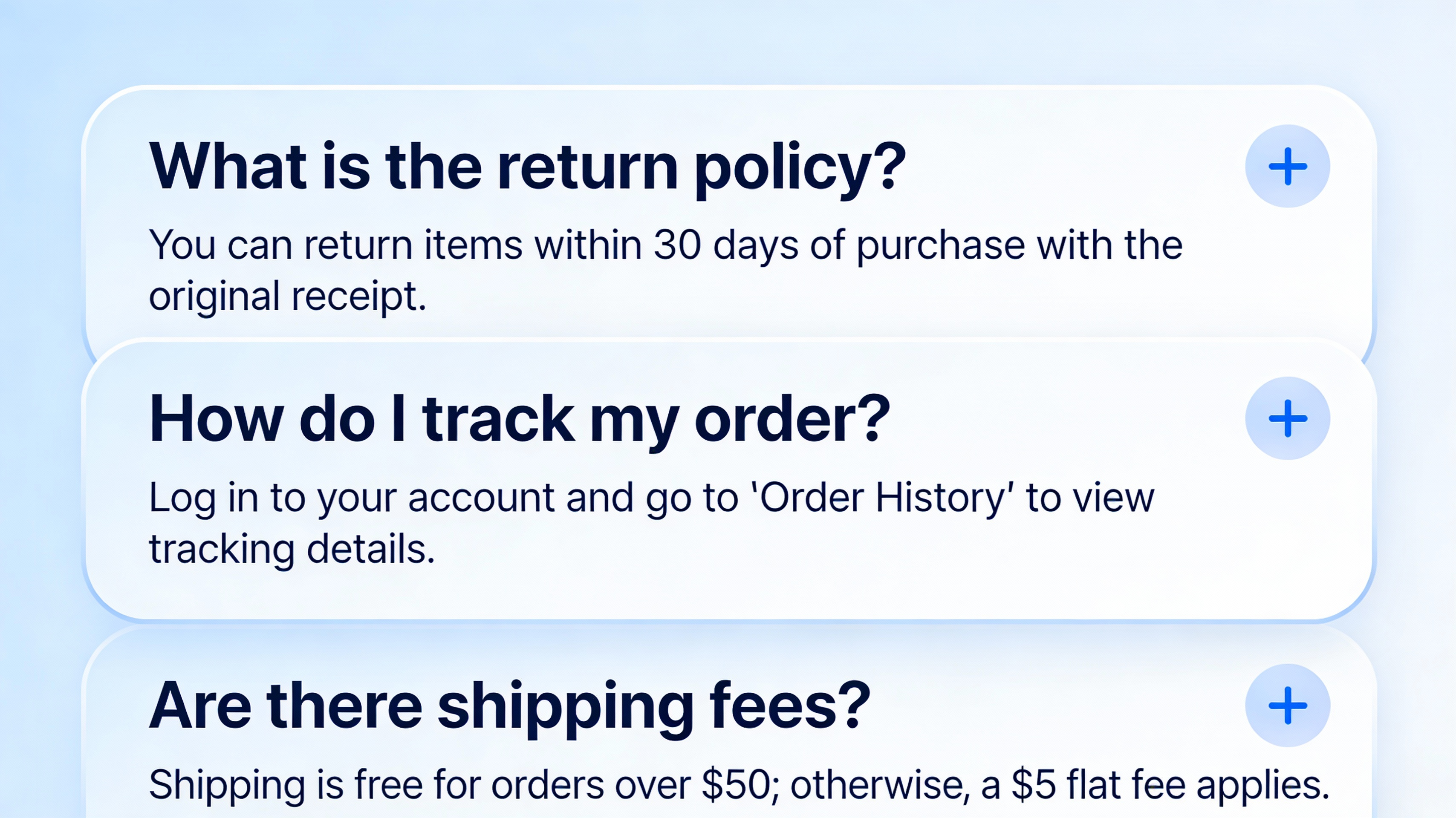
Common questions regarding content updates often revolve around timing, tools, and expectations for ranking improvements. Understanding the nuances of the Helpful Content Update can help set realistic goals for your SEO strategy. Below are answers to the most frequent concerns encountered by content marketers.
Does updating old posts always improve rankings?While refreshing content is a strong positive signal, improvements depend on the quality of the update and the level of competition. Significant gains are most common when the update addresses a specific gap in user intent or fixes outdated data.
How often should I refresh content?Most industry experts suggest auditing your top-performing content every 6 to 12 months. However, fast-moving industries may require quarterly updates to ensure statistics and trends remain accurate.
Can AI-generated content comply with the Helpful Content Update?Yes, as long as the AI content is edited for accuracy, includes human insight, and focuses on helping the user. Google's guidelines emphasize the quality of the content rather than how it was produced.
What metrics prove a successful revamp?A successful revamp is typically marked by an increase in organic impressions, improved keyword rankings, and higher user engagement metrics like dwell time. Referencing a Google's FAQ on helpful content can provide more specific criteria.
Next steps for SEO content revamps
Maximizing your search visibility requires a proactive approach to maintaining and improving your existing content assets. Articfly provides the AI-powered tools you need to audit, plan, and rewrite your articles with minimal effort and maximum SEO impact. Start your free trial today to see how Articfly can transform your content strategy into a scalable growth engine.