Content Marketing ROI Calculator: How to Prove Blog Posts Make Money
Key Takeaways
Content marketing ROI is the measure of revenue generated by content relative to the amount spent on its production and distribution. A positive ROI means your blog generates more than it costs to maintain. Calculating this metric requires tracking the total cost of ownership (TCO) against conversions, lead value, or ad revenue attributed to specific WordPress URLs. For most teams, the primary goal is a return that exceeds the initial investment in writers, tools, and distribution within a 6-to-12-month window.
In many agencies, success is benchmarked through a reduction in Cost Per Lead (CPL) compared to paid search. If a blog post costs $200 to produce and generates 10 leads at a $50 market value each, the immediate ROI is 150%. Long-term value increases as organic traffic compounds without additional per-click costs. Tracking these metrics inside a WordPress environment ensures data remains tied to the actual publishing platform (Actually, tracking via the WP_Query class or Google Analytics 4 event tags provides the most granular conversion data).
Calculating the financial impact of a WordPress blog requires moving beyond vanity metrics like pageviews toward hard cost-per-article and conversion data. How much does a single published post actually cost when factoring in research, drafting, and SEO optimization? Traditional editorial workflows often see costs ranging from $150 to $500 per post. A necessary shift for scale.
- Cost Efficiency: Transitioning from manual drafting to an AI-powered lifecycle reduces production costs by up to 80%, lowering the break-even point for each article.
- Time-to-Publish: Advanced generation modes and direct WordPress syncing cut the production cycle from 12 hours to under 30 minutes per post.
- SEO Compounding: Content that receives regular refreshes via automated scoring tools maintains a 20-30% higher ranking position over 12 months compared to static posts.
- Resource Allocation: A single content manager can oversee a 360-day editorial roadmap, eliminating the need for a 5-person editorial team.
A 10-person agency managing 50 WordPress sites typically sees these savings manifest as reclaimed billable hours within the first 90 days.
The Fundamental Content ROI Formula
The fundamental formula for content ROI is (Revenue from Content - Cost of Production) / Cost of Production, expressed as a percentage. This calculation determines the net profit generated relative to the capital invested in creating and distributing assets. To reach an accurate figure, teams need to aggregate direct expenses like freelance fees and distribution spend alongside indirect costs such as software subscriptions and internal management time. A content piece that costs $500 to produce and generates $2,500 in attributed pipeline value results in a 400% ROI.

Effective measurement requires distinguishing between immediate lead generation and the compounding value of evergreen traffic. While a paid campaign stops delivering the moment the budget hits zero, an SEO-optimized blog post continues to capture organic demand for months or years. Calculating the long-term value involves tracking the Customer Acquisition Cost (CAC) reduction over time as organic search replaces paid clicks. (Calculations often vary based on attribution windows, typically 30 or 90 days). A 6-month lookback period is necessary when evaluating specific content clusters.
Operational expenses often extend beyond the writer's invoice. Not ideal for tight margins. Most teams fail to account for the $50/month stock asset cost or the hidden "context switching" tax when editors jump between Google Docs and a CMS.
Itemizing variables like the $250/month SEO tool stack or the $45 labor cost for manual WordPress uploads reveals the true cost per published word. Suppose a SaaS company scales from 4 to 20 articles per month using Articfly’s automated workflows. The cost of production per unit typically drops as fixed tool costs are spread across a higher volume of output. A team producing 20 articles at $150 each ($3,000 total) sees a better margin than one producing 2 articles at $500 each ($1,000 total), assuming conversion rates remain stable. Included in this calculation are keyword analysis, internal link mapping, and schema generation tools that would otherwise require individual licenses. By centralizing these functions, a marketing manager can justify a $5,000 monthly spend by demonstrating a 60% reduction in the cost-per-lead compared to traditional agency rates. A 20-article monthly cadence allows for testing more keyword variations and landing page triggers. Engineers running these workflows often see a "flywheel effect" where internal links from new posts boost the authority of older, high-converting assets. Systemic growth of this nature eventually drives the CAC below the $100 mark for competitive SaaS niches.
Calculating Production Costs: Manual vs. Articfly
Articfly reduces the 'Cost' variable in the ROI equation by automating the research, drafting, and publishing phases, allowing teams to scale without increasing headcount. Manual production typically involves a writer, an SEO specialist, and an editor, often totaling $150 to $400 per high-quality post. By centralizing these functions into a single dashboard, Articfly lowers the direct expense to the cost of a subscription and a few minutes of human oversight. This shift allows a single manager to handle the output of what previously required a full content department.
Time-to-market is the hidden multiplier in these calculations. A digital agency managing 10 clients previously spent 40 hours per week on research and drafting; they now use Articfly to cut that to 5 hours. The 87.5% reduction in labor hours enables faster indexing and earlier ranking, which triggers the compounding interest of SEO traffic sooner. Every day an article sits in a "draft" state is a day of lost data and potential revenue. Zero wasted motion.
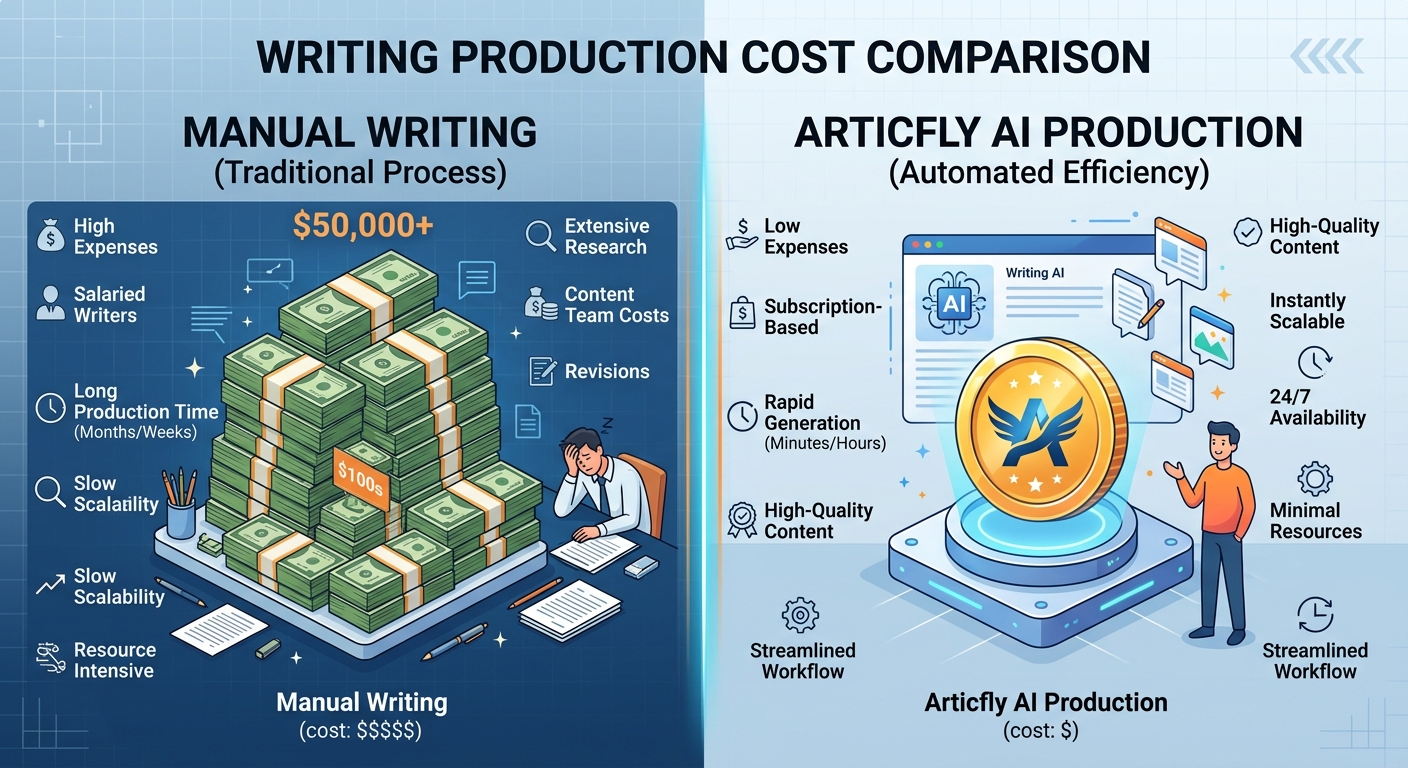
Comparing the unit economics reveals a stark divide between manual and automated workflows. A standard 1,500-word SEO-optimized article requires roughly 4 to 6 hours of manual labor, including keyword density checks and internal link mapping. In contrast, the Articfly Advanced mode generates a brand-aligned draft in under 3 minutes. The built-in 13 SEO tools handle schema generation and SERP previews instantly. (Actually, the native WordPress plugin eliminates the 20-minute manual formatting tax entirely). Teams that automate these steps see cost-per-article drops from $200 down to roughly $15.
Efficiency gains translate directly into more "shots on goal" within the same budget. Instead of publishing 4 articles a month for $1,200, engineers running 50+ workflows often publish 20+ articles for the same total spend. Higher volume accelerates the feedback loop from Google Search Console, providing the data needed to use the Article Refresher tool on posts showing early traction. AI-planned 360-day roadmaps ensure the production line never stalls due to ideation fatigue. Faster publishing cycles mean the blog reaches the break-even point of the ROI curve months earlier than manual-only competitors using the standard Gutenberg editor.
The native WordPress plugin handles the final sync to the CMS.
Tracking Revenue: Direct vs. Assisted Conversions
To track content revenue, use UTM parameters and Google Analytics 4 'Assisted Conversions' reports to see how blog posts contribute to a sale even if they aren't the final click. Content often serves as the initial touchpoint in a multi-stage funnel rather than the closing action. An e-commerce brand might notice that 40% of customers read a blog post before purchasing, even if those users return later via a direct link or a branded search. These patterns indicate that measuring only "Last Click" attribution undervalues the top-of-funnel work performed by informational articles. Assigning value through the "Linear" or "Data-driven" models in GA4 provides a more accurate view of how specific URLs drive dollars.
Articfly facilitates this revenue path by automating internal link mapping toward high-converting money pages. The platform identifies existing content gaps and suggests anchors that point toward product pages or lead magnets. Instead of manual cross-referencing, the system scans the WordPress database to find semantically relevant opportunities. Such guidance moves readers from low-intent educational content to high-intent commercial pages. For instance, a post about "how to clean leather boots" can automatically link to a specific $15 cleaning kit product page. Not ideal for revenue if this link is missing. A 10-person ops team manually managing 200 posts often misses these connections, leading to orphan pages that fail to convert.
Consider a scenario where a SaaS company publishes a technical guide on API integration. A developer reads the guide, bookmarks it, and signs up for a $99/month Pro plan three weeks later. Without "First User Source" data, the marketing lead might wrongly assume the conversion came from a direct visit. How can a team justify content spend if the data only shows the final step? Articfly’s dashboard allows users to monitor these paths by ensuring every post includes a structured internal link toward a conversion point. This prevents potential customers from dropping off after finding the answer they needed.
Effective tracking requires setting up "Monetary Value" for conversion events in the GA4 Admin panel. Teams running 50+ workflows often use the "Path Exploration" report to visualize the exact sequence from a blog landing page to a checkout_success event. A specific 3-step internal link strategy—linking from top-level guides to mid-funnel case studies and finally to pricing—reduces bounce rates significantly. Data tells the truth. (Actually, GA4 allows for a 90-day lookback window, which is essential for tracking long-tail content impact). Articfly’s SEO tools specifically flag posts lacking these outbound internal links to ensure no content remains isolated from the revenue funnel.
Factoring in Content Decay and Maintenance
Content decay is the natural loss of organic traffic that occurs as information ages and competitors publish newer material. Using Articfly's Article Refresher tool to update old posts is 3x more cost-effective than writing new ones. A refresh capitalizes on existing URL authority and backlinks to restore rankings. Technical maintenance of this kind prevents the negative ROI that occurs when high-value pages slip from the first page of search results.
A blogger seeing a 2022 "Best Of" list drop from page 1 to page 4 might lose $200 per month in affiliate revenue alone. Such a decline often stems from outdated pricing, broken links, or a lack of recent "freshness" signals. Articfly's system monitors these specific performance metrics, flagging articles before the traffic loss becomes terminal. By automating the identification of aging assets, teams can protect their existing revenue streams without manual audits.
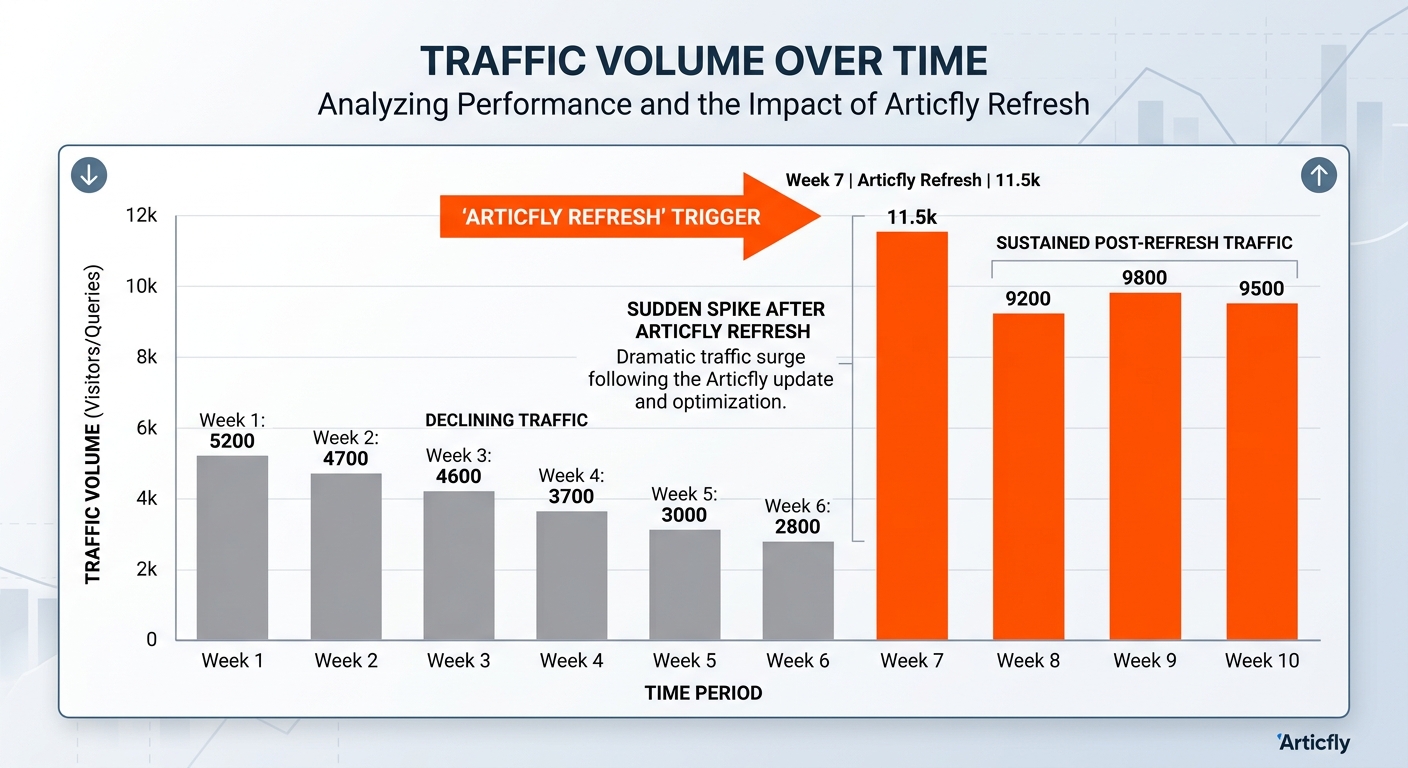
Not ideal for a 500-order batch. (Actually, the system prioritizes the top 20% of pages that drive 80% of revenue based on the attribution data discussed previously).
The Article Refresher analyzes keywords that have lost position over the last 90 days and suggests specific updates to headers, internal links, and metadata. Targeting specific updates identifies exact content gaps without requiring a full rewrite of the existing text. Refreshing a post typically takes 30% of the time required for a new draft. A 10-person ops team managing 500+ articles can reduce their cost-per-click by simply maintaining the "top 50" highest-earning pages. Consistent updates prevent the "leaky bucket" effect where new content merely replaces the traffic lost from dying older posts. Regular updates keep the schema markup valid—actually, Articfly updates JSON-LD automatically during the refresh—which preserves rich snippet visibility in SERPs. The dashboard displays a "decay score" based on real-time SEO performance. This score integrates with the WordPress plugin to trigger a re-optimization workflow directly in the editor. Maintaining a 2023 guide costs far less than commissioning a 2025 replacement draft.
Building Your Content ROI Calculator Spreadsheet
A content ROI calculator should include columns for Production Cost, Traffic Volume, Conversion Rate, and Average Order Value (AOV). These inputs allow for the calculation of Gross Profit per post against the initial investment. Production Cost must account for freelancer fees or internal hourly rates, while Traffic Volume tracks unique visits over a 30-day window. Conversion Rate measures the percentage of those visitors who complete a goal, such as an email signup or a direct purchase. Finally, the AOV represents the mean revenue generated per successful conversion, providing a clear baseline for performance.
Effective tracking requires a Google Sheets or Excel document organized by individual URL. Beyond basic metrics, adding a column for "Traffic Value" from tools like Ahrefs provides a benchmark for what that same traffic would cost in a PPC campaign. Comparing these costs against PPC benchmarks helps justify content spend even before direct conversions occur.
Such a data-driven approach removes the guesswork from content strategy and identifies which topics yield the highest financial returns over time. Organizing a tracking sheet starts with a raw list of URLs in Column A. Column B tracks "Fixed Cost," which includes the writer's fee, a $20 stock image license, and a flat $50 for internal editing or formatting time. Column C pulls "Organic Clicks" from a 30-day Google Search Console export, while Column D holds the "Conversion Rate," often estimated at 1.25% for informational posts. The formula in Column E calculates "Monthly Revenue" by multiplying clicks, conversion rate, and lead value.
Actually, Google Sheets formulas like =IF(E2>0, B2/E2, 0) help visualize the exact day a post pays for itself. Break-even happens fast. For a solo blogger, tracking this manually takes five minutes but saves thousands in wasted ad spend. Not bad for a one-time $250 investment.
Frequently Asked Questions about Content ROI
Common questions about content ROI include the timeline for results, the inclusion of software costs, and the value of organic traffic. Most B2B blogs require 6 to 14 months to reach a break-even point where cumulative revenue from organic leads exceeds the total cost of production. This timeline depends on domain authority and keyword competitiveness. For example, a new domain targeting "enterprise CRM" will see a slower return than an established site targeting niche long-tail queries.
Software costs are a fixed component of this equation. Successful models factor in subscriptions for tools like Articfly or Ahrefs to ensure the margin reflects true net profit. While organic traffic lacks a per-click fee, the labor involved in keyword research, drafting, and periodic refreshing creates a real cost per acquisition (CPA). Treating organic traffic as free leads to inflated ROI figures that fail to account for the $150–$500 typically spent per high-quality article.
When will a blog post start generating profit?
Data from 1,000+ SaaS blogs suggests that individual posts typically hit their peak traffic 7 to 10 months after indexing. (Actually, Google's "sandbox" effect often suppresses new URLs for the first 90 days regardless of quality).
Is organic traffic "free"?
Organic reach is never zero-cost. Beyond the initial draft, content decay requires an "Article Refresher" workflow to maintain rankings. A post that drops from position 2 to position 8 can lose 70% of its lead-generation value in weeks. Teams that ignore maintenance costs often see their ROI plummet after the first year.
Why include software subscriptions in ROI?
Pro-level tools are operational expenses that directly impact the bottom line. A necessary expense—not a small sum. If a $99/month Articfly subscription enables a team to publish 20 optimized articles instead of 5, the cost per article drops significantly. Accurate ROI models treat a $99 Articfly subscription as a leverage multiplier rather than a sunk cost.
Next Steps: Audit and Automate Your ROI
To start proving ROI, audit your top 10 posts, calculate their current value, and then use Articfly to automate your next 10 to compare the cost-basis. A comparison of this nature provides a baseline for acquisition costs versus organic performance. Identifying high-traffic articles showing a downward trend in Search Console is a priority for any content team lead aiming for a 25% ROI increase next quarter. Using Articfly’s Article Refresher, these pages can be updated with new keywords and internal links in under five minutes.
Establishing a tracking framework is the secondary requirement for measurable growth. Every URL generated within the Articfly dashboard should include a standardized UTM string (e.g., utm_medium=organic&utm_source=articfly) to isolate AI-assisted traffic from manual efforts. Granularity of this level allows for precise attribution within Google Analytics 4 or Plausible. Data-driven teams often find that consistent publishing schedules—enabled by Articfly’s 30-day editorial roadmaps—reduce the cost per lead by 40% compared to sporadic manual posting. The goal is knowing which keywords drive revenue.
Immediate implementation requires a three-step technical audit. First, export the top 50 URLs from WordPress. Second, identify "decaying" assets where impressions have dropped by 15% or more over the last 90 days. Third, sync Articfly to a WordPress instance via the native plugin to begin the refresh cycle. Simple enough.
Suppose a 5-person agency manages 12 client blogs; auditing 600 posts manually takes weeks. Not ideal for a manual workflow. Articfly’s SEO scoring tool handles this instantly to ensure every word hits the $15 target.
Want the system behind this content?
Join the top 1% of SEOs generating programmatic, high-converting organic traffic completely on auto-pilot.
DEPLOY ARTICFLYMore Articles

How Local Service Businesses Win Customers with 'Near Me' Blog Content
Discover how local service businesses can dominate 'near me' search results by moving beyond basic landing pages. Learn to scale hyper-local blog content that builds trust, captures high-intent leads, and leverages AI-driven automation for multi-location growth.
READ
The Future of Blogging in the Age of AI: Dead, Dying, or More Important Than Ever?
Is AI killing the blog? Discover why the future of blogging isn't about 'writing' anymore—it's about managing a high-performance content lifecycle. Learn how to leverage AI to scale SEO without losing your brand voice.
READ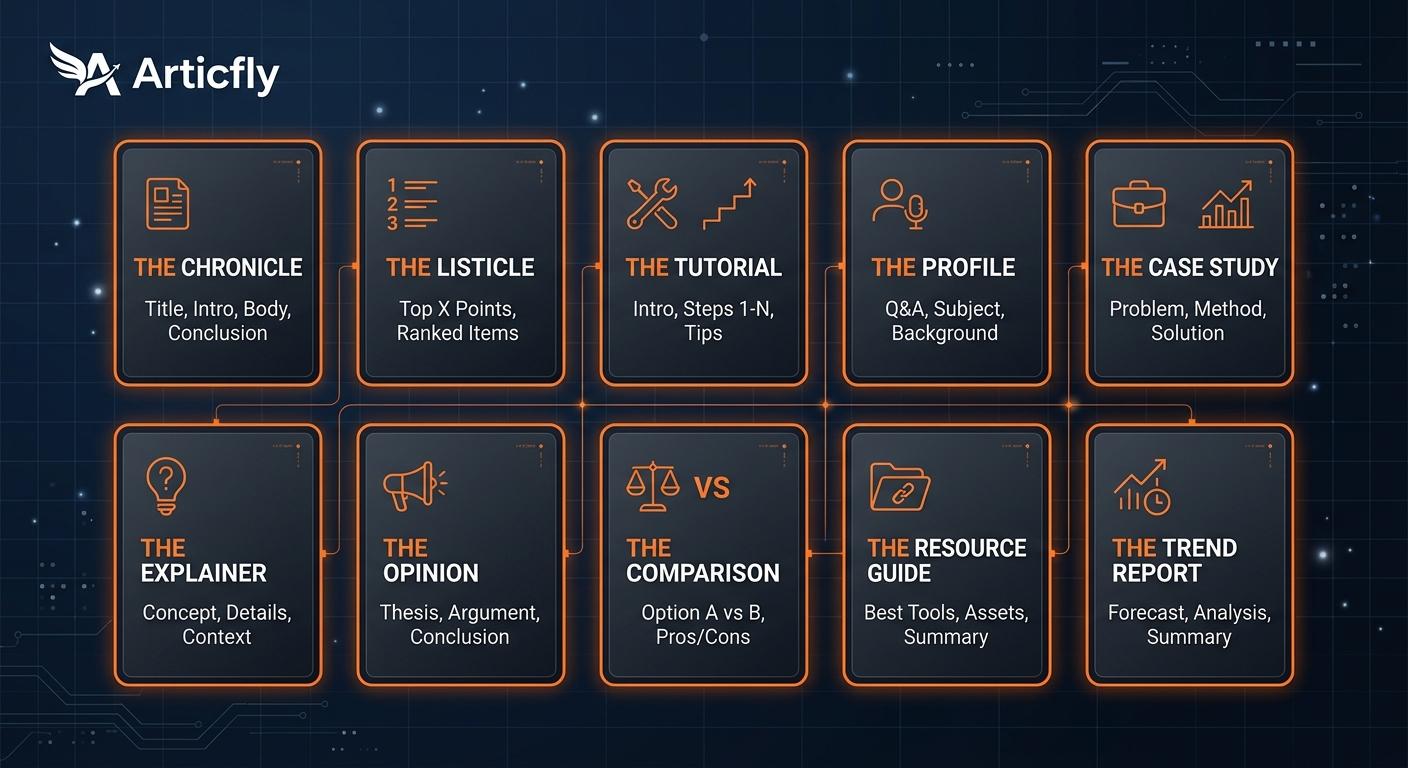
Blog Post Templates: 10 Copy-Paste Structures for Every Type of Article
Stop staring at a blank cursor. Use these 10 proven blog post templates to structure your content for SEO, readability, and conversions, plus how to automate the process with Articfly.
READ