E-commerce SEO Content Strategy: How to Write Product Blog Posts That Drive Sales
Key Takeaways for E-commerce Content Success
An effective e-commerce SEO content strategy focuses on capturing top-of-funnel traffic through informational blog posts and funneling them toward high-intent product pages using internal links and PAS frameworks. Instead of targeting bottom-of-funnel keywords like "buy hiking boots"—where competition from marketplaces like Amazon is high—the strategy targets queries such as "how to break in leather boots" or "best waterproof materials for hiking." Such an approach builds brand authority while providing value before a user reaches a final decision point.
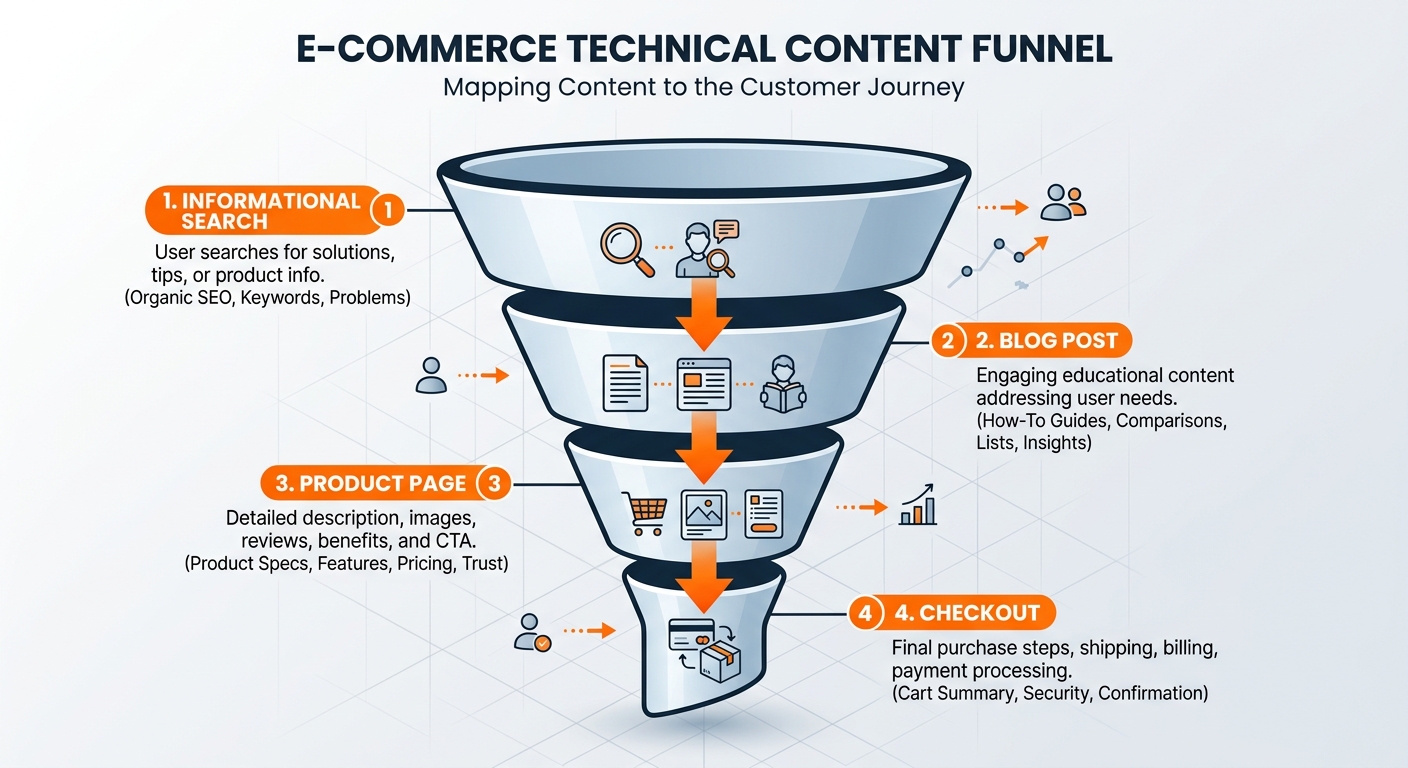
Real-world data supports the transition toward utility-based content. An outdoor gear retailer increased organic revenue by 40% by shifting from generic "best tents" lists to specific "how to choose a 4-season tent" guides that linked directly to their inventory. Guides like these serve as entry points for new customers who might not yet be searching for a specific SKU. Through the provision of technical answers to complex questions, stores build a funnel that leads directly to the cart.
Why settle for high-competition product keywords when the research phase offers untapped search volume? (Actually, informational queries make up roughly 80% of total web searches, according to most SEO industry benchmarks). If you manage a high-SKU inventory, the blog becomes the primary driver for middle-of-funnel engagement. Integrating a blog into a WordPress site allows for the creation of long-form assets that support transactional pages through deliberate link equity distribution.
- Targeting informational intent captures users during the awareness stage, allowing a brand to influence the criteria for their final purchase.
- Internal link mapping between blog posts and product detail pages (PDPs) passes authority and guides the user journey toward the checkout.
- Structured data implementation via Schema.org types like "HowTo" or "Article" helps search engines understand the relationship between a guide and the products it mentions.
- The PAS framework structures blog content to highlight a specific pain point before presenting a product as the technical resolution.
A technical alignment between content and commerce creates a sustainable growth loop for any WordPress-based store using tools like n8n or the Articfly plugin.
Why Product Pages Aren’t Enough for Modern SEO
E-commerce brands need blog content because product pages often lack the word count and keyword depth required to rank for broad, high-volume informational queries. Search engines prioritize pages that demonstrate coverage of a topic, which a standard SKU description rarely achieves; while a product page focuses on conversion intent—pricing, dimensions, and technical specs—it often fails to address the "why" or "how" behind a purchase.
When a skincare brand analyzed their traffic, they found that their "How to treat dry skin" blog post outranked their "Moisturizer" product page for 15+ related keywords. This pattern emerges because informational content allows for a higher density of semantic entities and long-tail phrases that do not fit naturally in a checkout-focused UI. (Actually, Google’s Helpful Content updates prioritize pages that satisfy user intent beyond a simple transaction, favoring 1,200-word guides over 200-word product blurbs).
Attempting to stuff 1,500 words of educational text into a product description creates a poor user experience and dilutes conversion signals. High-ranking pages in competitive niches usually require a specific structural depth—H2s and H3s targeting secondary queries like "best time to apply serum" or "side effects of retinol"—that would clutter a clean product layout. Educational articles serve as the primary vehicle for building E-E-A-T (Experience, Expertise, Authoritativeness, and Trustworthiness). By answering specific user problems through long-form text, brands signal to crawlers that they are subject matter experts rather than just vendors.
Teams managing 500+ SKUs often struggle to maintain this depth across every category. Internal linking passes topical authority from the high-traffic blog post to the high-converting product page. Not ideal for a 500-order batch without automation. Articfly’s internal link mapping tool automates this by identifying these semantic connections within the WordPress database.
Identifying High-Intent Keywords for Your Online Store
High-intent keywords for e-commerce blogs include 'best [category]', '[product A] vs [product B]', and 'how to solve [problem] with [product]'. These terms signal that a searcher is actively comparing options or seeking a solution to a specific pain point. E-commerce teams often overlook "Commercial Investigation" queries because they don't lead to an immediate checkout, but these keywords capture users in the final decision-making phase. Mapping content to "Problem-Solving" queries positions a store's inventory as the logical resolution to a customer's friction. For instance, a user searching for "how to remove pet hair from velvet" is primed to buy a specialized brush. Targeting these specific intent buckets ensures that blog traffic consists of qualified leads rather than casual browsers. Articfly’s 13 SEO tools facilitate this by identifying gaps where competitors fail to address these nuanced search patterns.
Effective keyword mapping relies on separating high-volume vanity metrics from conversion-ready phrases. Using Articfly's keyword analysis tool, a kitchenware site identified that 'best carbon steel pan for induction' had 60% less competition than 'carbon steel pan'. This level of granularity (specifically targeting the induction stove segment) allows smaller stores to outrank massive retailers. Such specificity often yields higher click-through rates because the content addresses a precise technical requirement.
Commercial investigation queries often take the form of comparison guides or top-ten lists. These articles serve users who know what they need but haven't settled on a brand. A 10-person marketing team managing a skincare brand might use the Articfly dashboard to scan for "competitor vs" keywords that have low difficulty scores. Identifying these gaps allows for the creation of "alternative to" pages that target dissatisfied customers of larger brands. Articfly's SERP analysis tool highlights whether these competitors are missing structured data or specific headers. Not ideal for broad awareness, but perfect for poaching bottom-of-funnel traffic. (Actually, Articfly's internal link mapping tool helps connect these comparison posts back to the direct product pages to shorten the path to purchase).
Problem-solving queries shift the focus from the product to the desired outcome. High-quality guides on technical fixes, such as using silicone spray for squeaking running shoes, create a logical conversion bridge for specialized footwear retailers.
The Anatomy of a Product Blog Post That Sells
A high-converting product blog post uses the PAS (Problem-Agitation-Solution) framework, features clear CTAs, and includes structured data to appear in rich snippets. This structural approach ensures the content addresses the specific intent identified during keyword mapping. By starting with a clear problem statement—such as a 40% drop in mobile conversion rates—the article immediately signals its value to the reader. The agitation phase then deepens this engagement by highlighting the long-term consequences of ignoring the issue, like compounding data debt or rising customer acquisition costs.
If the problem is manual data entry, the solution phase transitions from theory to execution by positioning the product as the primary mechanism for resolution. The PAS method transforms a standard blog post into a functional sales asset that guides a lead through the middle of the funnel without relying on aggressive sales copy. Effective posts map specific product capabilities to the agitation points previously discussed. For instance, if the problem is manual data entry, the solution highlights a specific API integration or a 1-click sync feature.
Strategic CTA placement reduces the cognitive load on a reader ready to convert. Placing a primary CTA—like a "Start Free Trial" button—immediately after the solution section captures high-intent traffic before they scroll past the value proposition. Comparison tables further streamline this journey by aggregating technical specifications into a scannable 3-column layout (Feature, Competitor X, Your Product). A fashion blogger switched from 'outfit ideas' to '5 ways to style a blazer for work' and saw a 25% increase in click-through rates to the featured products. This shift works because it provides a specific context for the purchase decision rather than a generic suggestion. (Actually, 3-column tables with 'Yes/No' checkmarks or specific numeric values like '0.5s Load Time' often outperform long-form feature lists by 15% in conversion tests).
By minimizing technical ambiguity, authors can reduce common conversion friction. Specific and actionable. You should aim for at least one CTA every 400 words to ensure the next step is always visible. Data-backed tables that compare price-per-unit or integration counts provide the evidence needed for a final "Buy" click. A 10-person ops team managing 50+ WordPress sites needs these hard numbers to justify software spend to stakeholders. High-converting posts end with a specific directive, such as a link to a documentation page or a direct checkout URL for a $49 starter pack with 5 license seats. Adding Product Schema (using the 'offers' and 'aggregateRating' properties) directly to these sections helps the blog post display price and availability in search results, further reducing friction.
Scaling Production Without Losing Your Brand Voice
AI scales e-commerce content by automating the research and drafting process, but it must be trained on a specific brand voice to ensure product descriptions remain accurate and on-brand. Mapping a brand's unique selling proposition (USP) directly into the LLM prompt layer prevents the generic AI tone that often alienates repeat customers. This technical alignment ensures that every generated sentence adheres to specific vocabulary constraints and tonal markers—such as minimalist or technical—across hundreds of product pages.
By fixing these parameters, teams avoid the manual rewrite cycles that typically stall high-volume SEO campaigns. The result is a library of 100+ articles that feel written by a single subject matter expert rather than a disjointed collection of machine outputs. Maintaining such consistency allows e-commerce sites to build authority without increasing the size of their editorial staff or sacrificing the specific brand identity that drives conversions.
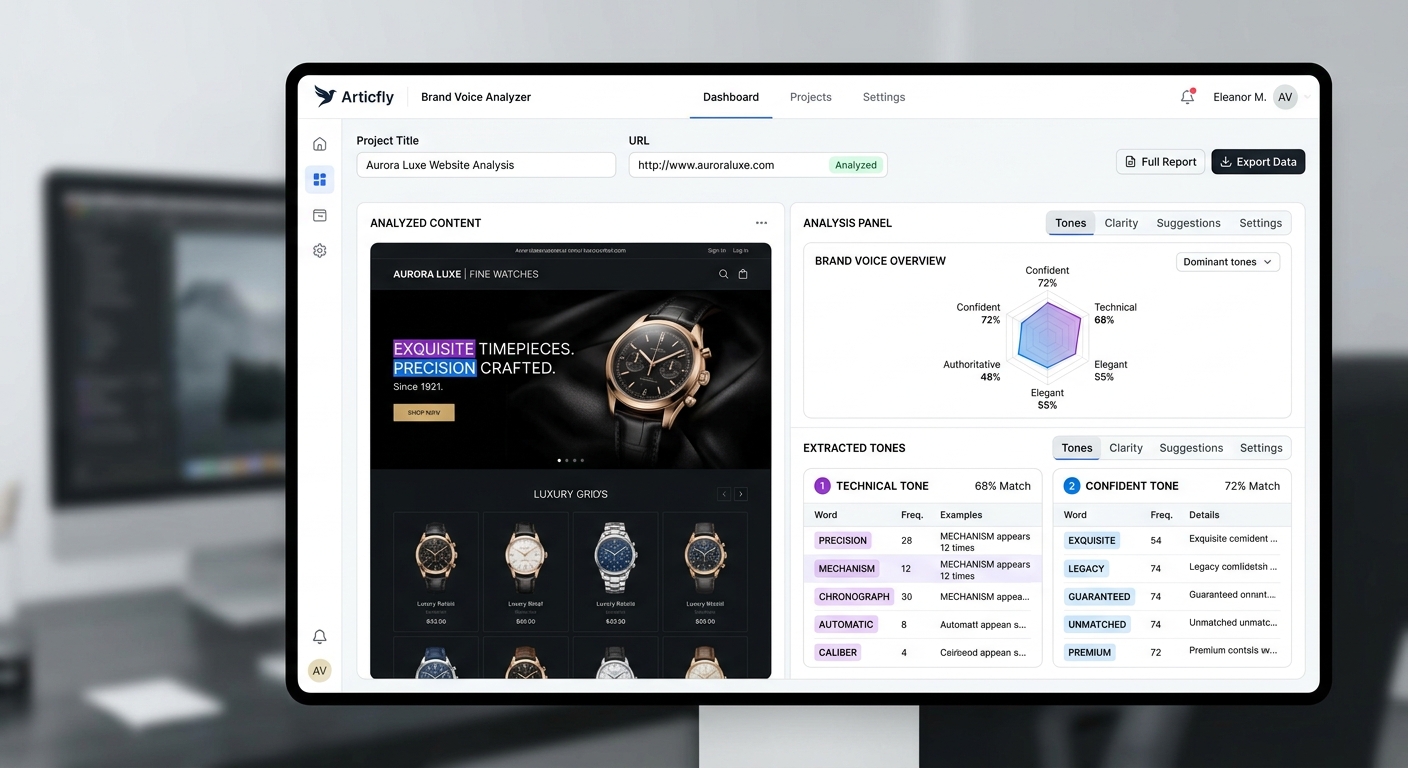
The Articfly Brand Voice Analyzer scans a luxury retail website or a specific blog subfolder to extract 15+ tonal parameters including sentence length variance and preferred vocabulary. Instead of manual prompt engineering, users sync these extracted profiles to the Advanced Mode writer. Does a brand really want its technical outdoor gear described in the same flowery prose as a skincare line? Probably not. (Actually, the analyzer extracts specific bigram frequencies and common adjectives to build a JSON-based tonal profile). This profile then informs every heading and paragraph generated, ensuring the "Confident" or "Technical" tone remains constant across a 2,000-word deep dive.
A digital agency recently scaled a client's blog from 2 to 20 posts per month while maintaining a strict minimalist brand voice using these automated profiles. Syncing drafts directly to the WordPress dashboard via a native plugin removes the copy-paste bottleneck. Content teams also utilize 360-day editorial roadmaps built around specific seasonal search trends to keep the production pipeline full months in advance. These roadmaps link directly to keyword analysis tools to ensure every scheduled post targets high-intent commercial terms. Just pure output. Production continues at scale without manual oversight, pushing live articles directly to the WordPress block editor.
Technical SEO and Schema for E-commerce Articles
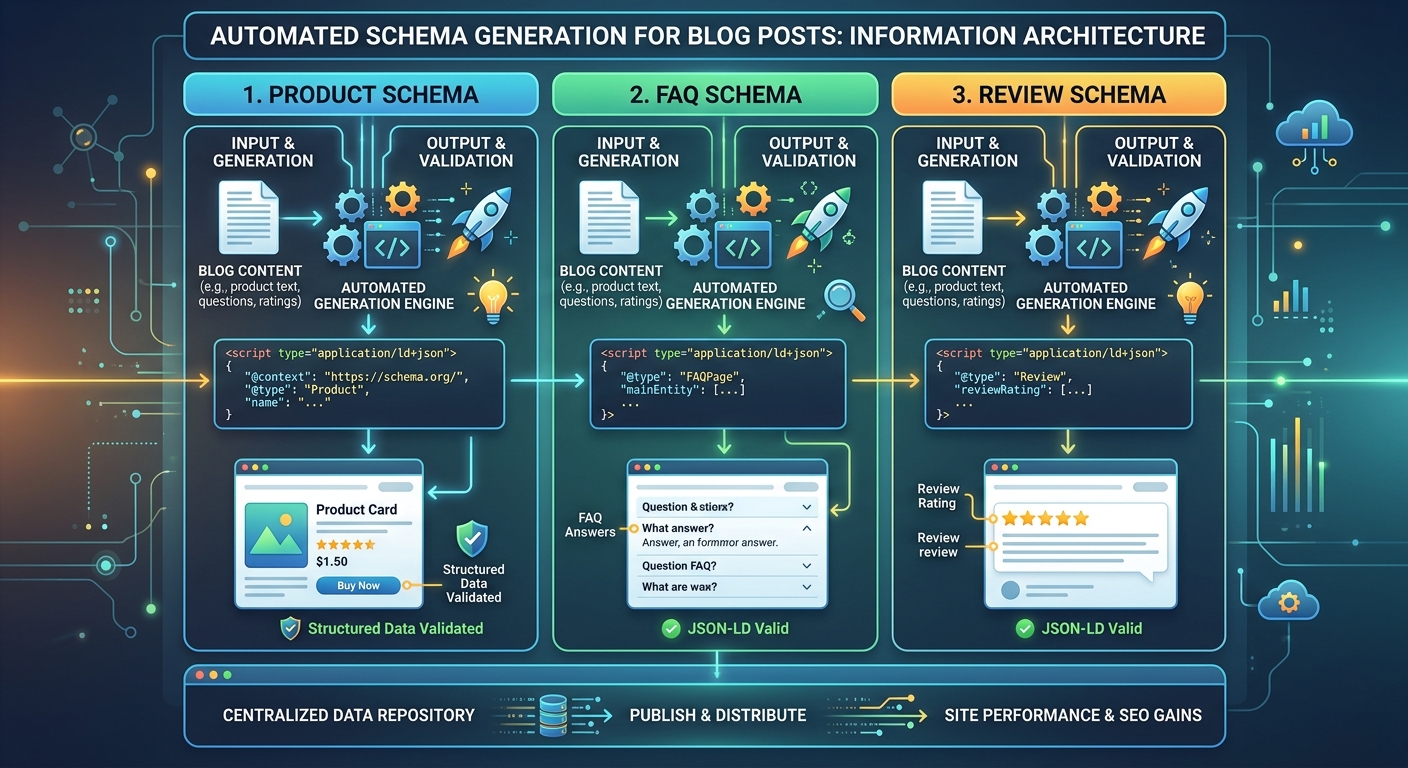
Essential SEO for e-commerce blogs includes Product Schema, FAQ Schema, and internal link mapping to ensure search engines understand the relationship between articles and products. These structured data formats communicate specific attributes like price, availability, and direct answers to common queries to crawlers. By embedding JSON-LD snippets directly into the article’s code, a site provides explicit signals that help search engines categorize the content as transactional or informational.
A tech retailer recently added FAQ schema to their 'Best Laptops' guide and saw their SERP real estate double due to the expanded dropdowns in Google. Such additions convert a standard listicle into a rich result that captures more screen space on mobile devices. (Specifically, the FAQPage type allows for multiple questions to appear directly beneath the meta description). That specific guide saw a 14% increase in click-through rate over three months.
Internal link mapping within the Articfly dashboard prevents keyword cannibalization between informational blogs and transactional product pages. If a blog post about "how to clean suede shoes" competes for the same primary keyword as a product category page, search engines may struggle to rank either effectively. Articfly’s mapper identifies these overlaps, ensuring the blog links back to the product page with specific anchor text that reinforces the product's authority for commercial terms. A 10-person ops team managing 200+ product categories uses this mapping to ensure content never competes with the main shop pages.
Generating a Product schema block includes the offers property and priceCurrency (set to ISO 4217 standards like USD or EUR). Using a 3-step validation check, the tool confirms the schema is free of "missing field" warnings in Google Search Console. Not ideal for manual coding at scale. Automation handles the heavy lifting for a 500-article catalog, while the aggregateRating field pulls from real customer reviews to display gold stars in search results.
Maintaining Freshness: Preventing Content Decay in Retail
Content decay in e-commerce occurs when products go out of stock or trends shift; using an automated refresher tool ensures your blog always points to active, relevant inventory. This decay typically manifests as a steady decline in organic traffic as search engines detect outdated links, expired promotions, or seasonal advice that no longer applies. For a retail site, a high-ranking post about "Best Winter Boots 2023" becomes a liability by January 2024 if 40% of the featured SKUs are discontinued. Google's freshness algorithms prioritize content that reflects current availability. When a page's click-through rate drops because users see "Out of Stock" badges, its search ranking often follows. Maintaining a competitive edge requires a systematic approach to identifying these performance dips before they result in a permanent loss of visibility.
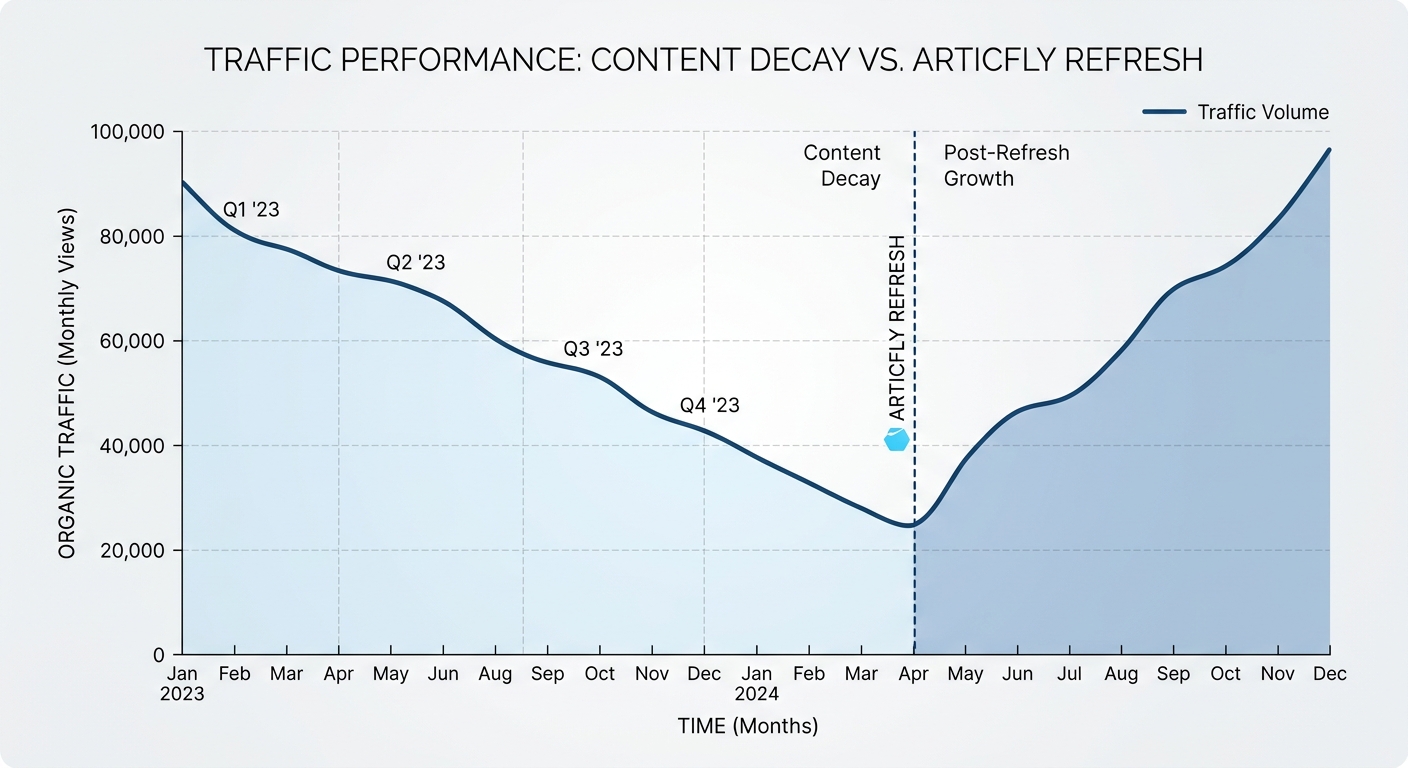
Articfly’s Article Refresher monitors these metrics by connecting directly to a WordPress site to track post-age and keyword performance.
An apparel brand recently used this tool to target a "Summer Trends" post originally published in 2022. Manual audits are slow. By the start of 2024, the post had lost nearly all its ranking power. The refresher identified the decay, allowing the team to swap out dead product links for current inventory and update the seasonal advice. Such an update recovered 80% of the lost organic traffic within six weeks. The system analyzed the gap between the old content and the latest SERP requirements for the "sustainable swimwear" keyword. A recipe for burnout if done manually by a 10-person team for 500+ articles.
Effective refreshing involves more than changing the year in the title. It requires updating the internal link structure and refreshing the lastmod date in the XML sitemap (actually, many SEO plugins handle the sitemap update automatically once the post is saved). A quick swap of three outdated product images and a 200-word update to the "Buying Guide" section often suffices to regain top-3 positions. The process maintains the URL's existing authority while signaling to crawlers that the information remains accurate for the current shopping season. Retailers with consistent growth aim for a balance where at least 30% of their monthly publishing schedule focuses on refreshing existing blog assets.
Frequently Asked Questions About E-commerce SEO
Common questions about e-commerce blogging include post length (1,500+ words), frequency (2-4 times per week), and ROI measurement (tracking assisted conversions). A minimum threshold of 1,500 words per article ensures enough semantic depth to rank for secondary long-tail keywords. This volume allows for the inclusion of technical specifications, comparison tables, and user-intent-driven subheadings that short-form content lacks.
Data from high-growth Shopify stores suggest that publishing 2 to 4 times per week provides the best balance between crawl frequency and quality. Maintaining this pace signals to Google that the site is an active authority. Tracking the actual value of these posts requires looking beyond direct sales. By monitoring assisted conversions in Google Analytics 4, teams can see how a blog post initiated a journey that later ended in a purchase.
How long should an e-commerce blog post be?
High-ranking pillar content typically reaches 1,500 words or more. Shorter posts often fail to cover technical details for complex products (like your 400-watt solar panel). Not ideal for quick updates, but necessary for ranking.
What is the ideal publishing frequency?
Weekly schedules of 2 to 4 posts are standard for scaling agencies. Consistency outweighs raw volume. Quality over quantity.
Can I track the ROI of my blog in GA4?
Conversion path reports in Google Analytics 4 identify these touchpoints. Setting the 'Path length' filter shows interactions before a transaction. If a blog post appears early in a $200 journey, it contributes to the GA4 conversion event.
Your 3-Step Plan to Scalable E-commerce Content
To start, audit your existing content for decay, identify 5 high-intent keywords, and use Articfly to generate your first brand-aligned product guide. This initial step focuses on reclaiming traffic from underperforming pages before expanding into new territory. A boutique owner recently configured the Articfly WordPress plugin in 15 minutes, scheduling an entire month of niche-specific content by the afternoon.
Is a massive editorial team necessary for this volume? Not with an automated workflow. First, connect the WordPress instance via the Articfly dashboard to enable direct syncing and schema injection. Second, use the keyword analysis tool to filter for high-conversion product terms, then feed these into the generator. Selecting "Advanced" mode allows for deeper brand voice alignment (actually, the Brand Voice Analyzer needs only 3-5 existing blog posts to map specific vocabulary).
Finalize the setup by activating the Article Refresher. This ensures that every published guide maintains its SERP position without manual oversight while testing the internal link mapping feature.
Want the system behind this content?
Join the top 1% of SEOs generating programmatic, high-converting organic traffic completely on auto-pilot.
DEPLOY ARTICFLYMore Articles

The 15-Minute Blog Audit: Find Out If Your Content Is Making Money or Wasting Space
Stop letting dead content kill your rankings. Learn how to perform a high-impact blog audit in just 15 minutes to identify which posts drive revenue and which are simply wasting crawl budget.
READ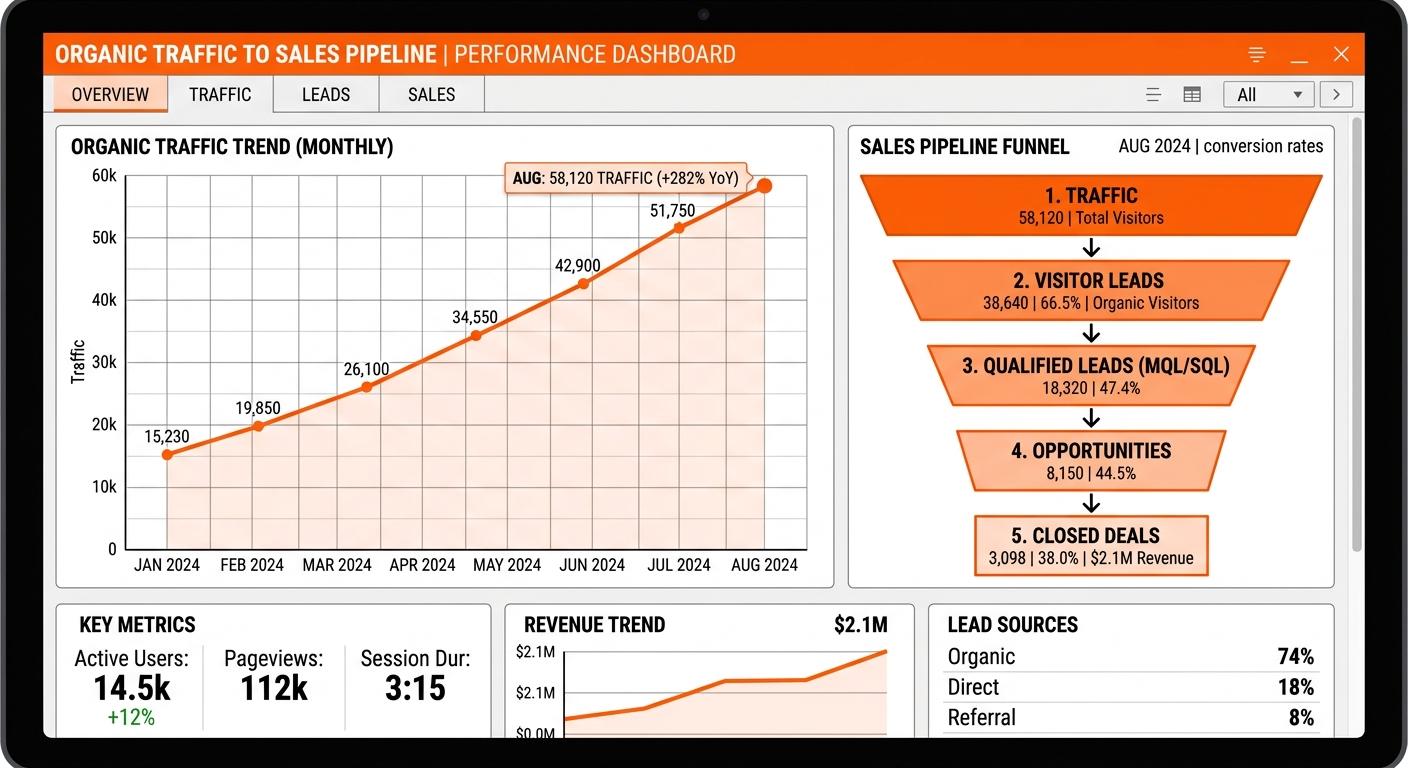
How to Build a Sales Pipeline with Nothing but Blog Content and Zero Ad Spend
Learn how to transform your WordPress blog into a self-sustaining lead generation machine. This guide breaks down the strategy for scaling organic traffic and building a sales pipeline using high-volume, AI-optimized content without spending a dime on advertising.
READ
Real Estate Agent Blog Guide: 15 Post Ideas That Actually Generate Seller Leads
Stop wasting time on generic content. Learn 15 high-intent blog post ideas designed to attract motivated home sellers and how to automate your production with Articfly.
READ