Real Estate Agent Blog Guide: 15 Post Ideas That Actually Generate Seller Leads
Key Takeaways for Generating Seller Leads via Blogging
To generate seller leads, real estate agents should focus on high-intent topics like hyper-local market data, home preparation costs, and case studies of successful sales. The shift toward bottom-of-the-funnel (BOFU) content addresses the immediate financial and logistical concerns of a homeowner, such as net proceeds or neighborhood-specific absorption rates. A top-performing agent in Austin, TX, recently shifted from lifestyle blogging to market data blogging and recorded a 40% increase in inbound listing appointments within six months. (Actually, market data posts often see higher time-on-page metrics because they provide utility rather than entertainment). Focusing on the specific variables of a local ZIP code—like the average days-on-market for 3-bedroom homes—establishes authority that generic national reports cannot match. Such a technical approach filters for serious prospects who are actively calculating their potential equity before contacting a listing agent.
Effective blogging strategies for real estate require a departure from broad top-ten lists. Data over fluff.
- BOFU Content Mapping: Focusing on how to sell topics rather than how to decorate guides ensures the audience consists of active sellers. Articles detailing the cost of pre-listing inspections or specific closing costs in a given state convert at higher rates than generic neighborhood summaries.
- Granular Market Data: Utilizing actual MLS data points provides tangible value. A table showing the median sale price versus list price for a specific subdivision provides more utility to a seller than a broad city-wide update.
- Automated Distribution: Teams running consistent schedules often use tools like Articfly to sync content directly to WordPress. This removes the manual friction of formatting and internal linking, which often leads to content rot or irregular posting cycles.
- Performance Tracking: Monitoring Search Console for queries like "sell my home in [Neighborhood]" helps identify gaps. Not ideal for a high-volume team to guess which keywords work.
Integrating a 15-minute weekly review of Google Search Console data ensures the content strategy remains aligned with local search trends.
The Psychology of a Home Seller's Search Journey
Home sellers search for information regarding home value, local market competition, and the logistics of moving before they ever contact an agent. This search behavior follows a predictable pattern of information gathering that dictates which search terms dominate their browser history at specific intervals. A homeowner six months from listing typically prioritizes broad valuation data over specific agent credentials. Initial search queries often focus on the Curiosity phase, where users interact with automated valuation models (AVMs) to establish a baseline price. Most homeowners in this bucket want to see how their equity has changed over a five-year holding period. Providing a clear analysis of local appreciation rates—perhaps a 4.2% annual increase in the suburban corridor—satisfies the initial need for data without forcing a premature consultation.
At this early stage, content should address high-level market trends rather than specific sales pitches. Not exactly a ready-to-sign lead.
As the timeline narrows to three months, the intent shifts toward the Validation phase. Here, the searcher looks for local market absorption rates or recent comparable sales within a 2-mile radius. Why settle for a generic national report? They need to know if the 4-bedroom layout in their specific zip code is currently in demand. Analyzing search intent for a seller 90 days out reveals a preference for "days on market" stats for similar properties (Actually, 90 days is the standard window for most pre-listing research cycles).
The final Selection phase occurs roughly two to four weeks before the listing goes live. Search volume moves toward "top-rated listing agents in [City]" or "how to prepare a home for sale in [Neighborhood]." Such authority signals—like a breakdown of a recent $1.2M closing—become the primary conversion driver. High-intent traffic often converts best through a checklist of 15 pre-listing repairs including estimated ROI for kitchen refreshes.
5 Hyper-Local Market Report Ideas to Build Authority
Effective local market reports for real estate blogs include neighborhood-specific price trends, absorption rates, and 'days on market' comparisons. These metrics provide a granular view of inventory levels that generic national data misses. By breaking down stats by zip code or school district, agents demonstrate a technical understanding of micro-market shifts. High-quality reports often highlight the "absorption rate," which calculates how many months it would take to sell the current inventory at the current pace of sales. This specific data point signals to sellers whether they are entering a buyer's or seller's market without relying on vague adjectives.
A report comparing the original list price to the final sale price across three adjacent neighborhoods offers immediate value to homeowners tracking their equity. Including a "Days on Market" (DOM) breakdown for different price brackets—such as homes under $500,000 versus those over $1 million—helps set realistic expectations. These technical insights serve as a primary SEO driver. Search engines prioritize hyper-local content that answers specific user queries about local property values and market velocity.
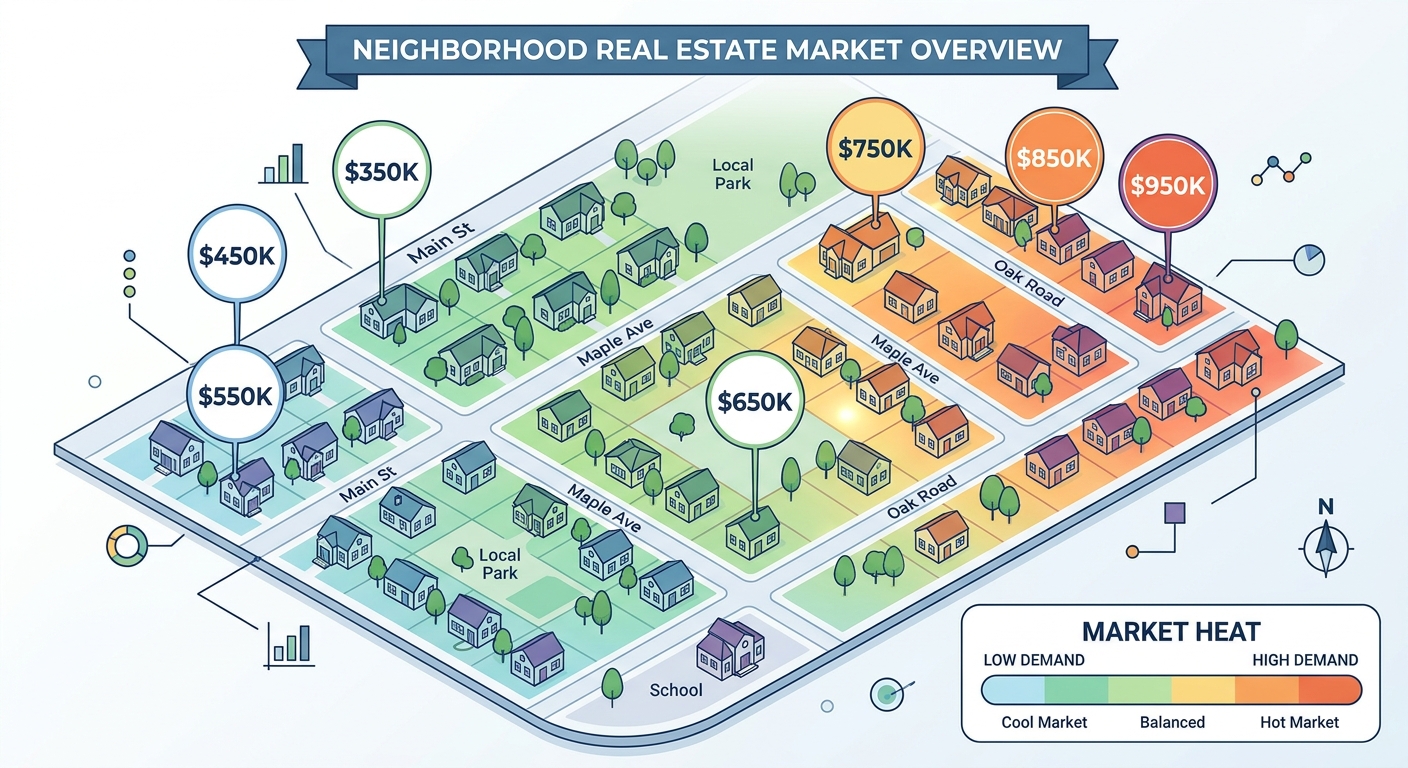
Efficiency increases when an agent uses Articfly to generate monthly updates for five different sub-markets simultaneously. Automation handles the heavy lifting of formatting while the agent focuses on interpreting the 'why' behind the numbers. (Actually, most MLS exports provide the 'Cumulative Days on Market' or CDOM, which accounts for re-listings and offers a more honest look at liquidity). Granular data over generic fluff. Five distinct report archetypes help establish technical dominance in a crowded market:
- Neighborhood Price Index: Contrast the city-wide median ($450,000) with specific enclaves ($620,000) to highlight micro-growth.
- Absorption Rate Analysis: Calculate months of inventory (e.g., a 2.1-month supply in 'North Hill') to define the scarcity level.
- List-to-Sale Percentage: Track if homes are selling for 97% or 103% of the asking price to manage seller expectations.
- Price-per-Square-Foot Trends: Compare 2022 vs. 2024 values to show long-term appreciation despite interest rate hikes.
- Days on Market by Price Point: Show that $500k homes move in 14 days while $1M+ estates take 60+ days.
Teams managing 20+ zip codes establish a dominant digital footprint by refreshing these stats quarterly. Why does the 90210 zip code consistently outperform its neighbors? Answering that with 2023 vs 2024 data attracts high-intent sellers. Such reports often function as evergreen lead magnets when distributed through a consistent newsletter. For example, a post detailing a 0.5-month decrease in absorption rates in the 'Southside' district provides a clear urgency signal via a 3-retry automated email sequence.
5 'How-To' Guides for Motivated Home Sellers
High-intent preparation guides focus on ROI-driven renovations, staging costs, and the logistics of preparing a home for the market. These resources target sellers who are actively transitioning from the "thinking" phase to the "execution" phase of a sale. Data suggests that a seller reading a 'Decluttering Guide' is statistically 3x more likely to list within 90 days than one reading a 'Home Decor' post. Focusing on the financial impact of specific prep tasks attracts leads who prioritize a high net return over aesthetic trends.
In high-value markets, a Pre-Sale ROI Audit serves as a financial filter for homeowners who are unsure where to allocate their renovation budget. Instead of suggesting full kitchen remodels, this guide focuses on high-yield updates like minor bathroom refreshes (roughly 1.6% increase in sale price) or a $500 front door replacement. Professional staging often costs between $1,500 and $4,000 but can reduce time-on-market by 30% to 50%. Detailed guides on local staging costs versus potential carry-cost savings provide immediate utility.

How much does it actually cost to sell a house when the 6% commission is just the starting point? A "Hidden Costs of Selling" guide breaks down the 1-3% in closing costs, $500+ for professional inspections, and the $2,000 average for pre-listing repairs. Suppose a seller in a competitive market like Austin ignores a $300 HVAC service—they might face a $5,000 credit request during the inspection period. Providing a "Inspection-Proofing Checklist" helps sellers mitigate these large price drops by addressing small issues like leaky P-traps or cracked window seals early. Sellers also need to account for capital gains taxes if the profit exceeds $250,000 for single filers, a detail often missed in generic online calculators. Transfer taxes in some jurisdictions can add another $1,000 to $3,000 to the seller's side of the ledger. Detailed guides on title insurance premiums and escrow fees prevent the sticker shock that often occurs when the preliminary settlement statement arrives.
The "90-Day Listing Countdown" maps out the logistical sequence of getting a property market-ready without burnout. Not ideal for a last-minute weekend rush. This timeline ensures the property hits the MLS on a Thursday morning to maximize weekend showing traffic. Weeks 1-4 involve interviewing agents and completing structural repairs, while weeks 5-8 focus on deep cleaning and professional photography. Teams that provide these granular schedules often see higher client retention before the listing agreement is even signed. Use a simple Google Sheet template or a Notion board to track these 15-20 specific milestones. A structured approach prevents common delays caused by backordered materials or contractor scheduling conflicts during the final 30-day push. Landscaping updates like fresh mulch often return 100-150% of their cost, making them a priority for curb-appeal guides featuring sod installation.
5 Case Studies and Social Proof Concepts
Real estate case studies should highlight the problem solved, the strategy used, and the final financial outcome for the seller. Effective content moves beyond "just sold" updates by documenting specific friction points and the tactical adjustments made to overcome them. For instance, a property with zero offers after 60 days on market requires a detailed breakdown of how a $4,000 staging investment shifted buyer perception. High-performing case studies quantify success through metrics like the list-to-sale price ratio and days on market compared to local zip code averages.
By framing these stories as technical problem-solving exercises, agents demonstrate a repeatable process for high-stakes negotiations. This data-driven approach builds trust with prospective sellers who prioritize financial performance over generic marketing claims. Such transparency proves that a successful sale results from a planned sequence of actions rather than market luck.
Analyzing transaction history reveals patterns that serve as high-converting content for prospective sellers. Consider the "Expired Listing Resurrection" post. Instead of just showing the "Sold" sign, focus on a property that languished for 90 days with a previous agent but closed in 10 days under your management. Document the exact changes made to the MLS description and the specific lighting adjustments in the new photography. Another strong concept involves the simultaneous buy-sell transaction. Detail how a family moved from a four-bedroom suburban home into a downtown condo without carrying two mortgages or renting a storage unit.
The "Appraisal Gap Strategy" offers a technical look at protecting a seller's bottom line. Describe a scenario where a high offer exceeded the bank valuation and explain the specific evidence pack provided to the appraiser to justify the price. (Actually, most appraisers in the 90210 zip code require at least three comparable sales from the last 120 days to consider an adjustment). The breakdown of these logic-based decisions builds authority. For high-demand areas, a post on "Multi-Offer Management" works well. Break down how 12 offers were filtered using a custom spreadsheet to compare not just price, but inspection waivers and earnest money deposits.
Distressed property case studies provide a clear look at ROI for investors or estate executors. Suppose a seller inherits a home with 20 years of deferred maintenance. Outline the $15,000 in high-impact repairs—like neutral paint and floor refinishing—that yielded a $45,000 increase in the final sale price. Real data beats vague promises. Not a fluke. Such posts demonstrate a commitment to maximizing the final contract value.
Optimizing Real Estate Content for Lead Conversion
Real estate blogs should use lead magnets like "Instant Home Value Estimators" or "Seller's PDF Checklists" to convert readers into leads. Effective lead capture systems integrate these assets directly within the content flow rather than hiding them in a sidebar. A high-performing conversion path often starts with a specific market report that links to a gated PDF or a consultation calendar. Embedding a "Download My Seller's Roadmap" button at the midpoint of a 1,000-word article provides an immediate next step for motivated sellers. Technical implementation involves using tools like Gravity Forms or HubSpot to trigger automated email sequences upon submission. These systems allow agents to move traffic from passive reading to active CRM entries. A boutique agency in Seattle increased lead capture by 22% by adding a "Download My Seller's Roadmap" button to every blog post.
Internal linking creates a logical progression from general awareness to high-intent conversion pages. A market report analyzing ZIP code 98101 housing trends should link to a case study about a recent $1.2M sale in that exact area. This structure guides the user toward social proof without requiring manual navigation. Using the WordPress internal link mapper in Articfly helps identify these opportunities by scanning existing posts for relevant keywords like "sold price" or "market analysis."
Placement matters more than design. Sticky bottom bars or slide-in triggers set to 50% scroll depth capture attention without interrupting the reading experience. (Actually, a 3-second delay on a scroll-triggered popup often yields higher engagement for mobile users on 4G connections). Not ideal for a 500-order batch.
Conversion tracking requires a Google Tag Manager event for every CTA click. Mapping these events to a CRM like Follow Up Boss shows agents which specific blog posts generate the most revenue. Analyzing the "First Touch" attribute in Google Analytics 4 clarifies whether a seller first landed on a neighborhood guide or a pricing article. Data-driven teams use these insights to double down on high-performing topics like "probate sales" or "luxury downsizing." Every blog post should end with a direct link to a Calendly booking page or a contact form.
Scaling Your Real Estate Blog with Articfly AI
Articfly allows real estate agents to automate the creation and publication of local market reports and seller guides directly to WordPress. The system bypasses the manual drafting process by connecting an AI-powered editorial engine to a live CMS. Agents who use the Advanced mode for article generation can maintain a steady flow of neighborhood deep-dives without hiring external writers. The platform integrates 13 SEO tools to handle keyword analysis and schema generation. By automating the technical overhead, real estate teams can focus on closing deals while Articfly manages the content lifecycle.
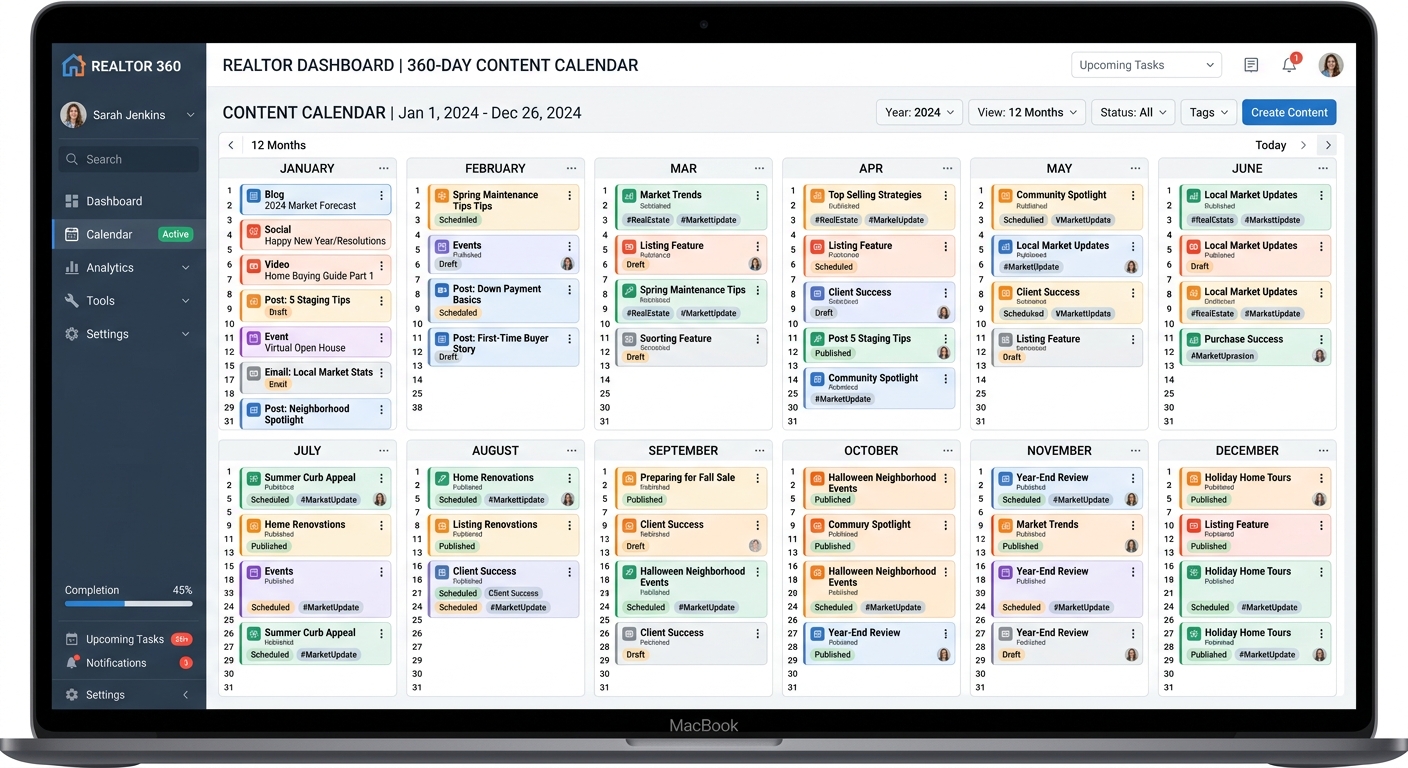
Setting up a 360-day content calendar takes less than 15 minutes. An agent simply inputs their niche—such as "luxury condos in Miami"—and the AI generates a year-long roadmap of targeted topics. Such planning ensures that the blog remains active and relevant to potential sellers throughout the entire fiscal year. Because the tool tracks content decay, it also triggers refreshes for older posts to maintain their search rankings.
Maintaining a specific personality is often the hardest part of automation. The Brand Voice Analyzer solves this by scanning an existing website to extract tone and vocabulary patterns. Rather than generic AI prose, the output mirrors the specific professional style of the brokerage. One agent managed to populate an entire year of seller guides while waiting for a client at a listing appointment. (Actually, the internal link mapper uses existing post IDs to ensure every new article connects to high-intent "Contact Me" pages). The system handles the internal link mapping and SERP previews, removing the need for a dedicated SEO manager.
Scale without headcount. Every post syncs directly via the native WordPress plugin.
Frequently Asked Questions About Real Estate Blogging
How often should real estate agents blog to see results?
Real estate agents should blog at least once a week to maintain SEO momentum and provide fresh content for social media. Publishing a 1,200-word post every seven days signals to Google that a site is active, which helps crawl frequency. Consistency prevents the content decay often seen on dormant agent sites where rankings drop after three months of inactivity. This schedule allows for a mix of local market updates, neighborhood guides, and seller advice without overwhelming a small team.
Data from property portals suggests that sites with 50+ indexed pages of high-quality local content receive 4x more organic traffic than those with only property listings. A single post targeting a phrase like "selling a home in [Neighborhood Name]" can capture high-intent traffic that generic Zillow searches miss. Maintaining such a cadence ensures a steady stream of internal linking opportunities, which strengthens the authority of core service pages. (Actually, Articfly’s content calendar tool can map out these 52 posts in under ten minutes using local ZIP codes).
Does blogging actually impact local SEO for individual agents?
Local SEO thrives on specificity. A 1,500-word guide on probate sales in a specific county often out-converts generic advice by capturing high-intent sellers.
Is it safe to use AI for real estate blog content?
Google’s E-E-A-T guidelines prioritize helpful, original content regardless of its origin. How much time is truly saved? Not much if the content requires heavy editing. Using Articfly ensures the output matches a specific brand voice while including technical elements like Schema markup. Agents using Advanced mode can feed market reports into the engine to produce data-driven articles directly within the WordPress dashboard.
Your 30-Day Real Estate Blogging Action Plan
To start generating seller leads, agents should audit their current blog, select three high-intent topics, and use Articfly to schedule their first month of content. The initial week focuses on identifying power neighborhoods — specific zip codes where inventory is low but turnover is high — to anchor the SEO strategy. Instead of broad city guides, an agent might focus on the 90210 area or a specific gated community like Silver Creek. During the second week, the focus shifts to lead magnets, such as a 2024 Home Seller’s Checklist or a neighborhood-specific market report PDF. These assets act as the conversion point for the traffic generated by the blog. By the third week, connecting Articfly to a WordPress site via the native plugin allows for the bulk generation of the first four articles.
Days 21-30 involve setting the Articfly Content Calendar to a weekly publishing cadence. A solo agent managing three listings doesn't have time for manual formatting.
The Articfly dashboard handles internal link mapping and schema generation automatically (The plugin syncs via a secure API key in the settings). Wait, starting with ten articles might be overkill for a new site. Connecting the WordPress site removes the friction of copy-pasting. Not ideal for a 50-post backlog. Most agents find that a 4-post monthly schedule is the most sustainable cadence for the Articfly dashboard.
Want the system behind this content?
Join the top 1% of SEOs generating programmatic, high-converting organic traffic completely on auto-pilot.
DEPLOY ARTICFLYMore Articles
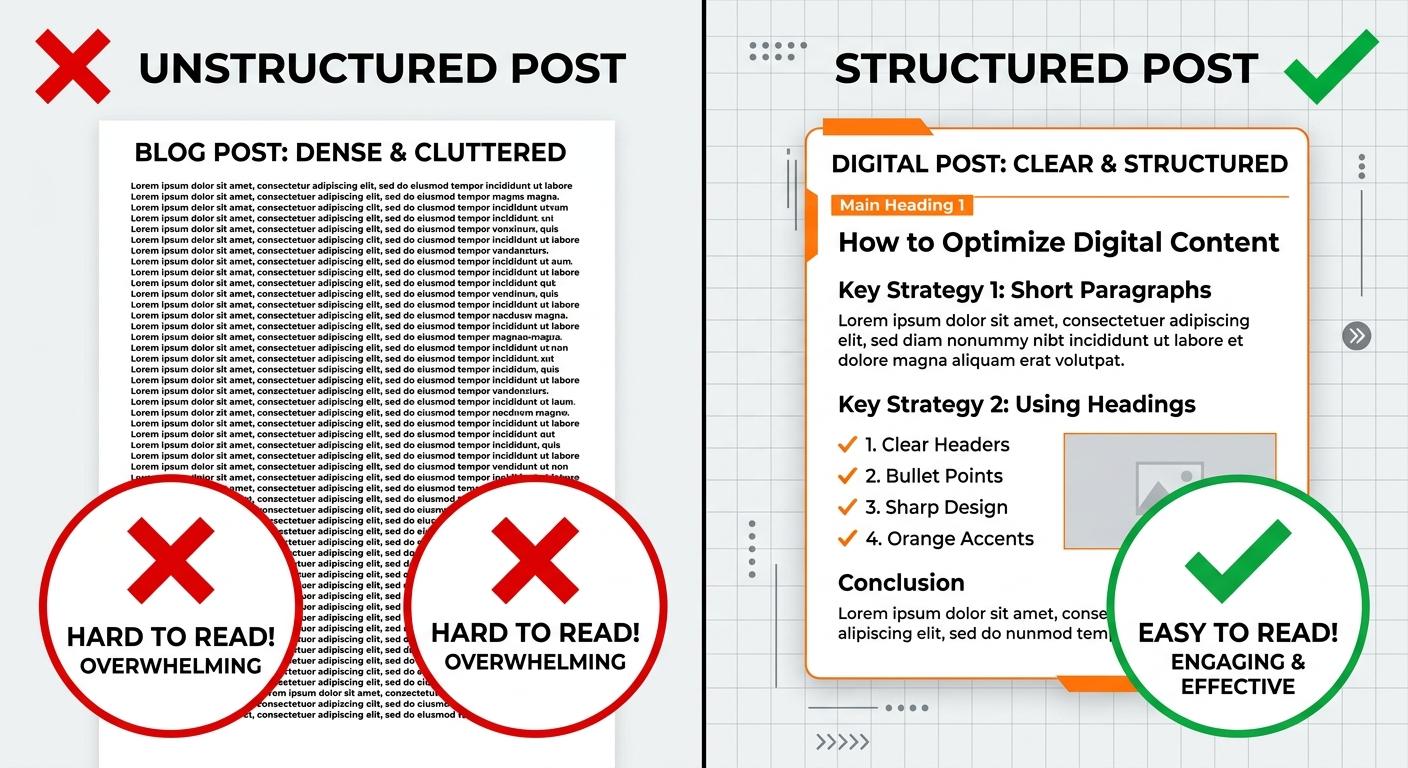
Why People Stop Reading Your Blog Post After 30 Seconds (and How to Fix It)
Most readers decide to stay or leave a blog post within the first 30 seconds. If your bounce rates are high, it's likely due to structural friction, poor hooks, or a lack of immediate value. Learn how to diagnose engagement killers and use AI-driven optimization to keep readers scrolling.
READ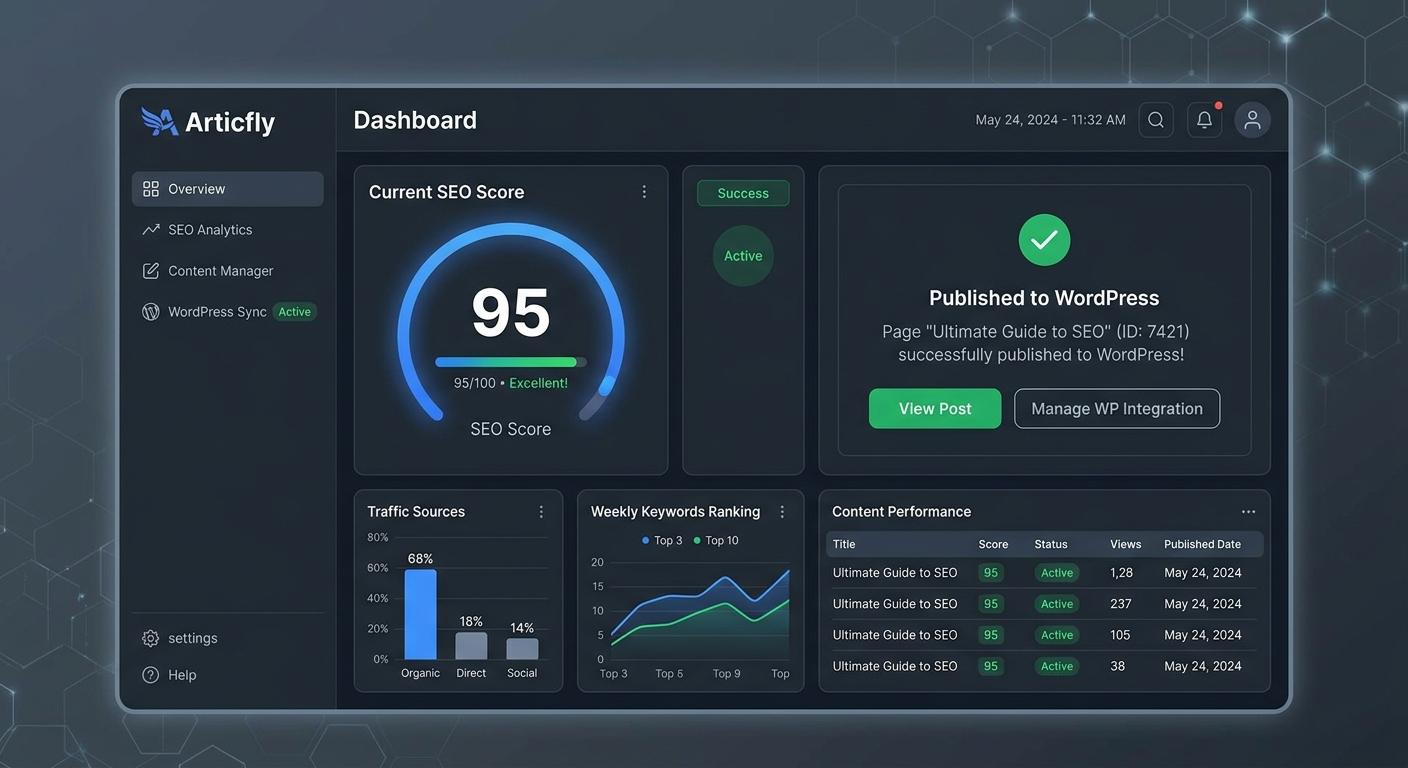
The $15 Blog Post That Brings in $2,000/Month: How AI Content Delivers 130x ROI
Discover the unit economics of high-scale AI publishing. Learn how to leverage Articfly to produce $15 blog posts that generate $2,000 in monthly recurring revenue through SEO optimization, automated publishing, and strategic content refreshing.
READ
Brand Voice in AI Content: How to Stop Your Blog from Sounding Like a Robot
Generic AI content is killing brand authority. Learn how to use Articfly’s Brand Voice Analyzer and Advanced Mode to produce high-scale, SEO-optimized content that sounds like your team, not a machine.
READ