Internal Linking Strategy for Bloggers: The Most Underrated SEO Technique
Key Takeaways for Mastering Internal Links
Internal linking is the practice of connecting one page on a domain to another page on the same domain. It facilitates SEO by distributing PageRank, establishing site architecture, and helping Google identify the topical relevance of your content. Search engines use these pathways to discover new URLs and update existing ones in the index. Why does a 2,000-word guide fail to rank? A crawl depth of more than three clicks from the homepage often results in slower indexing for deep-tier content. Not ideal for crawl budgets. By mapping links from high-authority "pillar" posts to newer articles, site owners pass equity down the funnel. Orphaned pages—content with zero incoming links—typically fail to rank regardless of quality. In one instance, a niche site owner with 200 posts discovered 40% of their content was orphaned, contributing to a 30% organic traffic decline over six months.
- PageRank distribution: Moving authority from high-traffic pages to underperforming ones stabilizes rankings across the domain.
- Crawler efficiency: Linking related topics allows Googlebot to crawl more pages per session (specifically, the 'rel' attribute remains 'dofollow' by default in internal contexts, maximizing link juice transfer).
- Topical relevance: Anchor text provides semantic signals that define a site's expertise in a specific niche.
- User retention: Contextual links lead readers to related resources, which often reduces bounce rates by 15-20% on informational hubs.
This strategy ensures every post maintains at least 3-5 outgoing connections to relevant internal URLs, a metric monitored within the Articfly dashboard.
Building Topical Authority: The Hub-and-Spoke Model
The most effective internal linking structure is the Hub-and-Spoke (or Silo) model, where a high-level Pillar page links to several specific cluster pages, which then link back to the pillar to reinforce topical authority. This architecture organizes information into distinct thematic groups, allowing search engines to categorize the site's expertise more accurately. A central pillar page (the Hub) covers a broad topic in depth, while support articles (the Spokes) target long-tail keywords related to that core theme.
Site owners implementing this system establish a clear hierarchy that prevents PageRank from dissipating across unrelated pages. By concentrating link equity within a specific silo, the domain signals to crawlers that it possesses deep knowledge on a specific subject. For instance, a digital agency restructuring a client's blog into three distinct silos—focusing on technical SEO, content marketing, and backlink strategy—achieved a first-page ranking for a competitive head term within 90 days. The strategy involved pruning 40 irrelevant posts and redirecting their internal links toward the new pillar pages.
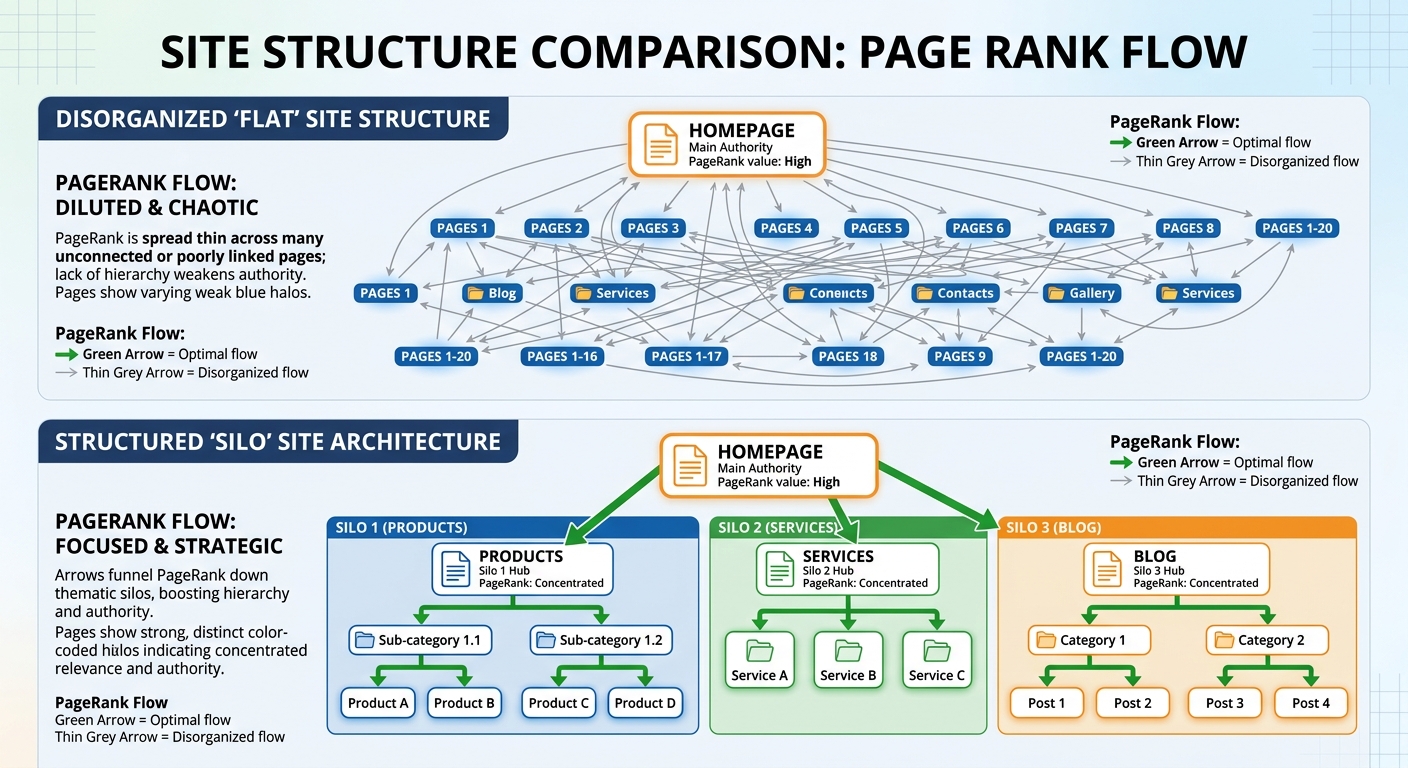
Directional linking mechanics rely on strict paths to maintain the integrity of the silo. Pillar pages typically link downward to every cluster post using descriptive anchor text, while each cluster post links back upward to the pillar. (Actually, placing the upward link within the first 200 words of a spoke article helps Google’s crawler associate the two pages faster during the initial indexation phase). Lateral linking between cluster posts within the same silo further distributes authority without leaking equity to unrelated topics. Internal mesh structures facilitate the flow of authority; if one spoke article gains external backlinks, the value moves upward to the hub and then downward to the rest of the cluster.
Suppose a WordPress site manages 50 articles on "Cloud Computing." If 10 posts about "Serverless Functions" only link to each other and their parent pillar, they form a tight topical cluster. Not ideal for a site with a flat, disorganized structure. Engineers running large-scale content sites often see more stable rankings during core updates when maintaining a 1:10 pillar-to-spoke ratio. Adhering to specific ratios prevents any single spoke from becoming an orphan page or losing its association with the primary /cloud-computing/ directory.
Mastering Anchor Text: Beyond 'Read More'
Anchor text must be descriptive, relevant to the target page, and varied to provide search engines with sufficient context about the linked URL's subject matter. Generic phrases like "click here" or "read more" waste a valuable opportunity to signal topical relevance, as they offer zero semantic value to crawlers. By replacing "this post" with descriptive keywords—such as "advanced keyword research techniques"—an editor can often observe measurable ranking improvements for the target pages within a single crawl cycle. (Actually, Google’s John Mueller has confirmed that anchor text provides context that surrounding text might miss). Effective internal linking relies on Latent Semantic Indexing (LSI) keywords to build a topical cluster. Instead of using the exact same keyword for every link, varying the anchor text with related terms helps prevent over-optimization flags while still reinforcing the primary topic. This approach creates a clear map for bots. Adhering to these principles is a fundamental technical requirement for any scalable SEO strategy.
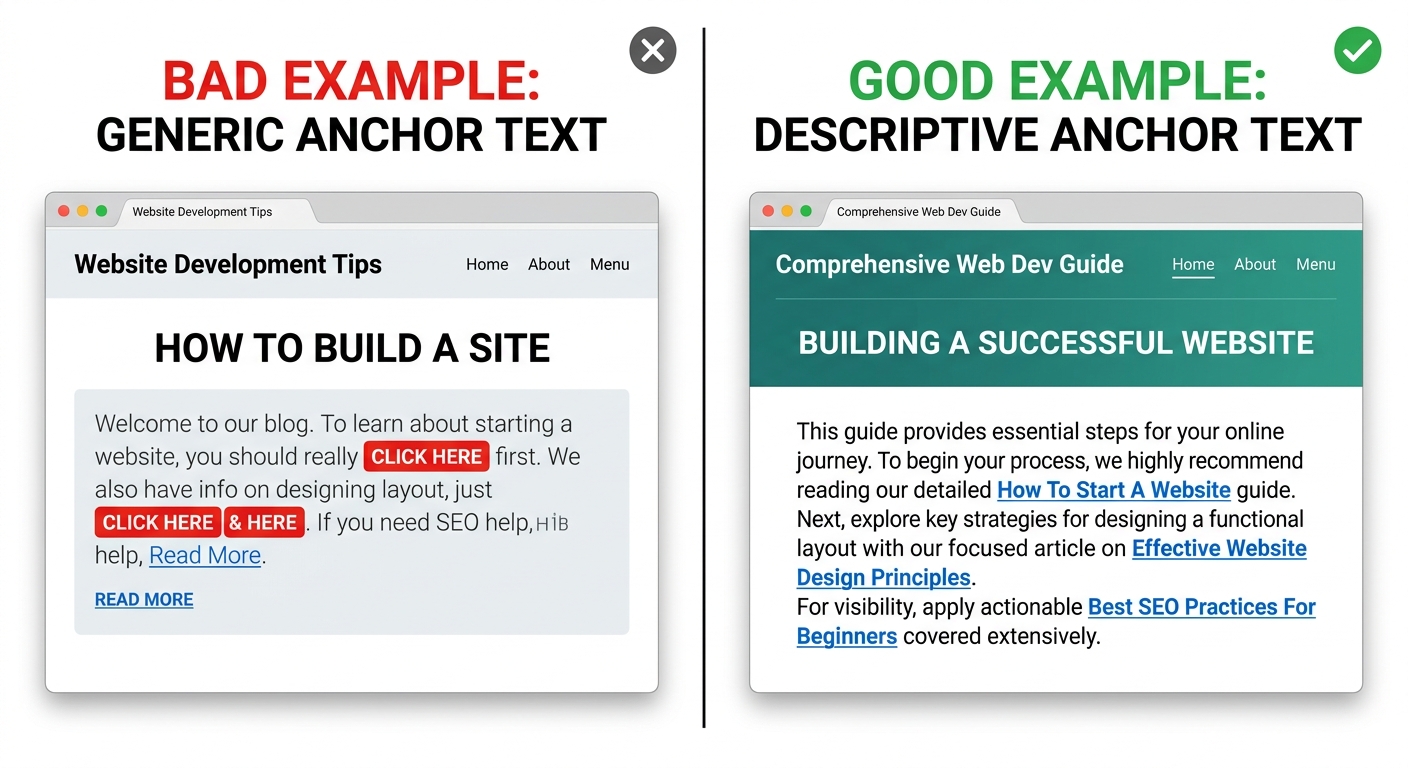
Search engines do not evaluate anchor text in a vacuum; the surrounding 20–30 words provide the semantic frame. A link placed within a paragraph about "PostgreSQL indexing" carries more weight for that specific topic than a link sitting in a generic sidebar. (Interestingly, the first link to a specific URL on a page usually receives the most SEO equity). If a post links to the same destination twice, the Google crawler typically prioritizes the anchor text of the first instance and may ignore the second for ranking purposes. Such behavior dictates that the most descriptive keyword should appear in the initial mention of a resource. Placing a "learn more" link at the end of a section after a keyword-rich link earlier in the text results in the bot ignoring the descriptive anchor in favor of the generic one if they both point to the same URL. When surrounding text acts as a secondary signal—a concept known as "link proximity"—the target page gains context from LSI terms like "database optimization" or "query performance" nearby. This contextual reinforcement signals to the crawler that the destination is an authoritative source for the specific sub-topic.
A 50-link audit often reveals that 80% of internal anchors are under-optimized. Engineers managing large WordPress sites often find that using specific phrases like "JSON-LD schema implementation" instead of "click for more" improves crawl depth efficiency. Not ideal for a high-traffic pillar page to have weak anchors. A technical team at a mid-sized SaaS company recently reduced their "orphaned pages" count by 40% simply by standardizing anchor text across their documentation. They moved from using vague pointers to using exact-match H2 headings as anchors. The update helped the crawler associate the target pages with technical terms like "headless CMS" and "REST API." Mapping anchors to the specific intent of the destination page helps teams avoid the "keyword cannibalization" that occurs when multiple pages compete for the same generic phrase. Monitoring these changes in a Google Search Console performance report usually confirms a shift in impressions for the newly linked terms.
The Internal Link Audit: Finding and Fixing Leaks
An internal link audit involves identifying orphan pages (pages with no incoming links), broken internal links (404 errors), and 'link heavy' pages that dilute PageRank. Tools like Articfly can automate this by mapping your site's link graph. A systematic review ensures that search engine crawlers can reach every indexed URL while preventing the loss of link equity through dead ends or inefficient paths. By isolating pages that exist outside the site's primary structure, teams can re-integrate valuable content into the user journey. Consistent auditing prevents the accumulation of technical debt that often plagues rapidly scaling WordPress sites.
Effective audits prioritize fixing 404 errors and flattening redirect chains—scenarios where one internal link points to a URL that then redirects to another. These chains force bots to make multiple requests, slowing down crawl speed and leaking authority at each hop. A 10-person marketing team using an automated refresher tool might discover 15 broken links in their top-performing evergreen guide, where fixing them restores the path to conversion revenue. Why let high-effort content sit in a vacuum? Without these audits, a blog becomes a graveyard of connections that confuse both users and search algorithms, leading to a slow decay in rankings.
Identifying orphan pages requires a cross-reference between the site's XML sitemap and a crawl of the actual link architecture. Pages that show zero inbound links in the Articfly dashboard are effectively invisible to users navigating the site. Suppose a SaaS blog has a high-value technical guide sitting at a click depth of 6 with no internal references; that page is unlikely to rank for competitive terms. Engineers running 50+ workflows often find that adding just three links from high-authority pillar pages can move an orphan page from page 10 to page 2 of the SERPs. (Actually, Google’s documentation suggests that while they follow up to 10 redirects, anything beyond 3 or 4 can cause crawl budget exhaustion on larger sites). A 3-step redirect chain might seem trivial, but it forces the browser to resolve multiple headers before displaying content. Maintaining a shallow architecture where most content is reachable within three clicks is a standard benchmark for crawl efficiency. Articfly’s mapping tool visualizes these gaps by highlighting nodes with zero incoming edges. Integrating these isolated posts back into the main content clusters often results in a measurable bump in impressions. Such a workflow ensures every internal connection serves a purpose without wasting crawl budget on dead ends or circular paths.
Not ideal for a 500-post archive to do manually. Automated technical tools handle the heavy lifting by scanning the database for 301 status codes and flagging specific entries within the Articfly dashboard.
Scaling the Strategy: Automation with Articfly
Articfly automates internal linking by analyzing the existing content library and suggesting relevant link placements during the article generation process, ensuring every new post is perfectly integrated into a site's architecture. This system scans for contextually relevant anchor text across hundreds of published pages to match new content with established high-authority URLs. Instead of manually searching for relevant posts, the engine identifies 3-5 specific link opportunities per 1,000 words based on topical relevance and keyword density.
The platform's native WordPress integration allows these links to be injected directly into the editor, maintaining a consistent link density without manual copy-pasting. Solo bloggers scaling from 1 to 10 posts per week use this feature to build a dense web of connections that search engines use to crawl and index new pages faster. By removing the friction of manual mapping, teams can maintain a 100% internal link coverage rate across their entire domain while also generating schema and meta descriptions automatically.

Within the Articfly dashboard, the internal link mapping tool functions as a central hub for site structure. It assigns specific target URLs to high-value keywords, preventing the "orphan page" problem common in high-volume publishing. Total control over anchor text distribution. (Actually, the system allows for exact, partial, and phrase-match settings to mimic natural human variation). The mapping logic prioritizes the 10 most recent articles to keep the site architecture fresh. The Brand Voice Analyzer ensures that these links appear in sentences matching the site's established vocabulary.
Managing a growing archive requires more than just linking forward; it requires back-linking from old content to new. The Articfly Article Refresher scans posts every 30 days to identify opportunities for these "reverse" links. A 10-person agency running 50+ workflows can handle this process through a single sync button rather than a manual audit. This proactive maintenance keeps the link juice flowing into newer, more competitive keywords. (Actually, the API handles up to 100 refreshes per batch, which is more than enough for a standard monthly maintenance cycle). Teams that utilize the 360-day editorial roadmap see higher crawl rates because the internal link structure is planned before the first word is even written.
Frequently Asked Questions About Internal Linking
Common internal linking questions include the ideal number of links per post (typically 3-5 per 1,000 words) and whether to use "nofollow" tags (rarely for internal links). While Google does not enforce a hard limit, excessive linking can dilute PageRank and distract readers. Most SEOs prioritize linking from high-authority pages to deep content to ensure crawlers discover new URLs efficiently. Using "nofollow" on internal links is generally counterproductive, as it prevents the flow of link equity between your own pages. Instead, use "noindex" if a page should not appear in search results.
Consistency in anchor text helps search engines understand page context, but using the exact same phrase for two different URLs creates topical confusion. A balanced strategy focuses on relevance and user navigation rather than hitting a specific numeric quota. Search engines generally prioritize the first instance of a link if multiple links point to the same URL on a single page. Proper internal linking remains the primary driver for indexing deep-level content that lacks external backlinks.
How many internal links should a 1,000-word post contain?
A standard 1,000-word article performs best with 3 to 5 contextual links to other internal pages. While search engines can technically process hundreds of links per page, the value (PageRank) passed to each destination decreases as the link count increases. Focus on high-relevance connections rather than hitting a specific numeric quota. Quality over quantity. (Actually, Google’s crawler has a limit of roughly 100kb for page analysis, so extremely link-heavy pages might see the bottom half ignored during the first pass).
Is it beneficial to use "nofollow" tags on internal links?
Internal links should almost never carry the rel="nofollow" attribute. Such a tag instructs crawlers to ignore the link's relationship, which stops the transfer of authority to your other content. If the goal is to keep a specific page out of search results—such as a private login portal or a checkout page—the noindex meta tag is the correct technical solution. Applying nofollow to your own content essentially wastes "crawl budget" without providing any SEO advantage.
What happens if the same anchor text is used for two different pages?
Using identical anchor text for two separate URLs leads to topical confusion and potential keyword cannibalization. When "Email Marketing Guide" points to both a landing page and a blog post, search engines struggle to rank either effectively for that specific term. Such ambiguity forces Google to choose one, often picking the page with more external backlinks. Maintain clear topical boundaries by assigning one primary anchor phrase to exactly one URL.
Action Plan: 4 Steps to Optimize Your Site Today
To start, **audit your top 10 performing posts** and ensure they link to at least 3 relevant, lower-performing articles to distribute authority. This redistribution helps Google discover deeper content that might otherwise stagnate without a direct path from high-traffic hubs. A content manager at a mid-sized SaaS agency recently set a recurring monthly task in the Articfly dashboard to flag these orphan pages specifically. Identifying high-traffic power pages via Google Search Console provides the initial seed list for this mapping.
Once the seed list is ready, the next step involves matching these high-authority URLs to newer posts that share a primary keyword cluster. Mapping these connections manually often leads to spreadsheets that fall out of date within weeks as new content goes live. Using a dedicated internal link mapper prevents this decay by visualizing the relationships between existing and upcoming articles in a single view.
Scaling requires automation. Not ideal for a 50-post backlog.
Integrating Articfly directly into the WordPress workflow allows teams to automate these suggestions during the initial drafting phase. The system analyzes the existing site structure to recommend three internal links before the Publish button is even clicked (Actually, the Articfly SEO toolset provides these suggestions based on real-time site crawls). Such a workflow prevents the creation of content silos within the WordPress database.
Want the system behind this content?
Join the top 1% of SEOs generating programmatic, high-converting organic traffic completely on auto-pilot.
DEPLOY ARTICFLYMore Articles
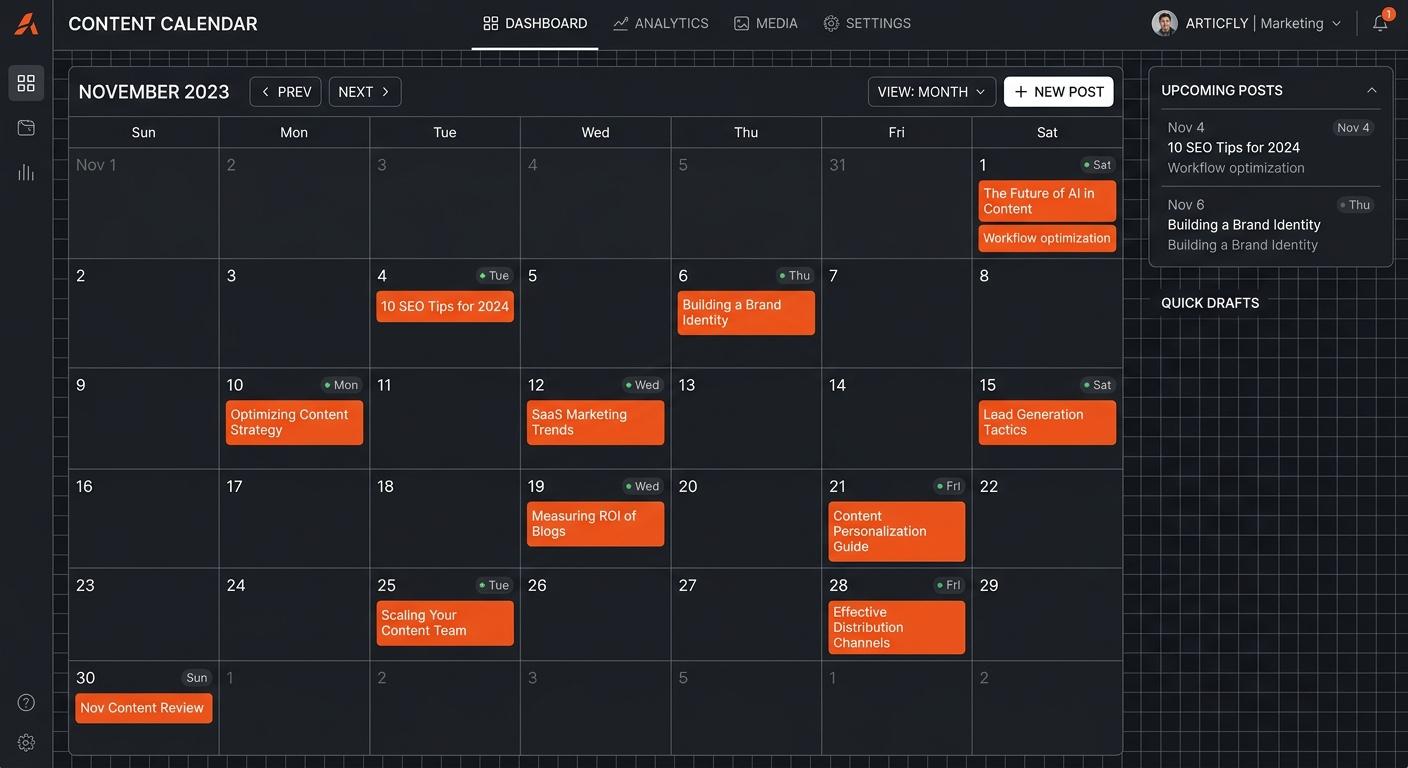
How to Scale Your Blog from 4 to 40 Posts Per Month Without Hiring Writers
Scaling a blog from 4 to 40 posts per month usually requires a massive editorial team. Learn how to use AI-driven systems and automated workflows to 10x your content output while maintaining brand integrity and SEO performance.
READ
The Science of Shareability: What Makes a Blog Post Go Viral
Discover the psychological triggers and structural frameworks that drive content virality. Learn how to engineer shareable blog posts using data-driven strategies and AI-powered optimization tools.
READ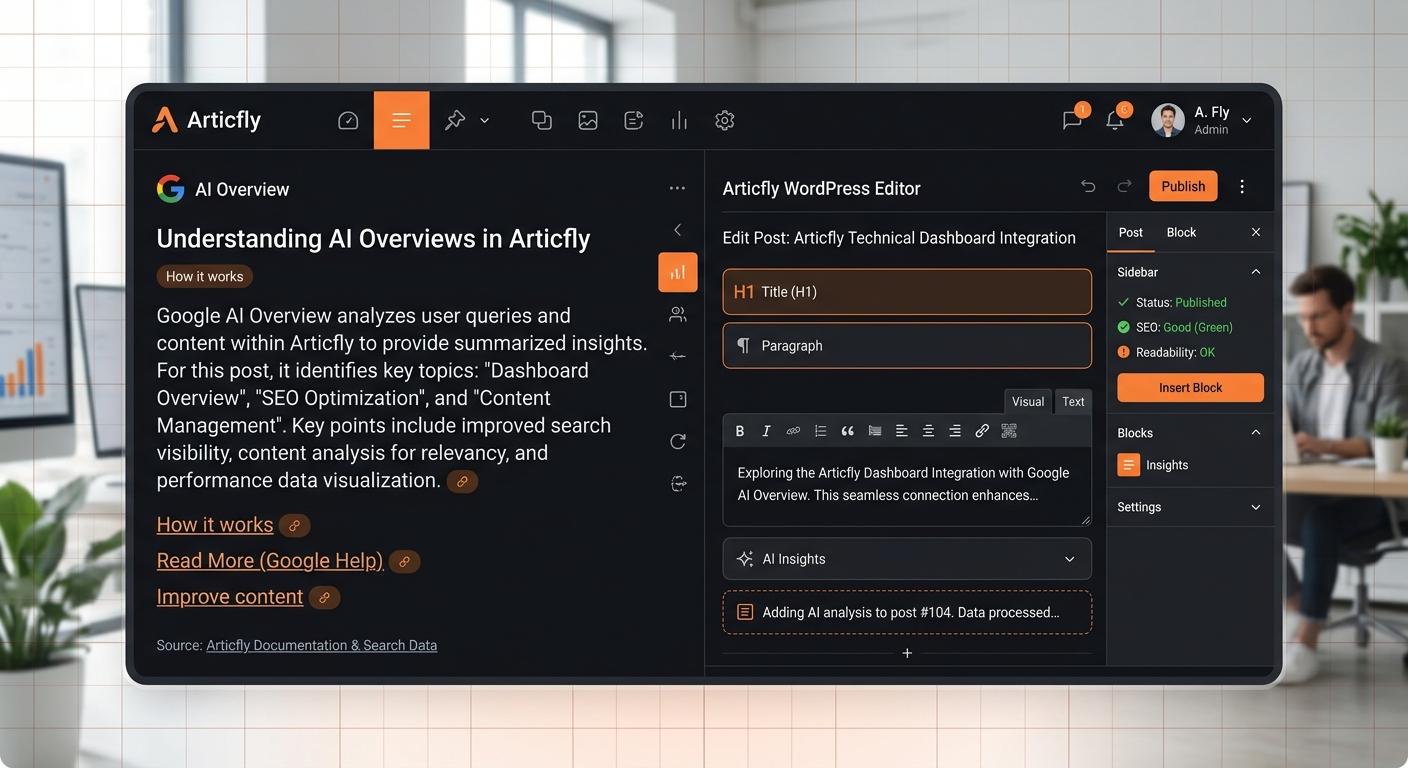
How to Rank in Google AI Overviews: A Blogger's Survival Guide for 2026
A technical roadmap for bloggers and agencies to secure citations in Google AI Overviews by prioritizing information gain, entity-based SEO, and automated content refreshing in 2026.
READ