How to Scale Your Blog from 4 to 40 Posts Per Month Without Hiring Writers
Key Takeaways for Scaling Content Output
To scale a blog from 4 to 40 posts per month without hiring, transitioning from a creator to an editor role is the only way to manage a high-volume output, using an AI-powered content engine that handles ideation, brand voice alignment, SEO optimization, and direct WordPress publishing.
Through the removal of manual labor, the transition shifts the workload from drafting 2,000-word articles to reviewing machine-generated drafts that already incorporate specific keyword data and internal link structures. A solo affiliate marketer who previously spent 20 hours a month writing 4 posts now manages a 40-post schedule in just 5 hours using automated workflows. Efficiency gains stem from using tools like Articfly to automate the 13-step SEO checklist, including schema generation and SERP previews, directly within the WordPress ecosystem. The system ensures every post maintains a consistent brand voice without manual intervention for every paragraph.
High-volume production requires a fundamental shift in WordPress management. Instead of spending 15 hours on one guide, the focus shifts to supervising an automated pipeline. Directly inside WordPress. Such a strategy relies on an AI engine for technical SEO tasks—like internal link mapping—while the operator acts as a quality gate. Articfly doesn't just generate.
- Transitioning from writer to editor reduces the time spent per article from 5 hours to roughly 15 minutes of review.
- Automated brand voice analysis ensures that AI-generated drafts match the existing site's tone without manual rewriting (Articfly’s analyzer extracts these guidelines from a URL in seconds).
- A 30-day editorial roadmap, built around specific keyword clusters, eliminates the daily friction of ideation.
- Direct WordPress integration removes the "copy-paste" bottleneck that often adds 30 minutes of formatting per post.
- Technical SEO tools, such as readability scoring and SERP previews, must be integrated into the generation workflow rather than treated as a post-production step.
Running a 10-person agency with 50+ workflows is only possible when the system handles the repetitive logic of keyword analysis and image alt-text. Success depends on the Articfly Pro plan configuration.
The Efficiency Gap: Why Traditional Scaling Breaks
Editorial Friction represents the primary bottleneck in scaling content, encompassing the time spent on research, drafting, SEO auditing, and manual WordPress formatting. Such friction typically limits a single person to 4-6 high-quality posts per month before quality degrades.
Hiring freelancers for manual production requires a linear increase in human hours for every new article published. A standard 1,500-word post often demands 2 hours of research, 4 hours of writing, and 3 hours for SEO optimization and CMS staging. For an agency owner managing multiple WordPress sites, the manual editing and formatting phase frequently takes 3x longer than the actual writing phase. This inefficiency creates a hard ceiling where increasing output necessitates hiring expensive freelancers at $0.10 to $0.25 per word. Scaling to 40 posts per month using this traditional model would cost upwards of $6,000 in writing fees alone—a cost that excludes the overhead of managing a 5-person editorial team.
Within the typical content team, operational drag happens during the "handover" between external documents and the WordPress Gutenberg editor. Teams often lose 45 minutes per post just fixing broken HTML tags, re-uploading images, and manually adding alt text. Then comes the SEO audit. Running a post through Yoast or Rank Math requires manual keyword placement and meta description drafting, which adds another 20 minutes of repetitive clicking. (Actually, most SEO plugins require at least 12 distinct manual configurations per post to hit a "green" score). Not ideal for a high-volume schedule.
Why pay for human management of low-level tasks? If a content manager earns $35/hour and spends 90 minutes on formatting and basic SEO per post, the hidden cost of "publishing" is $52.50 per article—totaling $2,100 per month for a 40-post schedule. Shifting these tasks to an automated engine like Articfly removes the $0.15-per-word freelancer dependency. Agencies running 50+ workflows find that reclaiming these 60 hours per month allows for higher-level client strategy. Adopting such a model reduces the cost per article by roughly 85% while maintaining specific WordPress schema requirements.
Building a 360-Day Content Roadmap Automatically
An automated editorial roadmap uses niche-specific AI analysis to generate 30 to 360 days of content topics, ensuring that high-volume output remains strategically aligned with SEO goals. Topical clustering engines replace the manual "blank page" brainstorming process by identifying semantic relationships between keywords across a defined domain. This shift moves production from reactive searching to structured execution, where every article serves a specific purpose within a broader content silo.
By mapping 50 or 100 related topics at once, systems like Articfly prevent content gaps that usually occur during manual planning sessions. A niche site owner focused on "hydroponic lettuce systems" might use this 360-day roadmap to cover every sub-topic from nutrient ratios to LED wavelengths without performing individual keyword searches for every day of the year. Actually, generating 360 titles at once can feel overwhelming until the AI groups them into logical silos based on search intent and difficulty. The data-driven approach ensures the blog covers the entire topical map without redundant overlaps.
Visual calendars provide the necessary oversight for bulk-scheduling. Managing 40 posts per month requires more than a simple list; it demands a grid-based view where publication dates and status markers are visible at a glance. Not ideal for a spreadsheet-only workflow. (For example, seeing a cluster of "winter gardening" posts scheduled for October allows for immediate adjustments if the AI missed a specific local frost date).
- Bulk validation: Reviewing 30 titles in 5 minutes to ensure brand alignment.
- Silo visualization: Confirming that the "Nutrient" cluster has the same weight as the "Equipment" cluster.
- Gap identification: Spotting weeks where the publishing frequency drops below the 4-post minimum.
Strategic alignment happens when the AI analyzes existing site authority before suggesting new titles. A 10-person agency might use the 360-day roadmap to lock in a year of content for five different clients in a single afternoon. The automated roadmap prevents the common trap of publishing disconnected articles that fail to build internal link equity. Every generated topic is assigned to a specific pillar, ensuring that the blog develops topical authority across the entire WordPress site. Such mapping prevents internal competition between similar posts. The ARTICFLY dashboard syncs these planned slots directly to WordPress via the native plugin, maintaining a consistent 1.3 posts-per-day cadence.
Cloning Your Brand Voice for AI Consistency
Brand voice analysis tools extract the unique tone, vocabulary, and style of an existing website to ensure that AI-generated content is indistinguishable from human-written content. These systems scan high-performing URLs or raw text files to map linguistic patterns like sentence length, reading grade level, and specific industry jargon.
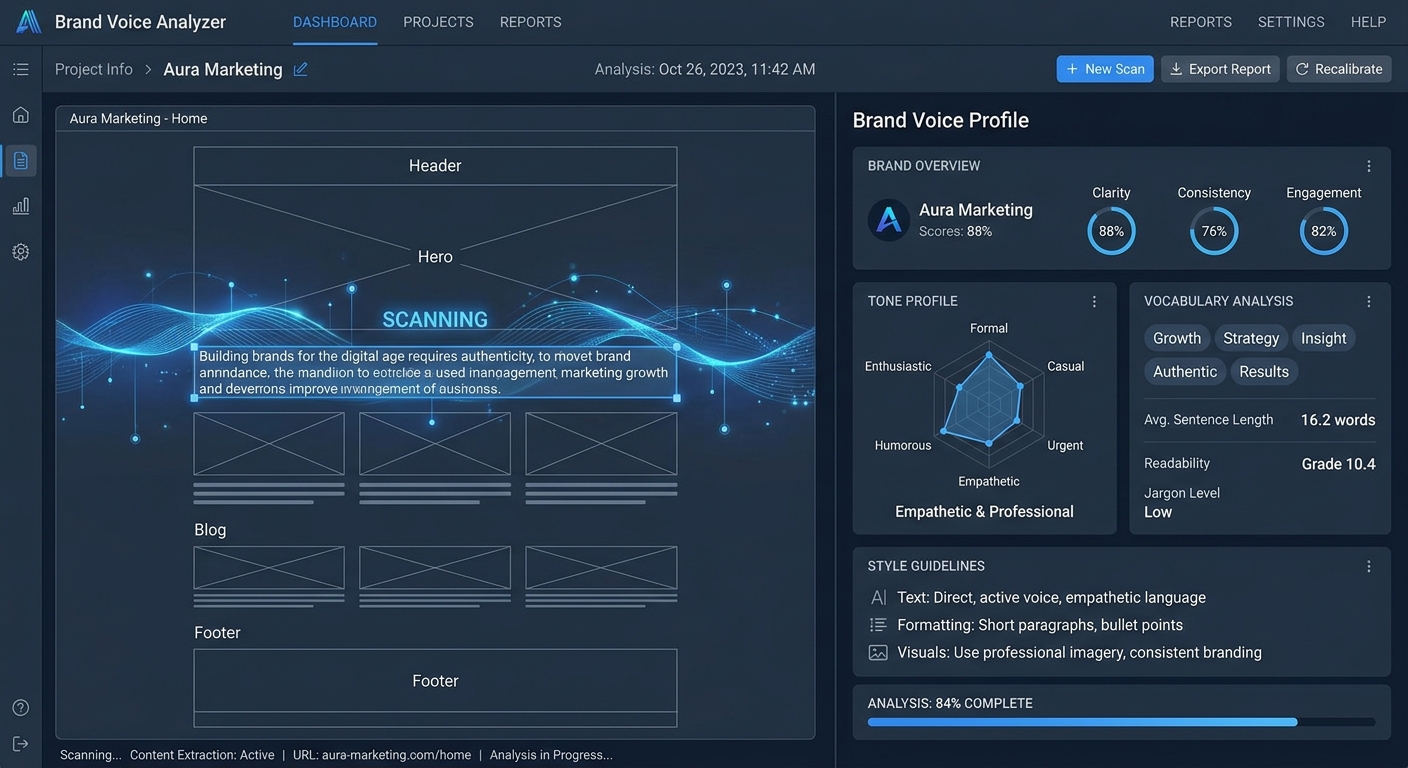
A technical SaaS brand that feeds its documentation into a Brand Voice Analyzer ensures the AI uses the correct industry terminology and a 'direct, tool-first' tone. Such a process moves beyond basic prompting by creating a structured style profile that includes forbidden words and preferred phrasing. By identifying these nuances, the engine maintains a consistent point of view even when scaling to 40+ posts per month. (Actually, Articfly’s analyzer looks for specific n-gram frequencies to catch those subtle verbal tics that make a brand feel authentic). This data-driven approach prevents the generic, "AI-sounding" fluff that typically plagues high-volume publishing.
Because vocabulary extraction represents the technical core of maintaining authority across 40 monthly articles, the system maps specific nouns and verbs unique to a niche. Examples include "containerization" for a DevOps blog or "LTV:CAC ratio" for a fintech site. When a model operates without these constraints, it defaults to generic synonyms that erode reader trust. The Brand Voice Analyzer crawls existing WordPress entries to build a "lexicon map" of these terms. High-volume publishing also requires a rigid point of view to avoid sounding like a committee. Vital for authority. A structured brand profile enforces a consistent perspective—whether that is a "first-person practitioner" or a "neutral technical observer"—across every draft. (Standard GPT-4 prompts often fail here because they lack the local context of the previous 50 posts).
For teams managing multi-site portfolios, these profiles allow switching between different brand identities in a single click. A 5-minute scan of a competitor's top 10 pages can also reveal the exact vocabulary gaps the site's content needs to fill. The resulting technical alignment ensures that every generated word adheres to a #F5571B-level of energy without manual editing.
The High-Velocity Production Workflow
A high-velocity production workflow involves using an AI engine to generate full articles in 'Advanced Mode' and syncing them directly to WordPress via a native plugin to eliminate manual copy-pasting. This setup minimizes the friction between content ideation and live publication by centralizing research, drafting, and optimization within a single dashboard. Centralizing these tasks allows a single Editor-in-Chief to maintain quality control without getting bogged down in the minutiae of formatting or CMS management.
Marketing teams reduce their 'Time-to-Publish' from 4 hours to 15 minutes per article by using a direct WordPress integration. By removing the need for manual formatting or image uploads, a single operator can oversee the entire output of a 40-post-per-month calendar. This efficiency is achieved through the elimination of the "copy-paste tax" that typically plagues high-volume content operations. Such a streamlined approach ensures that the transition from a drafted concept to a live URL happens in minutes rather than hours.

Scaling to 40 posts requires moving beyond basic prompts. Selecting Advanced Mode within the content engine enables a deeper research phase where the system crawls current SERPs to identify secondary keywords and intent gaps. Advanced Mode doesn't just predict text; it structures the article based on real-time data from the top 10 ranking pages. A single Editor-in-Chief can manage this by reviewing the generated outline before the final draft is produced. Efficiency through oversight.
The primary bottleneck in traditional scaling is the "copy-paste tax." Moving text from a Google Doc to a CMS often breaks formatting, loses alt text, and requires manual re-linking. Native WordPress plugins solve this by pushing the completed draft, including H-tags and metadata, directly to the site's database. If you use a plugin that handles internal link mapping and JSON-LD schema generation automatically, the manual workload drops to a final sanity check. (Actually, 300,000 milliseconds is the limit n8n or similar webhooks often hit, but a native plugin bypasses these timeout issues entirely). Suppose a 3-person agency needs to manage 10 different client sites. Using a centralized dashboard with direct sync allows them to push 300+ articles monthly without increasing headcount. One person, one dashboard, and a direct sync to the WP-JSON API.
Technical SEO Without the Manual Audit
Scaling SEO requires automated tools for internal link mapping, schema generation, and readability scoring to ensure every post is optimized for search engines without manual intervention. Content teams often struggle with the sheer volume of technical checks required for 40+ monthly articles. Automated systems handle these requirements by scanning the existing site architecture to find relevant anchor text opportunities. Instead of manual spreadsheets, the platform identifies high-authority pillar pages and inserts contextual links to new content. This process maintains a logical site hierarchy and distributes link equity efficiently. Schema generation pulls data directly from H-tags and metadata to build valid JSON-LD blocks. By removing the manual audit phase, agencies reduce the time spent per article from hours to minutes. Technical precision remains high because the software adheres to Google's structured data guidelines without human error.
Why settle for a generic meta description when a tool can simulate the exact mobile and desktop appearance in real-time? Actually, it is less about the visual preview and more about the pixel-width constraints — 580 pixels for mobile titles and 920 for desktop descriptions — which prevent truncated text in SERPs. An SEO manager at a mid-sized agency recently used automated internal link mapping to connect 40 new posts to existing pillar pages in seconds. Automated mapping eliminated the need for the "Site: search" manual method usually required to find relevant internal targets across a large domain.
The system generates specific schema types like Article, FAQ, and BreadcrumbList based on the post's structure. No manual JSON coding.
Teams running high-volume sites see better indexing speeds when JSON-LD is delivered cleanly in the header rather than buried in the body text. Readability scoring uses the Flesch-Kincaid scale to flag sentences over 25 words that might hurt user experience metrics. These checks happen inside the Articfly dashboard before the article hits the WordPress database to keep the production line moving. Integrated tools secure the technical foundation by applying pre-configured meta titles, descriptions, and canonical tags before the first bot crawl.
Preventing Traffic Erosion with Automated Refreshes
Automated content refreshing involves tracking content decay and using AI to update aging posts, ensuring that a high-volume blog doesn't lose traffic as older articles become outdated. Automated monitoring identifies pages where organic rankings have slipped by 5 or more positions over a trailing 90-day window. By pulling live performance data directly from a WordPress site, an automated system flags these declining URLs for immediate revision based on current search trends.
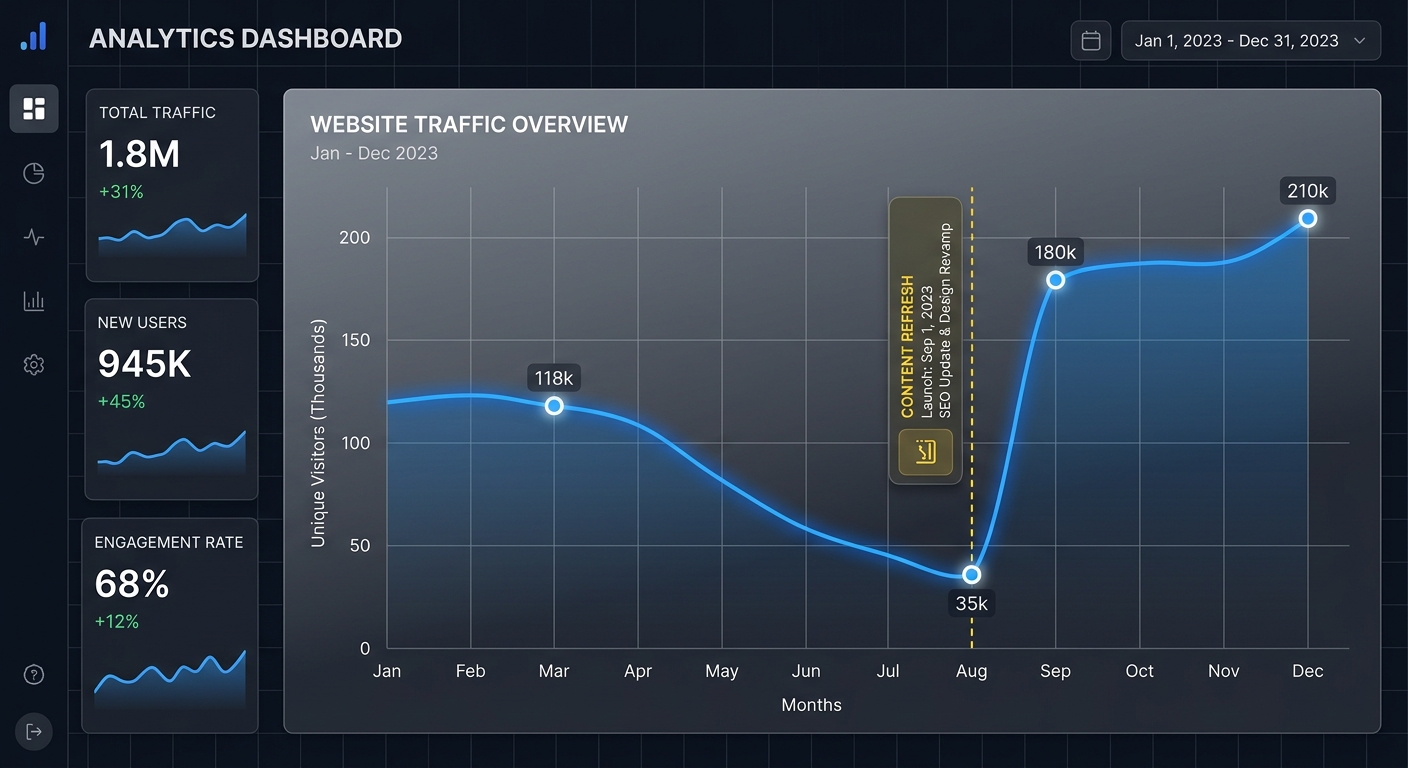
Maintaining a 40-post-per-month output requires protecting the equity of the existing content library. Instead of spending the full production cost on a new 2,000-word guide, an AI refresher updates the statistics, adds new internal links, and adjusts the H2 headers of an existing post for a fraction of the resources. This specific approach ensures the blog remains relevant to current SERP intent without increasing the editorial headcount or manual oversight. Such a workflow transforms a static archive into a dynamic asset that recovers its own value over time.
Consider the case of a two-year-old guide on "SaaS lead generation" that dropped from the top three to the second page of Google. After using an AI refresher to swap out 2022 benchmarks for 2024 data and inserting three fresh internal links to recent case studies, the post saw a 40% traffic increase within 14 days. This recovery happens because search engines prioritize "freshness" signals that manual teams often ignore due to the sheer volume of work (specifically, the Articfly Article Refresher scans for broken 404 links and outdated year-based tokens in titles).
The math favors maintenance. Producing a new high-quality article typically involves 4-6 hours of research and drafting, whereas an automated refresh cycle takes under 15 minutes of review. Teams managing 500+ articles often find that 20% of their catalog generates 80% of their revenue. Protecting that 20% through weekly automated audits prevents the slow traffic erosion that kills long-term ROI. A single Articfly refresh task can restore a page's CTR from 1.2% back to its peak of 3.5% through a simple update to the meta description and primary CTA.
Frequently Asked Questions About AI Content Scaling
Will Google penalize my site for using AI-generated content?
Google’s Search Essentials documentation clarifies that using AI is not a violation of their guidelines as long as the content is helpful. This documentation notes that original, informative material is rewarded regardless of the production method. (Actually, Google’s SPAM policies specifically target content generated primarily for search engine rankings rather than for users). By using Articfly to generate structured drafts, teams maintain these quality standards at scale. The risk lies in publishing unedited, repetitive text that lacks unique insights.
Editing time typically drops to 15 minutes per post when the AI is properly trained on a brand voice. Editors spend these minutes verifying specific technical claims or adding unique internal links that a general model might miss. It is about oversight, not reconstruction. Effective for high-volume pipelines. Maintaining a 40-post-per-month pace becomes feasible without sacrificing the technical accuracy required for competitive niches.
How much human oversight is required for 40 posts per month?
A single editor can manage the output of 40 articles by focusing on fact-checking and brand alignment rather than basic syntax. Standard editorial practice. Engineers running 50+ workflows often use this oversight method to maintain high quality across multiple domains.
Is a WordPress plugin necessary for this process?
Installing the Articfly WordPress plugin automates the transfer of metadata, images, and formatted HTML directly to your site. The connection removes the manual labor of formatting headers or uploading media files for every post. Manual copy-pasting is a bottleneck. Such an integration ensures that your content calendar stays on schedule without requiring manual login sessions for every new draft.
Next Steps: Launch Your 40-Post Monthly Schedule
To start scaling, first audit a brand voice profile, then connect a WordPress site to an AI content engine like ARTICFLY to begin generating your first automated 30-day roadmap. A Pro plan user typically completes the initial setup—including the WordPress plugin installation—in under 30 minutes to begin scheduling their first week of content. The API handshake handles the sync between the dashboard and the CMS.
Implementation begins with the Brand Voice Analyzer. Feeding the tool 3-5 high-performing URLs allows the engine to extract specific vocabulary and syntax patterns (actually, it looks for sentence length variance and specific industry jargon). Teams that prioritize this step see higher consistency across the first 40 posts. A quick sync via the native WordPress plugin then bridges the gap between the draft stage and the live URL. Pure output. This process eliminates manual copy-pasting.
The following workflow moves a site from four posts to 40 within a single billing cycle:
- Pillar identification via the 13 SEO tools.
- Roadmap generation based on keyword difficulty scores.
- Advanced mode configuration for the first batch of 10 articles.
- Post scheduling directly to the WordPress calendar.
Batching 10 articles at once reduces the per-post management time to roughly three minutes. Scaling no longer requires a five-person editorial board.
Want the system behind this content?
Join the top 1% of SEOs generating programmatic, high-converting organic traffic completely on auto-pilot.
DEPLOY ARTICFLYMore Articles

The Science of Shareability: What Makes a Blog Post Go Viral
Discover the psychological triggers and structural frameworks that drive content virality. Learn how to engineer shareable blog posts using data-driven strategies and AI-powered optimization tools.
READ
How to Rank in Google AI Overviews: A Blogger's Survival Guide for 2026
A technical roadmap for bloggers and agencies to secure citations in Google AI Overviews by prioritizing information gain, entity-based SEO, and automated content refreshing in 2026.
READ
SaaS Content Marketing: How to Write Blog Posts That Convert Free Users to Paid
Stop writing blog posts that just drive traffic. Learn how to create high-intent, product-led content that demonstrates value and moves free users into paid tiers using structured SEO and AI-driven workflows.
READ