Local SEO Blog Strategy: What Should a Local Business Actually Blog About?
Key Takeaways for Local Content Success
A successful local SEO blog strategy focuses on hyper-local relevance, community engagement, and solving region-specific problems rather than chasing high-volume global keywords. Prioritizing local intent over raw traffic volume builds a bridge between digital visibility and physical foot traffic. While a generic post about "best pizza toppings" might attract thousands of global visitors, it rarely converts into a sale for a Brooklyn-based pizzeria. Instead, content targeting "best pizza near Prospect Park" captures users with immediate purchasing intent.
Local search algorithms reward content that demonstrates geographic authority through mentions of specific landmarks, regional regulations, or neighborhood-level events. For instance, an HVAC provider in Austin, Texas, saw a 40% increase in organic leads after switching from generic "how to fix an AC" posts to "Preparing your Austin home for the July heatwave" content. This shift from broad educational topics to localized problem-solving signals relevance to both search engines and the immediate community. (Search engines typically weight proximity and local relevance signals higher for queries with "near me" or city-specific modifiers).
By focusing on specific regional pain points—like how the hard water in Phoenix affects copper piping—businesses build trust faster than with generic advice. Why compete for a keyword like "plumbing tips" against a multi-billion dollar conglomerate? High-intent traffic over vanity metrics. A local blog functions as a digital storefront that remains open 24/7, providing answers that a national competitor cannot offer.
- Geographic Anchoring: Referencing specific intersections, parks, or historical buildings like the Frost Bank Tower helps search engines associate a business with a precise service area.
- Regulatory Authority: Articles detailing state-specific building codes or regional tax incentives—such as the Texas Chapter 313 agreements—establish a site as a primary resource for local compliance.
- Conversion Alignment: Content mapping to the local buyer journey ensures that 100 visitors from a specific ZIP code carry more weight than 10,000 visitors from a different continent.
- Hyper-Local Data: Mentioning local weather patterns or specific soil types—such as the expansive clay soils in North Texas—provides utility that generic national blogs cannot replicate.
Teams managing WordPress sites often find that long-tail local keywords reduce the cost-per-acquisition compared to competitive national terms like home insurance.
The 'Local-First' Content Philosophy
Local businesses should blog about community events, local partnerships, region-specific problem solving, and customer success stories within their specific service area. This strategy moves away from the "Near Me" trap where companies chase high-volume, generic keywords that rarely convert at a local level. Instead of competing for broad terms like "best pizza," a restaurant might focus on "gluten-free options near the Westside Sports Complex." Such specificity signals geographic relevance to search engines and potential customers alike. It bypasses the noise of national competitors who cannot speak to the nuances of a specific street corner or regional zoning law.
In one instance, a digital marketing agency managing 10 local dental clinics used Articfly to generate unique, neighborhood-specific "Oral Health Guides" for each location. These guides addressed local water fluoridation levels and partnered with nearby schools for dental health month. By focusing on hyper-local concerns, these clinics saw higher engagement than generic health advice ever produced. Success in local search requires a transition from being a general information source to a neighborhood utility that solves immediate, physical problems.
Zero-volume keywords often represent the highest intent for service-based businesses. While a keyword tool might show 0 monthly searches for "emergency boiler repair in Oakhaven South," the person typing that phrase is likely standing in a flooded basement with a credit card ready. Capturing these queries involves mapping out specific landmarks, street names, and local pain points (for example, the way 1920s-era wiring in the historic district reacts to modern HVAC installs). Maintaining a neighborly tone during this process prevents the content from feeling like an automated landing page. Articfly’s Brand Voice Analyzer extracts specific vocabulary and tonal markers from existing site content to ensure every neighborhood guide sounds like a local expert rather than a generic scraper.
Executing this technically involves more than just inserting a city name into a H1 tag. Anyone managing production WordPress sites for local clients understands that geographic context is king. Teams that prioritize local utility often build content around local regulatory changes or seasonal events, such as a landscaping firm writing about specific drought restrictions in a county. Not just a list of dates. A structured roadmap that aligns with local climate patterns and municipal schedules creates a repository of high-intent pages. Using the Articfly Content Calendar to map these hyper-local topics across a 12-month cycle allows for precise seasonal targeting. This creates a repository of high-intent pages that serve as a 24/7 sales team for the specific zip code.
Community Spotlights and Local Partnerships
Community spotlights involve interviewing local figures or reviewing nearby businesses to build local backlinks and social proof. Spotlight strategies convert a standard blog post into a networking asset by highlighting the achievements of others in the neighborhood. A 10-person real estate agency in Austin, for example, might feature the owner of a new boutique gym or a long-standing hardware store. By focusing on non-competing entities, businesses create a "halo effect" where the featured subject's audience discovers the author’s brand during local searches.
Effective spotlights rely on the "Ego-Bait" mechanism, where individuals are more likely to share content that praises their work. When a business publishes a "Top 5 Interior Designers in [City]" list, those designers often link back to the article from their "As Seen In" or "Press" pages. Such lists generate high-authority local backlinks that are difficult to acquire through cold outreach. A local real estate agent created a 'Best Coffee Shops in [Neighborhood]' series, resulting in 15+ high-quality local backlinks from the featured shops.

The process of networking through content doesn't require a professional journalism background. It requires a structured process for gathering raw data—like a 10-minute phone interview or a set of bulleted notes from a site visit. Teams that publish these spotlights often use Articfly’s Advanced mode to process raw inputs, such as a rough transcript or a list of "Best of" criteria, to draft a production-ready post that retains the original brand voice. The dashboard allows a small marketing team to produce three detailed interviews per week without the overhead of a full-time writer or a dedicated editor. Maintaining this frequency keeps the blog active while building a library of local citations.
A "Best Roofer" list on a local HVAC company’s blog demonstrates the impact of non-competing partnerships. While the two services don't compete, they share a customer base of homeowners looking for exterior maintenance. A single post featuring five local contractors can lead to five social media shares and several direct referrals from the featured businesses' own customer lists. Simple, but high-impact. (Actually, Articfly’s internal link mapping tool helps connect these spotlight posts back to core service pages like "AC Repair" to ensure the traffic flows toward conversion points). This structural link between community content and service pages keeps the site’s bounce rate under 40% for mobile visitors.
Solving Hyper-Local Problems: The 'Utility' Strategy
Hyper-local problem solving involves creating content that addresses specific regional issues like local weather patterns, soil types, or municipal laws. Regional focus positions a business as a technical authority by providing answers to granular, site-specific questions that general national competitors often ignore. For example, a landscaping firm in the Pacific Northwest might focus on drainage solutions for clay-heavy soils during the October-to-April rainy season. Such precision signals that the service provider understands the environmental constraints of the area better than a broad-market aggregator.

Addressing these nuances requires a content plan built around utility rather than generic brand awareness. A roofing company in Florida creates content specifically about "Hurricane-Proofing Your Roof in Miami-Dade County," which converts at 3x the rate of general roofing articles. These localized guides serve as functional tools for residents navigating specific permit requirements or seasonal risks. By documenting the exact steps for securing a building permit in a specific zip code, a business removes friction from the customer's decision-making process.
Why should a contractor write about municipal code updates? Because search intent for "Miami-Dade High Velocity Hurricane Zone (HVHZ) requirements" is significantly higher-intent than "how to fix a roof." Identifying these long-tail local questions becomes efficient when using Articfly’s SEO tools to analyze regional search volume and keyword difficulty. The dashboard provides clear metrics on specific phrases that competitors miss. (Actually, Articfly’s keyword analysis often uncovers "zero-volume" terms that actually drive high-intent leads in small towns).
Seasonal checklists provide recurring value. A 10-person HVAC team in Denver might publish a "Boiler Winterization Checklist for 1920s Bungalows" every September. Functionality drives conversion. These guides often require specific technical details, like the exact PSI settings for older radiator systems. Using the Articfly Brand Voice Analyzer allows the software to capture these technical specifics from existing site documentation. Trade standards used in the field remain the primary focus.
Municipal laws and permit processes vary wildly between neighboring jurisdictions. A fencing company in Austin might publish a guide comparing the permit costs in Travis County versus Williamson County. This type of utility-based content builds a "moat" around the brand because it is too specific for national AI generators to replicate accurately without local data. An Articfly user can feed these specific PDF permit guides into the Brand Voice Analyzer to generate a series of "How-to-Permit" articles for every suburb in their service area. Providing the exact phone number for the local zoning office—(512) 974-2000 for Austin—adds a layer of practicality that generic content lacks.
Localized weather alerts also offer an opportunity for utility-based blogging. When a hail storm hits a specific region like North Dallas, a local roofer can quickly deploy a "Hail Damage Inspection Guide for Plano Residents" using Articfly's WordPress integration. Speed is the primary factor here. A 24-hour turnaround on a localized weather response can capture traffic while homeowners are actively surveying their property. High speed, high relevance. WordPress publishing workflows.
Scaling Local Content Without a Full-Time Editor
Articfly allows local businesses to scale content by automating the research, generation, and publishing process directly to WordPress, maintaining a consistent local presence without high overhead. The platform uses a central dashboard to sync with WordPress via a native plugin, removing the manual labor of managing metadata for dozens of location-based posts.
Engineers and marketers managing regional SEO often struggle with the "Local Variation" requirement, where content must be specific to a city while maintaining brand consistency. Articfly’s Advanced Mode handles this by allowing users to feed specific local data—like neighborhood landmarks or regional service pricing—into the generation engine. Localized generation ensures that a blog post for a Dallas branch feels distinct from one for a Houston branch without requiring two separate writers. A multi-location franchise used Articfly’s Content Calendar to plan 365 days of localized content for 5 different cities in under an hour.

The AI Content Calendar provides a structured roadmap for handling seasonal demand, such as a 12-month schedule for a roofing company facing storm season peaks. Users select a specific niche and the tool generates topics based on search volume and seasonal relevance, populating the grid with ready-to-generate drafts. Not ideal for a manual 500-order batch. (Actually, Articfly’s bulk generation allows for queuing up to 50 articles at once, which is sufficient for most quarterly localized pushes). This automation keeps the WordPress site active during peak business periods when staff have zero time for writing.
Direct WordPress integration eliminates the manual "upload and polish" routine that often consumes 20 minutes per post. The Articfly plugin syncs schema markup, internal link mapping, and SERP previews directly to the CMS, ensuring each localized post is technically sound upon arrival. The integration saves roughly 30 hours of production time every month for an agency managing 10 local service clients. A 10-person ops team can effectively do the work of a 30-person content agency by utilizing the Article Refresher to monitor for content decay. Such mapping reduces the need for manual site audits on sites running the Articfly WordPress plugin.
Frequently Asked Questions About Local Blogging
How often should a local business publish new blog posts?
Local businesses should post at least 2-4 times per month to maintain SEO momentum. Content should be 750-1,500 words depending on the topic's complexity. Search engines prioritize sites that demonstrate consistent activity within a specific geographic niche. A steady publishing cadence signals to Google that the business remains operational and relevant to local search queries. (Actually, 1,200 words is often the "sweet spot" for technical service guides in competitive markets like Los Angeles or New York).
Maintaining a regular schedule prevents the content decay that often plagues small business websites after the initial launch phase. High-quality posts provide fresh opportunities for internal linking to core service pages. This frequency provides enough data for the Articfly Article Refresher to identify which topics are gaining traction. Weekly updates often see faster indexing than quarterly posts. Consistent output builds a library of local signals that reinforce the PostalAddress schema found on the contact page.
What is the best site structure for a business with multiple locations?
A subfolder hierarchy like /locations/chicago/blog typically outperforms a flat structure for regional authority. Such an architecture allows search engines to associate specific content silos with geographic schema. Organizing by city prevents "near me" queries from landing on a generic homepage. A 5-location dental group might use separate categories to prevent keyword cannibalization between branches. (Notably, WordPress handles these permalink structures natively if the category base is set correctly). Linking each post to a specific location's Google Business Profile helps search engines verify the proximity of the service to the user.
Do local blog posts need to be long-form to rank?
Depth beats length. (Wait, search intent dictates the length, not a hard word count rule). High-performing posts often include a LocalBusiness schema snippet to anchor the content to a specific Google Maps CID.
Should local blogs focus on keywords or community news?
Success requires a 70/30 split favoring service-based keywords over community events. While a post about a local high school football game builds brand awareness, it rarely converts a lead looking for "HVAC repair." Solving specific problems like "how to handle hard water in Phoenix" captures high-intent traffic. (Most agencies find that the 30% community content acts as a "link magnet" that boosts the authority of the 70% commercial content). Such a balance maintains a high Articfly SEO score while keeping the brand grounded in the local ZIP code.
Your 30-Day Local Content Action Plan
Starting a local SEO blog strategy involves auditing local keywords, identifying 5 community partners to feature, and setting up an automated content calendar. This approach focuses on capturing geo-specific search volume while building local authority through relationship-based content. A 30-day window provides enough time to move from data collection to a live publication schedule on a WordPress site.
Initial research involves running a localized keyword gap analysis to find terms like "best plumbing services in [City Name]" or specific service-area queries. Teams then map these keywords to a 4-week content calendar, ensuring each post addresses a distinct local pain point or highlights a community entity. Such a structured timeline prevents the common bottleneck of over-planning without actually pushing content to production. (Actually, 30 days is the standard sprint length for most SEO agencies to show initial movement in SERP positions for low-competition local terms).
Week one starts with the Articfly Keyword Analysis tool to scrape "near me" variants and long-tail local modifiers. Suppose a HVAC company in Phoenix notices a spike in "AC capacitor replacement cost" searches every May. They can use Articfly’s Advanced Mode to generate a technical guide specifically for the Maricopa County climate, including local cost estimates and labor rates. Data-backed content over generic fluff. By ignoring these small-town queries, how much local traffic is left on the table?
The remaining three weeks focus on execution and outreach. Teams that maintain a strict 30-day publishing cycle tend to see faster indexing for new service pages:
- Mapping 4 hyper-local problems (e.g., "how to handle hard water in San Diego") to specific publication dates.
- Configuring the Articfly Content Calendar for a 30-day roadmap to maintain a consistent cadence.
- Selecting 5 non-competing local businesses—like a hardware store or a municipal permit office—for "community spotlight" posts to earn backlinks from high-relevance local domains.
- Syncing all drafts to WordPress via the native plugin to finalize internal linking.
The Articfly dashboard tracks these 5-8 new local articles to monitor ranking shifts for specific zip code queries.
Want the system behind this content?
Join the top 1% of SEOs generating programmatic, high-converting organic traffic completely on auto-pilot.
DEPLOY ARTICFLYMore Articles
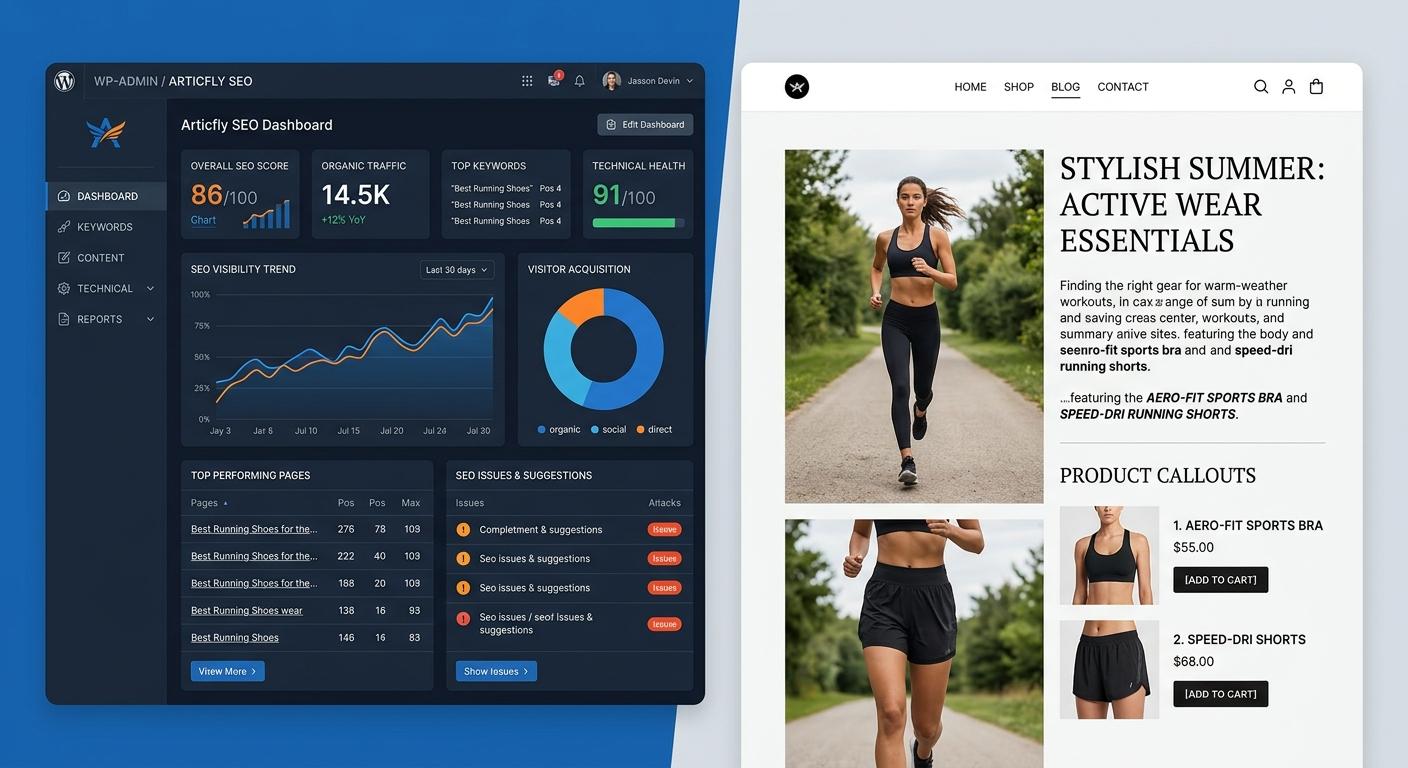
E-commerce SEO Content Strategy: How to Write Product Blog Posts That Drive Sales
Master the art of e-commerce SEO content strategy. Learn how to identify high-intent keywords, structure posts for conversion, and use AI to scale your product-led blog without losing your brand voice.
READ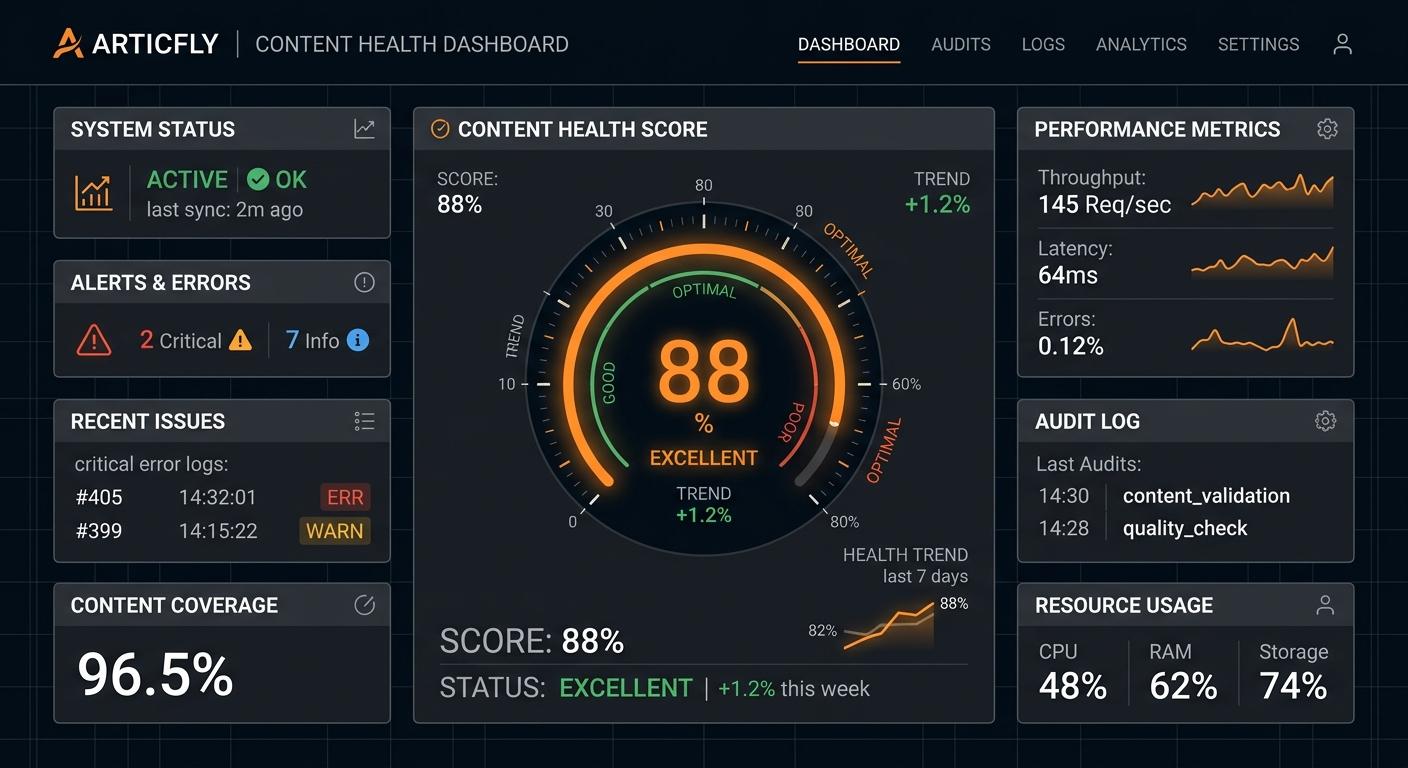
The 15-Minute Blog Audit: Find Out If Your Content Is Making Money or Wasting Space
Stop letting dead content kill your rankings. Learn how to perform a high-impact blog audit in just 15 minutes to identify which posts drive revenue and which are simply wasting crawl budget.
READ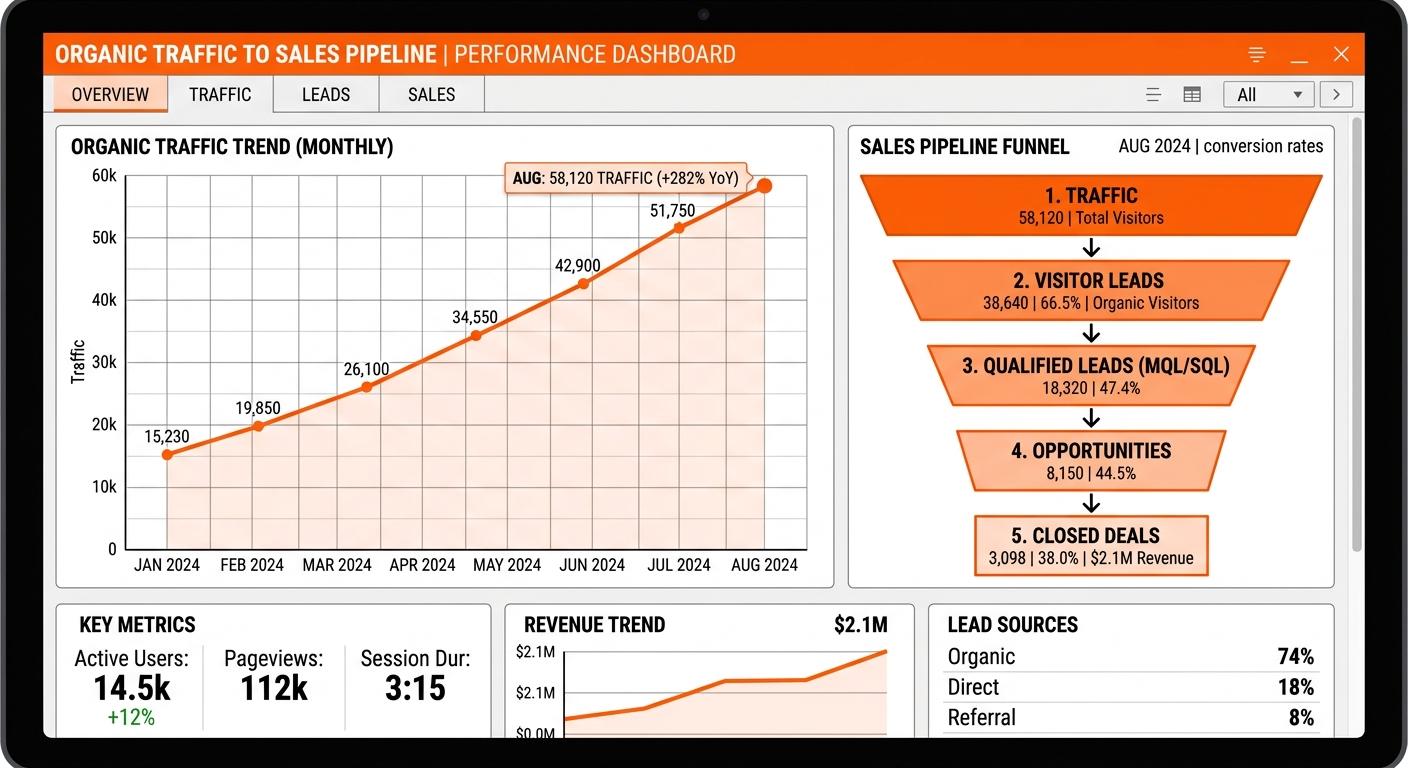
How to Build a Sales Pipeline with Nothing but Blog Content and Zero Ad Spend
Learn how to transform your WordPress blog into a self-sustaining lead generation machine. This guide breaks down the strategy for scaling organic traffic and building a sales pipeline using high-volume, AI-optimized content without spending a dime on advertising.
READ