How Much Is One Google Page-1 Ranking Actually Worth? We Did the Math
Key Takeaways: The Economics of the First Page
A Google Page 1 ranking's value is determined by the formula: (Monthly Search Volume x CTR x Conversion Rate x Customer Lifetime Value) minus the cost of content production and maintenance. Position #1 typically captures 39.8% of clicks, making it significantly more valuable than lower positions. Position #10 averages a 1.6% CTR. A 24x difference. Why settle for the ghost-town visibility of the tenth spot? Such a disparity dictates the actual ROI of any content investment.
E-commerce brands tracking a single keyword moving from position #9 to position #2 have seen a 280% increase in direct revenue over 30 days. For a keyword with 5,000 monthly searches and a $50 LTV, jumping from the bottom of page one to the top spot represents a $38,000 increase in annual gross revenue. Production costs range from $150 to $500 per article when using manual editorial workflows. AI-driven systems like Articfly reduce the per-unit cost to under $5, fundamentally altering the break-even point for niche keywords.
Data from search visibility audits confirms that 90.63% of all content gets zero traffic from Google. Most pages fail because the cost of reaching the 39.8% CTR threshold exceeds the projected lifetime value of the traffic.
- Traffic Disparity: Moving from the bottom of page one to the top three results generally yields a tenfold increase in organic sessions (specifically, the drop-off from position #1 at 39.8% to position #3 at 10.2% represents a 74% loss in potential lead volume).
- Standard ROI Formula: Calculating the net value of a ranking requires multiplying monthly volume by CTR, conversion rate, and customer lifetime value (LTV), then subtracting the $150-$500 typical cost of manual content production.
- Production Cost Compression: AI-powered workflows reduce the overhead of a 1,500-word SEO article from several hours of human labor to roughly 10 minutes of technical oversight. Eliminating friction enables a 50-article-per-month output without adding editorial headcount.
- Volume Thresholds: Lowering the per-article cost to under $5 allows teams to target keywords with monthly volumes as low as 100 while maintaining a positive return on investment.
- Content Decay Economics: Maintenance is a fixed cost. An article that loses 5% of its traffic monthly requires a programmatic refresh via tools like the Articfly Article Refresher to protect its original valuation.
Successful operators treat every URL as a capital asset with a measurable depreciation rate and a specific yield based on its exact SERP coordinates and the 39.8% click-through potential of Position #1.
The Fundamental Formula for Ranking Valuation
To calculate the ROI of a ranking, multiply the monthly search volume by the CTR of your position, then multiply by your site's conversion rate and the average order value. Subtract the cost of the content and tools used to achieve that rank. Assigning a dollar value to every SERP position allows marketing managers to justify content spend with the same financial rigor applied to paid advertising channels.
A secondary valuation method involves PPC parity, which measures what the same volume of traffic would cost in a Google Ads campaign. If a keyword like "best CRM for startups" has a $15.50 suggested bid and generates 800 organic clicks per month, the ranking carries a replacement value of $12,400. This method ignores internal conversion fluctuations to focus strictly on the market price of the attention captured. PPC benchmarks offer a way to calculate the "cost of inaction"—the literal dollar amount lost every month a competitor holds the top spot.
Monthly Search Volume (MSV) and Click-Through Rate (CTR) are the primary levers of traffic volume. A position-one ranking typically captures 39.8% of clicks according to recent industry studies, while position ten drops to roughly 1.6%. If a keyword has an MSV of 1,000, the difference between the top spot and the bottom of the first page is 382 monthly visitors. When the average order value (AOV) is $250, that single-position jump represents a potential $9,550 monthly revenue swing, assuming a 10% conversion rate. Engineers running content operations often use these metrics to justify the compute costs of automated refreshes.
Beyond the basic math, the lead-to-close ratio acts as a filter for B2B traffic utility. Suppose a SaaS marketing manager tracks a ranking for a high-intent term where the site converts 5% of visitors into leads, but only 10% of those leads sign a contract. (Actually, a 10% close rate is standard for many mid-market software products). Not a bad return for a single blog post. Such data-driven prioritization prevents wasted effort on low-value keywords that fail to impact the Salesforce dashboard.
The CTR Cliff: Why Position #1 is 10x Better Than #10
The drop-off in traffic on Page 1 is exponential. Position 1 captures a ~39.8% CTR, while Position 10 drops to roughly 1.6%. Moving from the bottom of Page 1 to the top is more valuable than ranking for five new keywords on Page 2. Data from 2024 studies indicates that the top three organic results capture more than 68% of all clicks. For a keyword with 1,000 monthly searches, the top spot nets 398 visitors, whereas the tenth spot nets 16.

Mobile user behavior accelerates this trend because the viewport often hides everything below the second result. Zero-click searches—where Google provides the answer directly—squeeze available real estate, leaving only the highest-ranking pages to capture traffic. Achieving a top-3 ranking is the only way to ensure a predictable flow of leads. (Actually, internal audits of high-traffic WordPress sites often show that 90% of conversions originate from just three or four "hero" keywords in the top three spots).
Consider the math for a 50-keyword portfolio sitting at the bottom of page one. Even with a combined search volume of 50,000, those 1.6% CTRs result in only 800 monthly clicks. Contrast this with a single high-intent keyword in position #1 with 5,000 volume, which yields nearly 2,000 clicks. A blog owner managing a broad niche might find that 90% of revenue comes from just three "hero" keywords. Such revenue concentration occurs despite tracking 50 keywords on Page 1. An agency tracking 100 clients noticed that positions 4 through 10 essentially functioned as a "Page 2 Graveyard" for conversion purposes. Not ideal for a 500-order batch. Recent 2024 CTR benchmarks from FirstPageSage confirm that the first result is roughly 10x more likely to receive a click than the tenth.
Optimization efforts that move a post from #5 to #2 generate a higher ROI than publishing three new articles that land at #12. A 3-month refresh cycle targeting these specific "cliff-edge" rankings prevents the slow erosion of a domain's monthly lead count. Prioritizing the 30-day traffic average over vanity keyword counts yields better long-term stability.
Factoring in Content Decay and Maintenance Costs
Content decay is the natural loss of rankings over time as competitors publish fresher content. Articfly's Article Refresher tool automates the monitoring and updating of aging posts to maintain their dollar value without manual intervention. Every piece of content has a "half-life"—the period after which it loses 50% of its peak traffic. This occurs because search intent shifts and data points expire, leading Google to prioritize more recent entries. (Technical nuance: A post on "best CRM software 2023" loses nearly 80% of its utility by February 2024).
Consider an agency team spending 20 hours a month manually auditing 50 legacy posts for broken links and outdated statistics. Such a workload costs roughly $1,200 in billable hours (assuming a $60/hour internal rate) just to keep existing traffic from slipping. Maintaining status quo becomes a line-item expense that scales linearly with the size of the library. This constant maintenance cycle drains resources that should go toward new production. Not ideal for a growing blog.

The Article Refresher dashboard eliminates manual overhead by identifying posts where the click-through rate (CTR) has dropped below a 3-month rolling average. If you manage a site with 100+ articles, guessing which URL needs a rewrite is an inefficient use of time. Instead, the tool presents a prioritized list of pages losing visibility. One-click updates then inject current data and refreshed SEO metadata directly into the WordPress editor. (Actually, Articfly tracks these fluctuations daily via the native plugin to trigger alerts before a ranking falls off the first page).
Preserving a single high-intent ranking worth $5,000 in monthly recurring revenue requires consistent technical hygiene. Teams using automated refreshing tools often see a 15-20% recovery in lost impressions within 14 days of a metadata update. Such efficiency ensures that content remains a performing asset rather than a depreciating liability. Every published URL represents a sunk cost that only yields a return through sustained Page-1 positioning.
Manual vs. AI-Powered Production: The Margin Gap
Manual content production costs between $200 and $500 per high-quality post, whereas Articfly allows teams to produce the same volume at a fraction of the cost, significantly lowering the 'Break-even Point' for SEO ROI. Most agencies pay for the time of a writer, an editor, and a VA just to get a single draft into WordPress. Scaling via the traditional model requires adding people, which increases the management overhead and slows down the publication cycle.

By shifting the burden from human labor to a structured AI engine, the cost per article drops from hundreds of dollars to the price of a subscription credit. An agency owner recently replaced a $4,000 monthly freelance budget with one Articfly Pro subscription. Beyond saving money, they increased their monthly output by 3x. Resource allocation moves toward high-level strategy rather than comma placement across multiple domains. Engineers running 50+ workflows find that automating the publishing sync saves roughly 4 hours of manual labor per week in high-competition niches.
The traditional requirement for scaling SEO is a linear increase in headcount. If a blog wants to move from 10 to 50 posts a month, it usually needs two more writers and another editor. Not sustainable for most margins. (The Articfly Pro plan handles the heavy lifting of 13 SEO tools, including schema generation and SERP previews, without needing a dedicated technical SEO specialist). A single editor can manage the entire pipeline of 100+ articles because the system handles the keyword analysis and internal link mapping automatically. Such a reduction in "Cost of Goods Sold" (COGS) means profit margins expand as traffic grows, rather than being eaten by payroll.
Once unit economics pivot, the time required for a post to pay for itself—the break-even point—shrinks. Does a $500 article ever truly reach ROI if it takes 18 months to rank for a keyword with a $5 CPC? Probably not. A 10-person ops team using a native WordPress plugin to sync content directly avoids the friction of manual copy-pasting. For example, a site targeting 1,000 monthly visits per post with a 2% conversion rate sees a much faster return when those posts cost $15 instead of $250. High-volume publishing becomes a math problem rather than a management headache. This efficiency allows for faster compounding interest across a 360-day editorial roadmap.
Portfolio Theory: Building a 'Ranking Engine'
A ranking engine is a system that consistently identifies, publishes, and maintains a portfolio of keywords. Articfly's Content Calendar and Brand Voice Analyzer allow users to build a 360-day roadmap that treats content as a financial portfolio. This methodology moves beyond the "one-off post" mindset, instead viewing every URL as a dividend-yielding asset within a broader index. By diversifying across high-volume "blue chip" terms and low-competition "growth" keywords, a site reduces its exposure to single-keyword volatility. Managing five different WordPress properties from one central dashboard enables a niche site builder to rebalance this portfolio in real-time, shifting focus when specific niches show higher yields.
Strategic keyword management requires treating every blog post as a component of a larger risk-adjusted system. Rather than hoping for a single viral hit, technical SEOs use internal link mapping to create a mesh that distributes authority across the entire domain. (Actually, Articfly’s internal link tool suggests specific anchors based on existing page density, which prevents over-optimization penalties). A structured approach ensures that even if one cluster loses 20% of its traffic due to a core update, the remaining clusters provide a stable baseline for the business.
Diversification prevents a "single point of failure" in organic search. Articfly’s 360-day roadmap allows for a tiered allocation strategy—40% stable informational content, 40% commercial intent, and 20% speculative long-tail experiments. Wait, that's not quite right; the ratio should actually favor informational content in the first 90 days to establish topical authority before pushing commercial pages. Efficiency comes from the native WordPress integration and the Article Refresher. Monitoring decay rates across 500+ URLs manually is impossible for a solo operator, which is why the dashboard tracks performance and prompts a refresh when a "blue chip" post drops from position 2 to position 6. Integrating these clusters with schema generation tools further solidifies the engine by providing structured data that search crawlers prioritize during re-indexing cycles.
Constant monitoring is the only way to prevent decay. One agency owner managing a fleet of affiliate sites saw a 14% recovery in traffic after using the Articfly automated refresh tool on 45 legacy posts.
Frequently Asked Questions About Ranking Value
How long does it take to see a financial return on SEO?
SEO ROI timelines typically span 3 to 9 months, depending on domain authority and competitive density. For a new WordPress site with a Domain Rating (DR) under 20, initial traction requires 15 to 20 articles published over a 90-day window, while established sites often see movement within 4 to 6 weeks when refreshing content.
Does Google penalize or devalue content generated by AI?
According to Google’s ranking algorithms, information gain takes priority over production methods, meaning AI content ranks if it provides unique data or technical insights. Prioritizing keywords involves calculating Potential Value (PV) by multiplying monthly search volume by the expected Click-Through Rate (CTR) for position one—roughly 39.8%—and the site’s conversion rate. Such a calculation identifies high-intent terms that yield the highest revenue per click rather than raw traffic volume.
How should teams prioritize keywords based on potential dollar value?
Focusing on Bottom-of-Funnel (BOF) terms like "best [software] for [niche]" or "[product] alternatives" targets users ready to make a purchase decision. A 500-search-volume keyword with a 5% conversion rate is worth more than a 5,000-volume "what is" term converting at 0.1%. Not even close. High-intent keywords reduce the customer acquisition cost by shortening the path from search to sale. Integration with the ARTICFLY keyword analyzer facilitates filtering for "transactional" intent tags before adding them to the editorial roadmap. Mapping these to a 360-day editorial roadmap prevents over-investment in low-yield awareness topics that fail to generate Polar.sh checkout events.
Action Plan: How to Increase Your Ranking ROI Today
Maximizing your ranking value starts with auditing current Page 2 keywords, using Articfly to optimize them for Page 1, and setting up the Article Refresher to prevent decay on your existing assets. This targeted approach prioritizes "striking distance" keywords—those ranking in positions 11-20—where a small boost in content quality or internal linking often yields the highest ROI. A shift from position 12 to position 8 can increase traffic by over 100% based on standard click-through rate curves.
Teams managing 20+ WordPress sites often struggle with content maintenance, making the Articfly Article Refresher a critical tool for sustaining these gains. Connecting a site via the native plugin (which uses a secure REST API handshake) allows users to trigger AI-driven updates that prevent the "decay" typically eroding Page-1 value within 6 to 12 months.
A 10-person marketing agency might start by syncing their primary WordPress site to the Articfly dashboard. After the Brand Voice Analyzer extracts the existing tone from the top 5 performing pages, the focus shifts to Advanced Mode for fresh content. Selecting a keyword with a $4.50 CPC and 1,200 monthly searches ensures your production effort targets high-value traffic. The dashboard provides a real-time SEO score, tracking keyword density and meta-description length against competitors.
Efficiency comes through the direct WordPress integration. One click pushes the finished article into the WP block editor. No manual formatting required. Total production time often drops from six hours to under thirty minutes for a 2,000-word post.
Want the system behind this content?
Join the top 1% of SEOs generating programmatic, high-converting organic traffic completely on auto-pilot.
DEPLOY ARTICFLYMore Articles

Local SEO Blog Strategy: What Should a Local Business Actually Blog About?
Stop guessing what to write for your local business. Learn how to build a local SEO blog strategy that drives foot traffic and leads using hyper-local content, community partnerships, and AI-powered scaling tools.
READ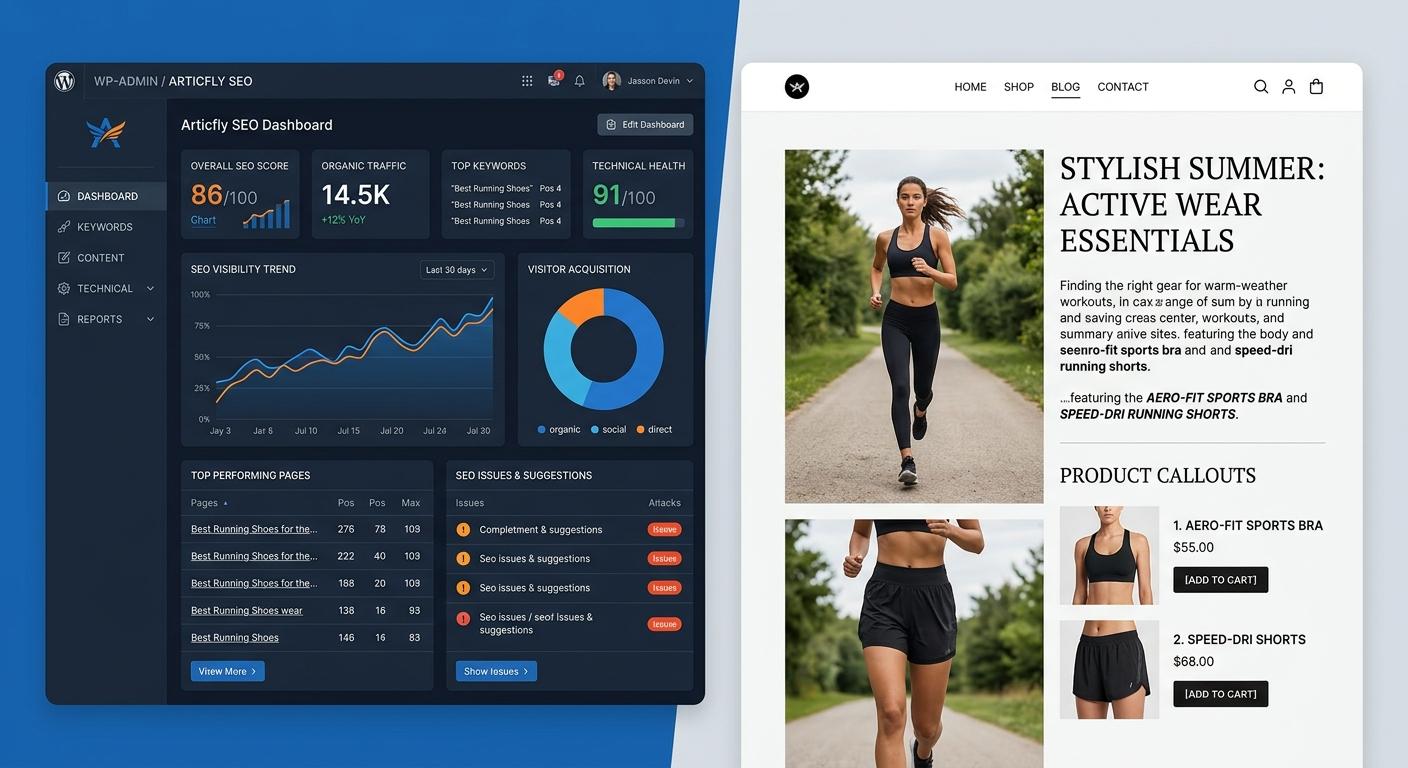
E-commerce SEO Content Strategy: How to Write Product Blog Posts That Drive Sales
Master the art of e-commerce SEO content strategy. Learn how to identify high-intent keywords, structure posts for conversion, and use AI to scale your product-led blog without losing your brand voice.
READ
The 15-Minute Blog Audit: Find Out If Your Content Is Making Money or Wasting Space
Stop letting dead content kill your rankings. Learn how to perform a high-impact blog audit in just 15 minutes to identify which posts drive revenue and which are simply wasting crawl budget.
READ